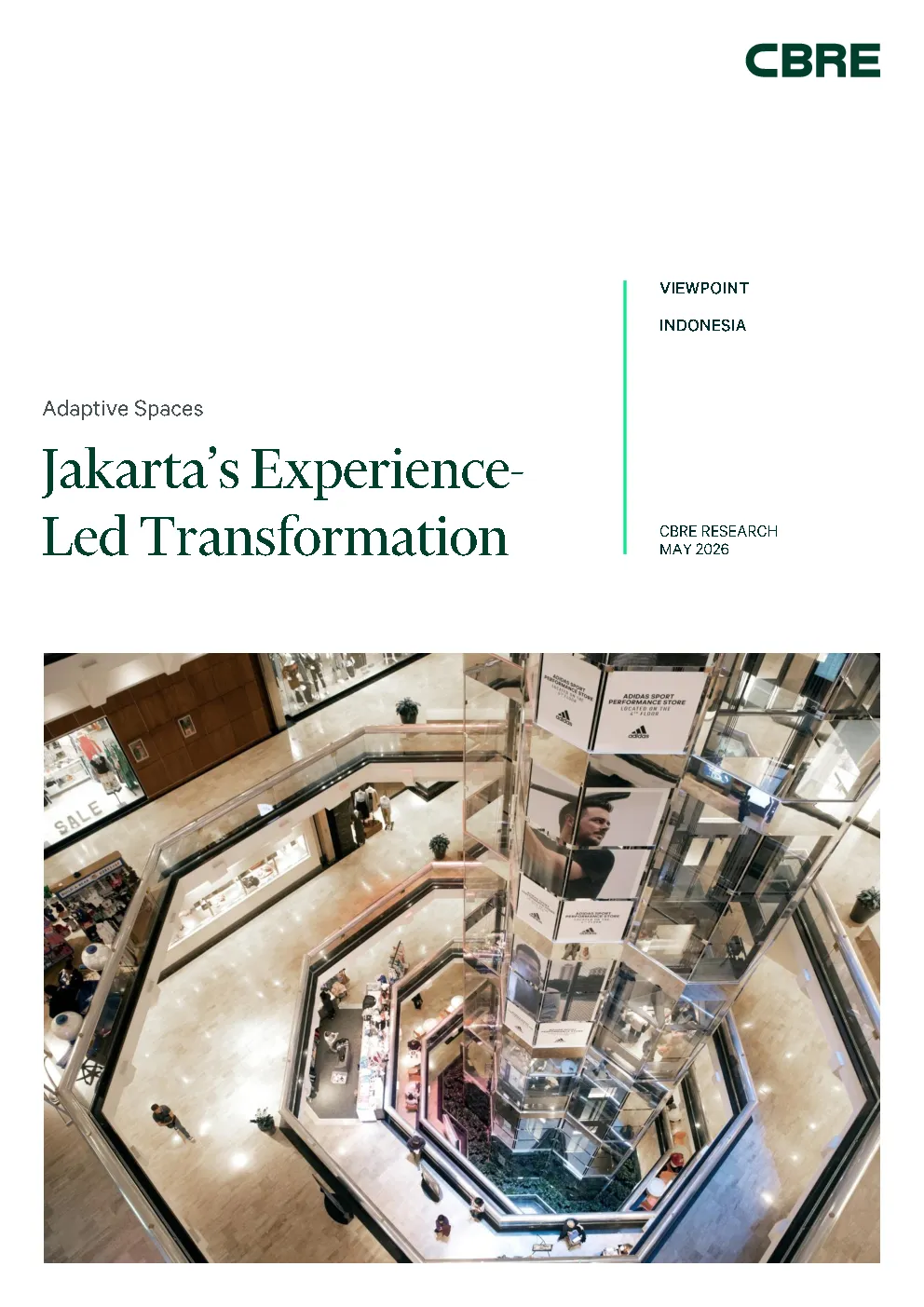
Jakarta's retail market demonstrates strong resilience due to favorable structural fundamentals and macroeconomic conditions, including population growth, urbanization, and rising disposable incomes. Shopping malls are evolving from traditional retail venues to integrated lifestyle destinations, with a clear shift toward experience-driven ecosystems. Key observations include:
- Market Resilience: Jakarta's retail sector remains robust, supported by sustained population growth, GDP expansion across key industries, and a growing middle class with rising disposable income. This creates a virtuous cycle of long-term growth in retail goods and services.
- Experience-Driven Transformation: Retail operators and developers are prioritizing engagement, personalization, and immersive experiences to cater to younger, digitally connected consumers. Malls are becoming multifunctional hubs combining retail, dining, entertainment, and social spaces.
- Performance Gap: High-end malls continue to outperform, with occupancy rates exceeding 95%, while other malls face more gradual recovery. This reflects differing leasing dynamics and tenant mixes.
- Enhancing Mall Performances: Well-performing malls demonstrate flexibility in space allocation and programming, accommodating dining, leisure, and non-retail uses. Strategies include tenant remixing, physical repositioning, and active programming.
- Retailtainment and F&B: The concept of "retailtainment" is gaining prominence, blending traditional retail with immersive, interactive experiences. F&B remains a primary demand driver, with operators introducing more experiential concepts.
- International and Emerging Brands: High-demand global retailers are entering the market with design-focused, experience-oriented store concepts, repositioning stores as brand destinations.
- Challenges and Constraints: Key challenges include limited supply for new entrants, intensifying market competition, and rapidly evolving consumer trends. Developers need to continuously adapt tenant mix, design, and programming to remain relevant.
- Future Outlook: The retail outlook is shaped by a growing emphasis on experiential formats, particularly among prime malls evolving into comprehensive lifestyle hubs. International and emerging brands are entering the market with design-led concepts, and wellness and sports-oriented tenants are expanding. New supply remains limited, with developers focusing on expanding and upgrading existing assets rather than large-scale greenfield developments.