工业AI采用加速,支持更高估值;买入
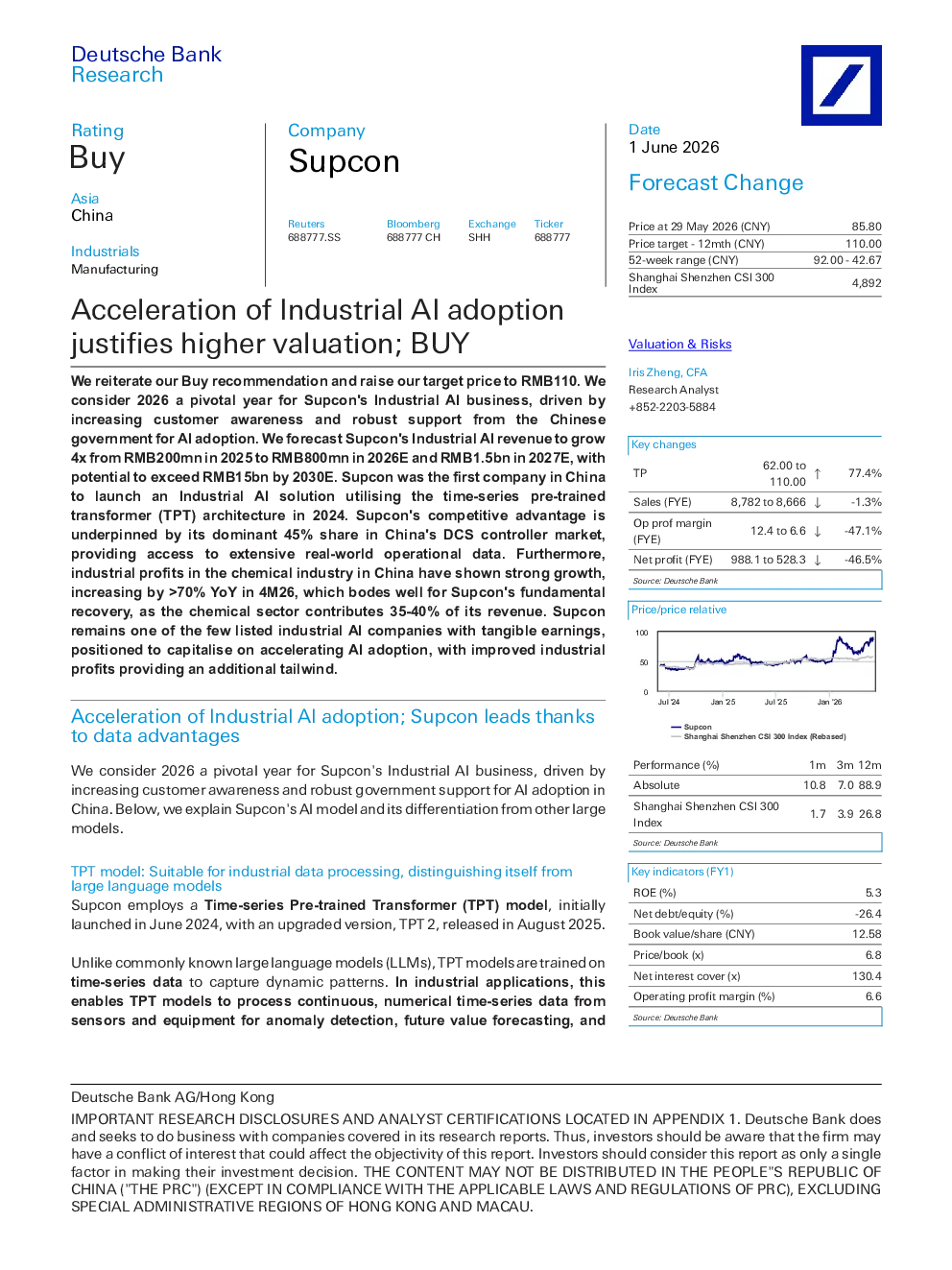
Forecast Change AsiaChina IndustrialsManufacturing Acceleration of Industrial AI adoptionjustifies higher valuation; BUY Valuation & Risks Iris Zheng, CFAResearch Analyst+852-2203-5884 We reiterate our Buy recommendation and raise our target price to RMB110. Weconsider 2026 a pivotal year for Supcon's Industrial AI business, driven byincreasingcustomer awareness and robust support from the Chinesegovernment for AI adoption. We forecast Supcon's Industrial AI revenue to grow4x from RMB200mn in 2025 to RMB800mn in 2026E and RMB1.5bn in 2027E, withpotential to exceed RMB15bn by 2030E. Supcon was the first company in Chinatolaunch an Industrial AI solution utilising the time-series pre-trainedtransformer (TPT) architecture in 2024. Supcon's competitive advantage isunderpinned by its dominant 45% share in China's DCS controller market,providingaccess to extensive real-world operational data.Furthermore,industrial profits in the chemical industry in China have shown strong growth,increasing by >70% YoY in 4M26, which bodes well for Supcon's fundamentalrecovery, as the chemical sector contributes 35-40% of its revenue. Supconremains one of the few listed industrial AI companies with tangible earnings,positioned to capitalise on accelerating AI adoption, with improved industrialprofits providing an additional tailwind. Acceleration of Industrial AI adoption; Supcon leads thanksto data advantages We consider 2026 a pivotal year for Supcon's Industrial AI business, driven byincreasing customer awareness and robust government support for AI adoption inChina. Below, we explain Supcon's AI model and its differentiation from other largemodels. TPT model: Suitable for industrial data processing, distinguishing itself fromlarge language models Supcon employs aTime-series Pre-trained Transformer (TPT) model, initiallylaunched in June 2024, with an upgraded version, TPT 2, released in August 2025. Unlike commonly known large language models (LLMs), TPT models are trained ontime-series datato capture dynamic patterns.In industrial applications, thisenables TPT models to process continuous, numerical time-series data fromsensors and equipment for anomaly detection, future value forecasting, and 1 June 2026ManufacturingSupcon production process optimization.In essence, TPT models reliably understand andpredict numerical data that changes over time, whereas LLMs comprehend andgenerate human language but are susceptible to hallucination. Key differences between TPT and LLM are outlined below and in Figure 1: nData type processed:TPT processescontinuous and numerical time-series datagenerated from devices such as sensors, and equipment in theindustrial space; LLM processes textual data; nTypical function:Forecasting future values, anomaly detection, patternrecognition,etc.for TPT;Q&A,translation,summarisation,codegeneration, etc. for LLM; nKnowledge acquisition:TPT primarily learns dynamics characteristics,underlying patterns, and complex relationships of data itself from massive,multi-source, multi-domain time series datasets; LLM primarily learnsworld knowledge, common sense, logic and linguistic rules from massivetext datasets. 1 June 2026ManufacturingSupcon Unlike TPT 1, which launched in June 2024 as more of a tool-based software,TPT2, released in August 2025, is capable of autonomously performing analysis andmaking decisionsbased on knowledge and data, demonstrating a certain level ofcognitive intelligence. Detailed improvements are noted in Figure 2. 1 June 2026ManufacturingSupcon TPT contributes to lower cost, higher efficiency and lower carbon emissions TPT 2 functions as an "industry expert," autonomously managing dynamic changesin complex processes without requiring repeated human intervention. Its workflowincludesanomaly prediction --> problem diagnosis --> solution generation -->model invocation --> adaptive control, and deployment implementation. TPT 2'scapabilities span simulation, control, optimization, prediction, evaluation, andstatistics. Details are provided in Figure 3. 1 June 2026ManufacturingSupcon The ultimate outcome for TPT customers includes lower costs, higher efficiency,and reduced carbon emissions.According to the company, various TPT agentscan lead toa 30-50% increase in human efficiency, as subtle changes in equipmentoperation are accurately observed and automatically optimized. Furthermore,customers could achievea 1-3% increase in overall project yields throughcontinuousiteration of operational decision optimization and productionefficiency,coupled with reduced energy consumption costs.Supcon hassuccessfully deployed the TPT model at several key customers, includingSINOPECandWanhua Chemical. Detailed use cases are presented in Figure 4. Supcon's competitive advantage underpinned by its extensive industrial data,largely accumulated through its leading market share in DCS in China. While the Time-series Pre-trained Transformer (TPT) is not a novel concept, Supcondifferentiat