您的浏览器禁用了JavaScript(一种计算机语言,用以实现您与网页的交互),请解除该禁用,或者联系我们。 [OECD]:2025年FDI流量整体增长,但分布不均,伴随温和增长与上升的不确定性。 - 发现报告

2025年FDI流量整体增长,但分布不均,伴随温和增长与上升的不确定性。

2026-04-15 - OECD Z.zy
报告封面

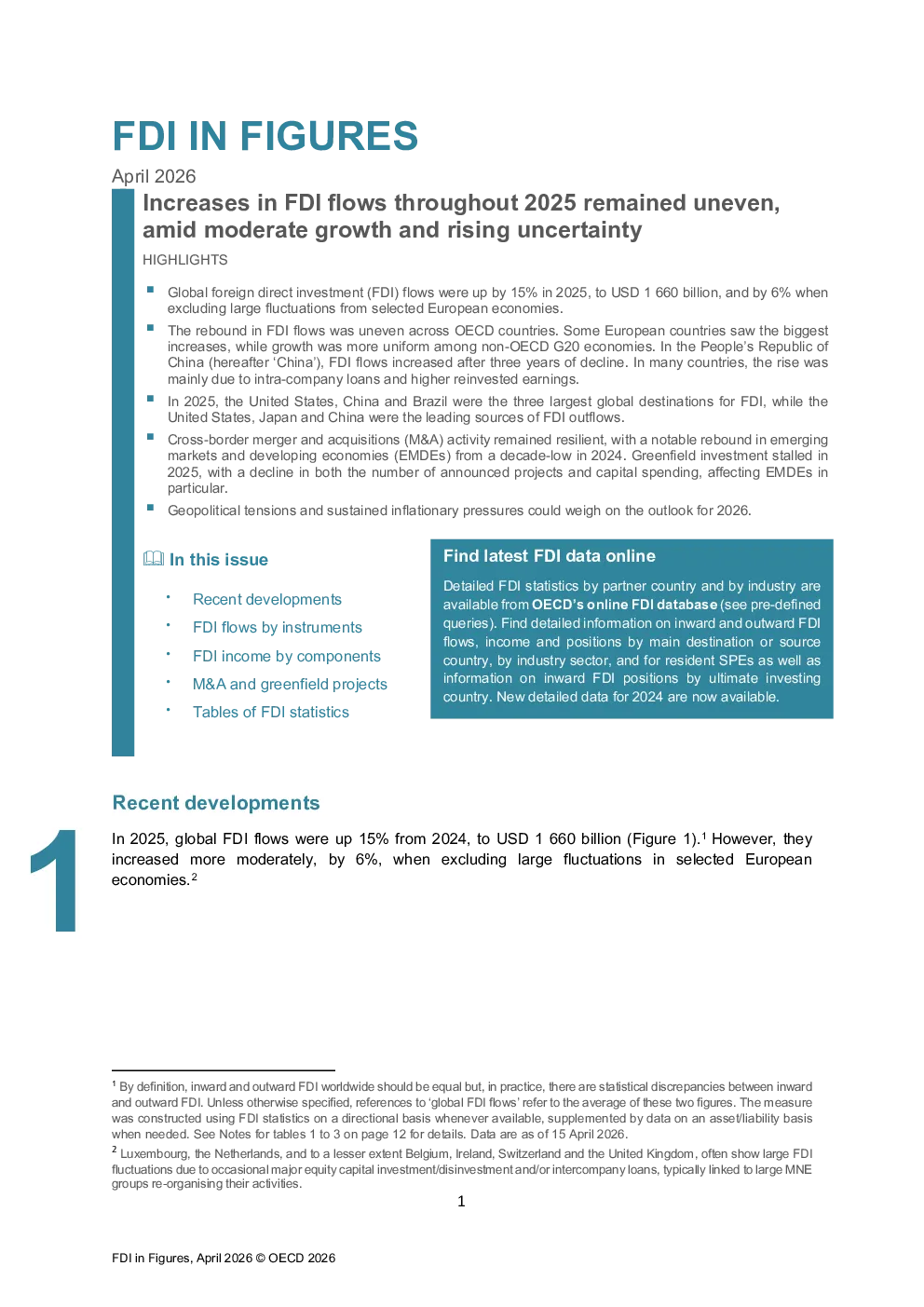
April 2026 Increases in FDI flows throughout 2025 remained uneven,amid moderate growth and rising uncertainty HIGHLIGHTS Global foreign direct investment (FDI) flows were up by 15% in 2025, to USD 1 660 billion, and by 6% whenexcluding large fluctuations from selected European economies. The rebound in FDI flows was uneven across OECD countries. Some European countries saw the biggestincreases, while growth was more uniform among non-OECD G20 economies. In the People’s Republic ofChina (hereafter ‘China’), FDI flows increased after three years of decline. In many countries, the rise wasmainly due to intra-company loans and higher reinvested earnings. In 2025, the United States, China and Brazil were the three largest global destinations for FDI, while theUnited States, Japan and China were the leading sources of FDI outflows. Cross-border merger and acquisitions (M&A) activity remained resilient, with a notable rebound in emergingmarkets and developing economies (EMDEs) from a decade-low in 2024. Greenfield investment stalled in2025, with a decline in both the number of announced projects and capital spending, affecting EMDEs inparticular. Geopolitical tensions and sustained inflationary pressures could weigh on the outlook for 2026. Find latest FDI data online In this issue Detailed FDI statistics by partner country and by industry areavailable fromOECD’s online FDI database(seepre-definedqueries). Find detailed information on inward and outward FDIflows, income and positions by main destination or sourcecountry, by industry sector, and for resident SPEs as well asinformation on inward FDI positions by ultimate investing Recent developmentsFDI flows by instrumentsFDI income by components Recent developments In 2025, global FDI flows were up 15% from 2024, to USD 1 660 billion (Figure 1).1However, theyincreasedmore moderately,by 6%,when excluding large fluctuations in selected European This increase was uneven among OECD economies but more consistently observed across emergingeconomies. In both groups, it was driven primarily by movements in intra-company loans and higherreinvestment of earnings (Section 3). Against a backdrop of stronger-than-expected global growth, butpersistent geopolitical tensions, policy uncertainty and inflationary pressures affecting many economies,M&A activity remained resilient, while greenfield investment announcements stalled in 2025 (Section Inflows FDI inflows in 2025 remained heavily influenced by large fluctuations in selected European economies(Figure 2). Overall, FDI flows inthe OECD areaincreased by 9% to USD 748 billion; however, excludingthese fluctuations, flows declined by 2%.2Among OECD economies, Austria, Norway and Australia Inthe EU area, FDI inflows dropped by 5% in 2025, driven by decreases in Luxembourg and theNetherlands, partly offset by rebounds in Ireland and a notable surge in Germany, due to movements FDI flowsinG20 non-OECDeconomies increased by 42%, with gains recorded across all economies,except Argentina, Indonesia and South Africa. FDI flows in the People’s Republic of China (hereafter‘China’) rebounded for the first time after three years of consecutive decline, driven by movements in The United States remained thetop destination for FDI inflowsworldwide in 2025 (USD 288 billion),followed by China (USD 80 billion) and Brazil (USD 77 billion).3 Outflows FDI outflows fromthe OECD areaincreased by 12% (Figure 4), but were broadly stable once largefluctuations in selected European countries were excluded. Among the other OECD economies, Franceand Germany recorded the most significant increases (Figure 5), driven mainly by equity flows in Franceand by higher reinvestment of earnings and movements in intra-company loans in Germany. By Inthe EU area, FDI outflows were up by 24% in 2025. However, when excluding volatile outflows fromselected EU countries, the increase was more moderate, at 10%, driven by rebounds in France and FDI outflows fromG20 non-OECD economiesdropped by 2% in 2025, driven by declines in China forthe second consecutive year, reflecting changes in intra-company loans.5Despite this decline, Chinaremains one of the world’s major sources of FDI outflows.By contrast, Brazil and India recorded higher In 2025, the United States (USD 310 billion), Japan (USD 186 billion) and China (USD 157 billion) werethemajor sources of FDI outflowsworldwide. OECD equity capital FDI flows In 2025, FDI equity flows in OECD countries declined sharply compared to 2024, falling by 84%(Figure 6). When large fluctuations in selected European economies are excluded, however, thedecrease is less pronounced, at 25%.This reduction does not necessarily indicate a slowdown innew investment activity, as substantial disinvestment operations can offset new investments, resultingin lower net equity flows. The largest declines among OECD economies were recorded in Norway,Australia and Austria (Figure 7), possibly reflecting a slowdown in new inves