周末科技简讯:银行卡的‘成本’——常被误导的比较;关键图表中的我们的观点
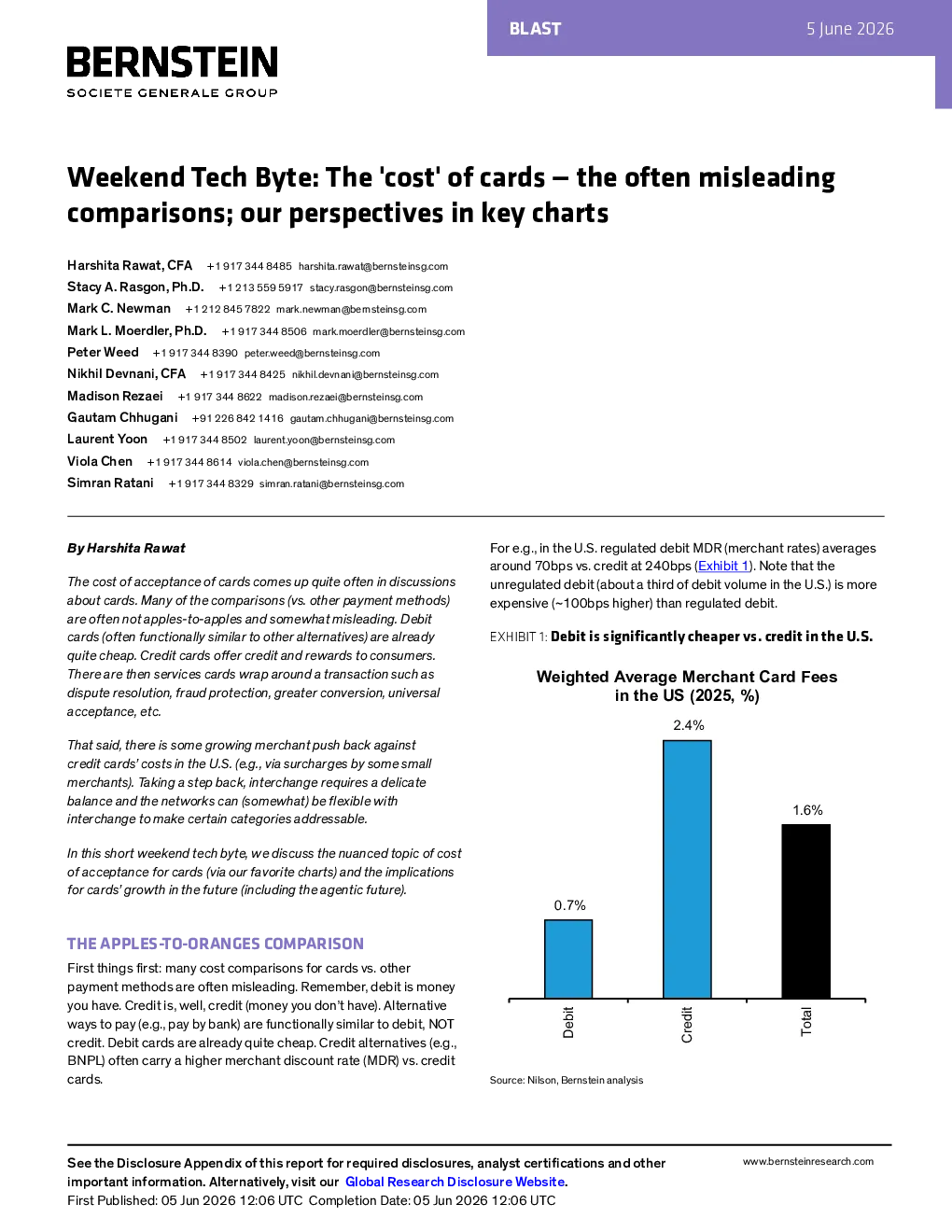
Harshita Rawat, CFA+1 917 344 8485harshita.rawat@bernsteinsg.comStacy A. Rasgon, Ph.D.+1 213 559 5917stacy.rasgon@bernsteinsg.comMark C. Newman+1 212 845 7822mark.newman@bernsteinsg.comMark L. Moerdler, Ph.D.+1 917 344 8506mark.moerdler@bernsteinsg.comPeter Weed+1 917 344 8390peter.weed@bernsteinsg.comNikhil Devnani, CFA+1 917 344 8425nikhil.devnani@bernsteinsg.comMadison Rezaei+1 917 344 8622madison.rezaei@bernsteinsg.comGautam Chhugani+91 226 842 1416gautam.chhugani@bernsteinsg.comLaurent Yoon+1 917 344 8502laurent.yoon@bernsteinsg.comViola Chen+1 917 344 8614viola.chen@bernsteinsg.comSimran Ratani+1 917 344 8329simran.ratani@bernsteinsg.com For e.g., in the U.S. regulated debit MDR (merchant rates) averagesaround 70bps vs. credit at 240bps (Exhibit 1). Note that theunregulated debit (about a third of debit volume in the U.S.) is moreexpensive (~100bps higher) than regulated debit. By Harshita Rawat The cost of acceptance of cards comes up quite often in discussionsabout cards. Many of the comparisons (vs. other payment methods)are often not apples-to-apples and somewhat misleading. Debitcards (often functionally similar to other alternatives) are alreadyquite cheap. Credit cards offer credit and rewards to consumers.There are then services cards wrap around a transaction such asdispute resolution, fraud protection, greater conversion, universalacceptance, etc. That said, there is some growing merchant push back againstcredit cards’ costs in the U.S. (e.g., via surcharges by some smallmerchants). Taking a step back, interchange requires a delicatebalance and the networks can (somewhat) be flexible withinterchange to make certain categories addressable. In this short weekend tech byte, we discuss the nuanced topic of costof acceptance for cards (via our favorite charts) and the implicationsfor cards’ growth in the future (including the agentic future). THE APPLES-TO-ORANGES COMPARISON First things first: many cost comparisons for cards vs. otherpayment methods are often misleading. Remember, debit is moneyyou have. Credit is, well, credit (money you don’t have). Alternativeways to pay (e.g., pay by bank) are functionally similar to debit, NOTcredit. Debit cards are already quite cheap. Credit alternatives (e.g.,BNPL) often carry a higher merchant discount rate (MDR) vs. creditcards. Cards are especially cheap in Europe (Exhibit 2) where interchangeis capped at ~20bps for debit and ~30bps for credit. Credit is moreexpensive than debit in most countries around the world. But, withthe exception of the U.S., the majority of card volumes in many geosare debit-related (Exhibit 3). CARDS WRAP AROUND A LOT OF SERVICES For example, dispute management (doesn’t currently exist withStablecoins), chargebacks (Stablecoin transactions are non-reversible) and rewards (float-income-induced stablecoin rewardshave mathematical limits) (Exhibit 4 and Exhibit 5). Can alternativepayment methods (pay-by-bank, stablecoins) include theseservices? Of course, they can - but it takes years and costs $$s (andbragging rights around being ‘cheap’). Card payments are beyond simplistic money movement. Moneymovement is a commodity (ACH transactions cost a fraction ofa cent — cheaper than many stablecoins). Trust and governance(which cards provide) are not. There are a lot of value-addedservices (some described above) embedded in a transaction, andthey also include governance standards (which have been decadesin the making, and typically very hard to enforce for alternatepayment schemes). There is then the universal acceptance across100m+ merchant locations and 7B+ KYCed credentials. Interestingly, with wrapped services, stablecoins’ costs to smallmerchants are not often cheaper vs. debit cards (Exhibit 6). INTERCHANGE IS GREAT, BUT CAPS ON IT ARE NOTTHAT BAD EITHER.. Interchange is a delicate topic in the payments world.It is oneof the many less-than-intuitive things about the sector. It is a feeset by the networks (i.e. Visa and Mastercard), which a merchant'sbank pays to the issuing bank for card transactions. Interchange isoften invisible to the consumer but passed on to the merchant. Itconstitutes the majority of fees that merchants pay to accept cards. Merchants don't like it, consumers do not care about it, issuerslove it, regulators want to cap it, and many lawyers often pay theirbills with it. Above all, interchange has, in aggregate, been brilliant.It creates incentives for issuers (including fintechs) to acquirecustomers and issue cards. It funds rewards, which then incentivizeconsumer behavior. Credit txn MDRInterchange creates a monetization model (beyond lending andinsurance) for consumer financial services. The fintechs (new-age issuers), which the so-called disruptors, are now increasinglyrelying on interchange to drive revenues. Ironically, the bestconsumer use-case for stablecoins is a stablecoin-linked card,which also benefits from lucrative interchange fees. All that said, card networks try to achieve a