5月全球PMI数据告诉我们什么?
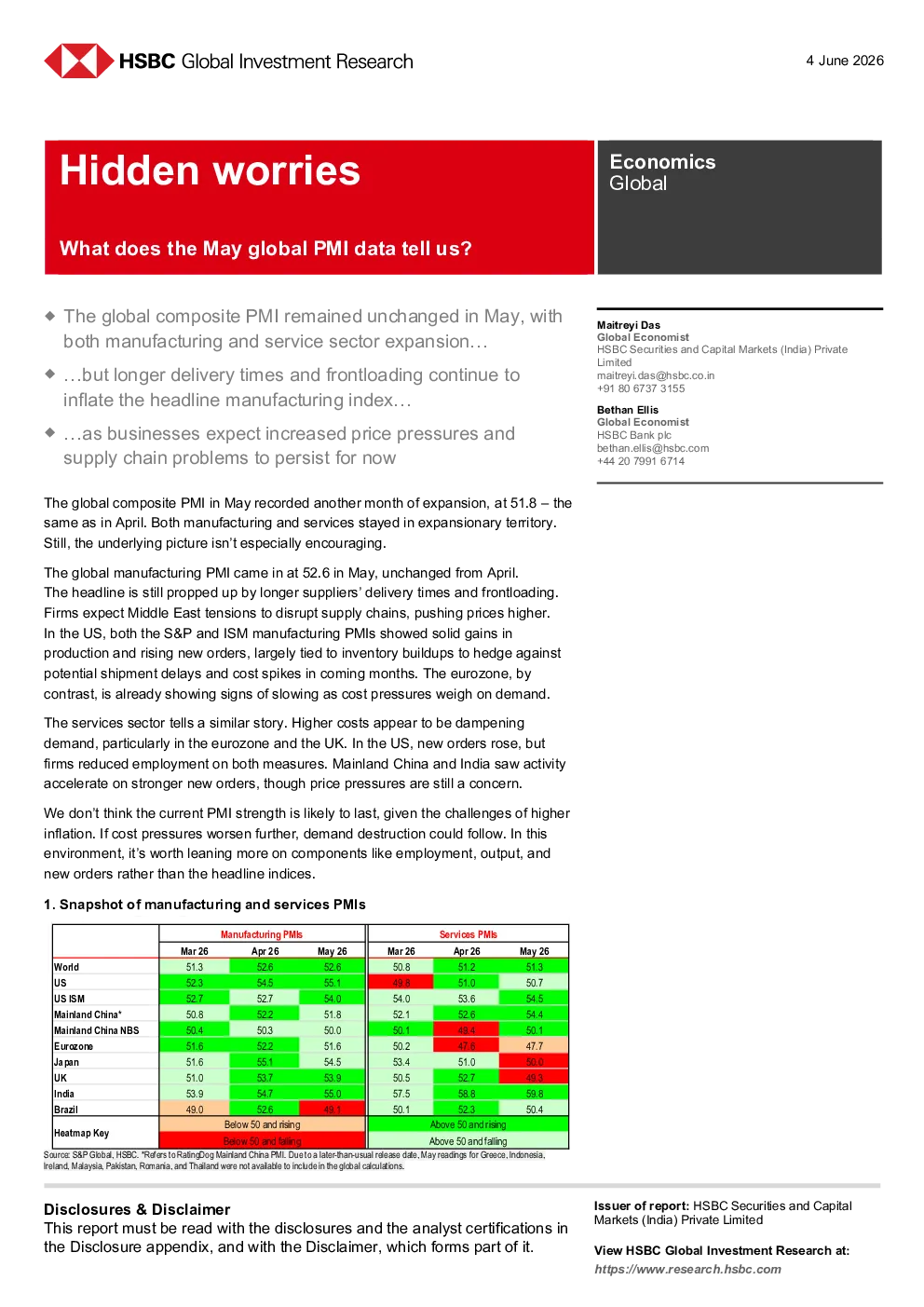
隐忧 五月全球PMI数据告诉我们什么? ◆ 全球综合PMI在5月份保持不变,制造业和服务业扩张…… HSBC Securities and Capital Markets (India) PrivateLimitedmaitreyi.das@hsbc.co.in+91 80 6737 3155马特雷伊·达斯全球经济学家 ◆ 但更长的交货时间和前置加载仍在推高制造业综合指数…… HSBC Bank plcbethan.ellis@hsbc.com+44 20 7991 6714贝珊·艾利斯全球经济学家 ◆ ……企业目前预计价格压力和供应链问题将持续存在 5月份全球综合PMI录得又一个扩张月,为51.8——与4月份持平。制造业和服务业均保持在扩张区间。然而,基本状况并非特别令人鼓舞。 5月份全球制造业采购经理人指数(PMI)为52.6,与4月份持平。主要数据依然受到供应商交货时间延长和提前采购的支撑。企业预计中东紧张局势将扰乱供应链,推高价格。在美国,标普和ISM制造业PMI均显示生产和新订单大幅增长,这主要与为防范未来几个月可能出现的运输延误和成本飙升而进行的库存积累有关。相比之下,欧元区已出现放缓迹象,因成本压力抑制了需求。 服务业的情况类似。成本上升似乎正在抑制需求,尤其是在欧元区和英国。在美国,新订单增加,但企业同时在两方面削减了就业。中国大陆和印度的新订单强劲,活动加速,但价格压力仍然是一个问题。 鉴于高通胀带来的挑战,我们认为当前的采购经理人指数(PMI)强度不太可能持续。如果成本压力进一步加剧,需求可能随之萎缩。在这种情况下,更应侧重于就业、产出和新增订单等指标,而非仅关注主要指数。 报告发行方:汇丰证券及资本市场(印度)私营有限公司 披露与免责声明本报告必须结合披露附录中的披露声明和分析师资质认定,以及作为其一部分 的免责声明一起阅读。 请访问:https://www.research.hsbc.com 查看汇丰环球投资研究。 本月数据中的三大关键要点 1. 现在供应冲击加剧和价格压力已成为全球性主题 5月份的PMI数据显示了又一个“扭曲”的增长月——主要指数的韧性掩盖了更长的交付时间。采购量连续第二个月加速,这与企业在与中东冲突相关的供应风险加剧的情况下提前采购投入相符。 五月份投入成本进一步加剧,全球制造业投入成本自2022年6月以来上涨速度最快。美国近四年来记录了最显著的增幅,受访者指出石油产品、钢铁和运费成本上涨。法国、德国、日本、英国和菲律宾也经历了更快的投入价格通胀。然而,在许多经济体中,成本转嫁仍不完整,这意味着利润空间受到挤压,而非最终商品价格干净利落地大幅上涨。因此,订单正在被下达以应对产出价格上涨。除了中东冲突,美国关税可能是导致这种提前下单的另一个因素。已有一些证据表明,美国进口商提前下单以应对今年晚些时候预期的关税增加,尤其是来自亚洲的订单。 在美国,标普全球和ISM的调研都注意到一些指出加速囤积的评论,这有助于推动新订单和生产达到多年来的高点。日本、印度、韩国和越南也记录了采购量的显著增长,这反映了人们对供应瓶颈和价格上涨的担忧。 2. 地区分化:美国优势与脆弱的欧元区 美国制造业的复苏势头似乎日益稳固,产量已回升至自2022年4月以来的最高水平。相比之下,欧元区正失去动力。该地区两大经济体——德国和法国——均有所放缓,受访者指出,与中东相关的中断正通过成本上升对需求造成压力,而新订单依然疲软。 欧元区综合PMI指数保持在50以上,但其构成情况值得警惕。部分支撑来自更长的交付时间,这会机械性地推高指数(其逻辑是,在正常情况下,更长的交付时间意味着需求更高)。若从指数中剔除交付时间因素,欧元区制造业将处于收缩状态。世界指数中也存在类似的扭曲现象,但程度较轻。 其他地区,在亚洲,包括印度、韩国和日本的经济体制造业活动有所改善,而中国大陆的扩张步伐则放缓。然而,这种积极势头似乎更多是由风险而非需求驱动:相当一部分增长与在潜在的供应链中断前进行的预防性购买一致。 3. 服务项目管理:成本上升已开始影响需求 全球服务行业在5月份继续扩张,全球服务采购经理人指数(PMI)为51.3。新订单有所增长,受访者指出客户提前采购。但就业人数下降,这表明潜在需求疲软,成本压力加大。最终,许多经济体中较高的价格压力将对服务活动造成影响。 该领域也呈现出熟悉的分化。亚洲和美国的表现好于欧元区和英国。新订单的强劲增长——尤其是在印度和中国大陆——推动了更快的活动步伐。在美国,ISM服务业指数加速增长,而标普指数虽有所下跌但仍处于扩张区间,两者均受新订单支撑。然而,就业人数大幅下降,反映出数据中的部分悲观情绪。与此同时,欧洲面临成本压力加剧开始抑制需求。在英国,受访者指出旅游、旅游和休闲领域的消费者支出疲软。 中东地区迅速降级将缓解供应链约束,并使价格有所回落,这有助于需求。然而,冲突已持续三个月以上,即便霍尔木兹海峡重新开放,PMI的正常化也需要时间。详见内页,了解最新发布的关键PMI图表。 制造业采购经理人指数 来源:S&P全球,Macrobond。注:垂直线表示解放日关税中断 来源:Rating Dog、S&P、Macrobond 来源:S&P Global,Macrobond。注:整体经济PMI 源自:S&P全球,Macrobond 来源:S&P全球、Macrobond、汇丰计算 制造业的其他关键趋势 源自:S&P全球,Macrobond 服务项目管理 来源:S&P Global, Macrobond。注:最新数据点为初步估计。 源自:S&P全球,Macrobond 源自:S&P全球,Macrobond 源自:S&P全球,Macrobond 来源:RatingDog,Macrobond 披露附录 分析师认证 本报告的主要负责人,包括负责本报告某一章节或数章节的作者,以及作为某一子公司在资产分拆估值中负责分析师的任何分析师,特此证明:关于标的证券或发行人的意见、其在报告中署名的章节中表达的任何观点或预测,以及报告中表达的任何其他观点或预测(包括研究报告封底表达的任何观点),均准确反映了其个人观点,并且其薪酬的任何部分均未直接或间接与其在本研究报告中所包含的具体建议或观点相关:Maitreyi Das和Bethan Ellis 重要披露 本文件由汇丰银行研究部编制并分发,仅供汇丰银行客户使用,不得通过媒体或其他方式向其他人公开。 本文件仅用于信息参考,不应被视为出售要约或购买所提及的证券或其他投资产品的要约邀请,亦不应被视为参与任何交易策略的邀请。本文件中的建议为一般性建议,不应被视为个人建议,因其制定时未考虑任何特定投资者的目标、财务状况或需求。因此,在根据本文件的建议采取行动之前,投资者应考虑建议的适用性,并顾及自身的目标、财务状况和需求。如有必要,请寻求专业的投资和税务建议。 本文件中提到的某些投资产品可能不符合在某些州或国家销售的条件,并且可能不适合所有类型的投资者。投资者应在购买投资产品前,就本文件中提到的投资产品的适用性咨询其汇丰代表,并考虑其特定的投资目标、财务状况或特殊需求。 本文件中提到的投资产品的价值和所产生的收入可能会波动,因此投资者可能收回的投资金额少于原始投资。某些高波动性投资可能面临价值突然大幅下跌的风险,跌幅可能等于或超过投资金额。投资产品的价值和收入可能受到汇率、利率或其他因素的影响而出现不利变化。某项投资产品的过往业绩并不预示未来结果。 汇丰银行及其附属机构将不时以主交易商或代理人的身份,向客户买卖其所覆盖的汇丰研究报告中涉及的公司发行的证券/工具(包括股票和债券,含衍生品),或作为本报告中提及的证券/工具的市场做市商或流动性提供方。 分析师、经济学家和策略师的部分薪酬是根据汇丰银行的盈利能力来确定的,该盈利能力包括投资银行业务、销售与交易以及主经纪业务收入。 此次分析更新的发布时间,或何时发布,尚未确定。 本报告提及的任何公司的披露信息,请参阅该公司最新发布的报告,网址为 www.hsbcnet.com/research。汇丰私人银行客户如需查询其他研究报告,应联系其客户关系经理。欲了解本报告所使用的专有模型的更多信息,请联系撰写该报告的分析师。 额外披露 1 本报告日期为2026年6月4日。2 本报告中包含的所有市场数据截至2026年6月3日收盘,除非报告中另有注明日期和/或具体时间。 免责声明 报告发行人 注册办事处 印度孟买 Fort,马哈特玛·甘地路 52/60号 400001 电话:+91 22 2267 4921 传真:+91 22 2263 1983 网站:www.research.hsbc.com SEBI注册号:INH000001287 CIN:U67120MH1994PTC081575 截至2026年5月13日的法人类别: 汇丰银行有限公司;汇丰欧洲大陆;汇丰欧洲大陆有限责任公司,德国;汇丰中东银行有限公司,迪拜国际金融中心;汇丰证券与资本市场(印度)汇丰银行中东有限公司迪拜分行;汇丰投资证券公司伊斯坦布尔;香港上海私人有限公司香港恒生银行有限公司;香港上海银行有限公司新加坡分行;香港上海银行有限公司首尔证券部;香港上海银行有限公司首尔分行;恒生Qianhai证券有限公司;恒生证券(台湾)有限公司;恒生证券与资本市场(印度)私营有限公司,孟买;恒生银行澳大利亚有限公司;恒生证券(美国)公司,纽约;墨西哥恒生银行,SA,多银行机构,恒生金融集团;HSBC银行SA This document has been issued by HSBC Securities and Capital Markets (India) Private Limited ("HSBC") for the information ofits customers only. HSBC Securities and Capital Markets (India) Private Limitedis registered as "Research Analyst" (Reg. No. INH000001287), Merchant Banker (Reg. No. INM000010353) and Stock Broker (Uniform Reg. No. INZ000234533) and regulated by the Securities and ExchangeBoard of India. If it is received by a customer of an affiliate of HSBC, its provision to the recipient is subject to the terms of business in place between the recipient and such affiliate. This document is not andshould not be construed as an offer to sell or the solicitation of an offer to purchase or subscribe for any investment. HSBChas based this document oninformation obtained from sources it believes to bereliable but which it has not independently verified; HSBC makes no guarantee, representation or warranty and accepts no responsibility or liability as to its accuracy or completeness. Ex