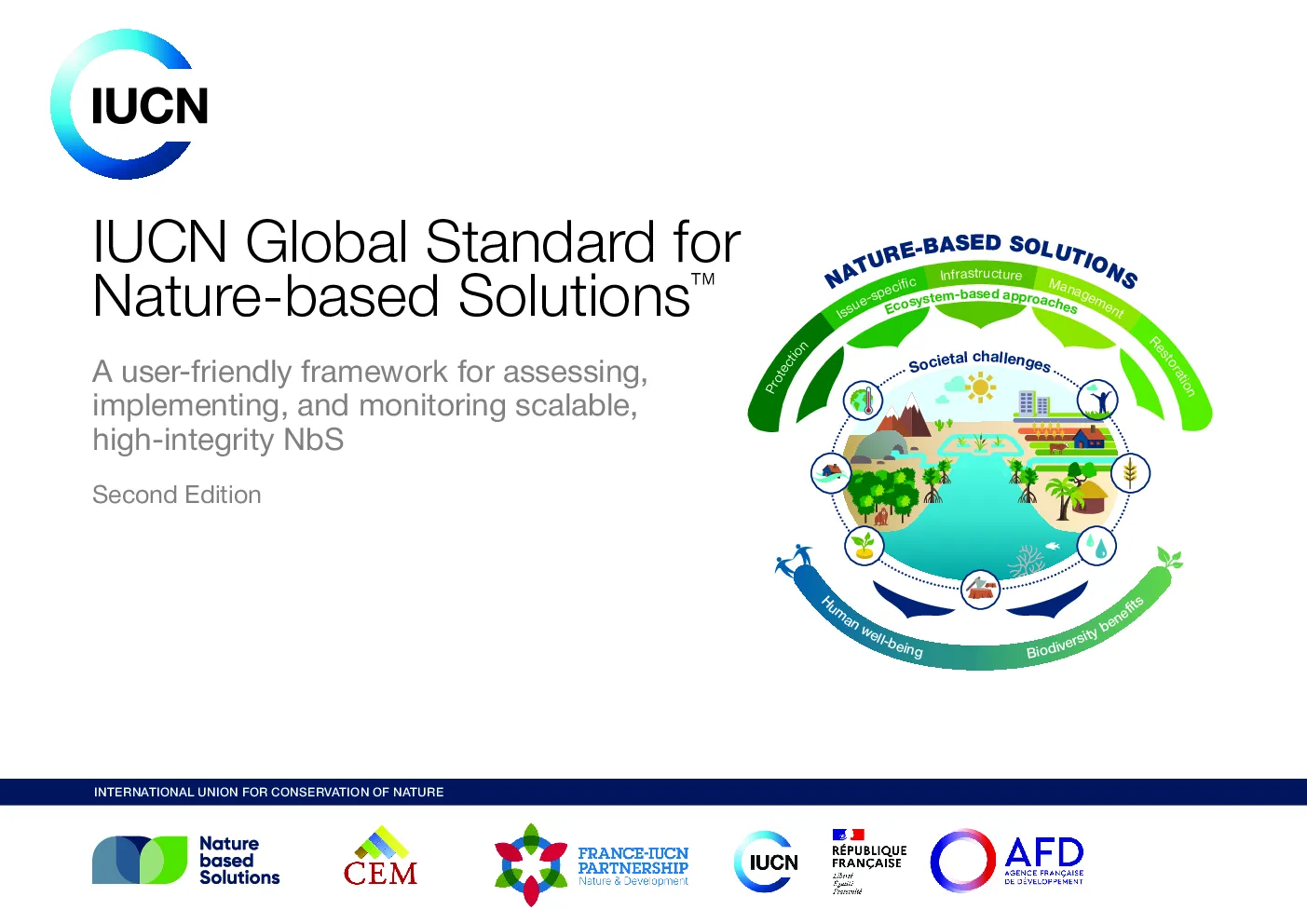
A user-friendly framework for assessing,implementing, and monitoring scalable,high-integrity NbS Second Edition About IUCN IUCN is a membership Union uniquely composed of both government and civil society organisations. Itprovides public, private and non-governmental organisations with the knowledge and tools that enable humanprogress, economic development and nature conservation to take place together. Created in 1948, IUCN is now the world’s largest and most diverse environmental network, harnessing theknowledge, resources and reach of more than 1,500 Member organisations and some 19,000 experts. It is aleading provider of conservation data, assessments and analysis. Its broad membership enables IUCN to fillthe role of incubator and trusted repository of best practices, tools and international standards. IUCN provides a neutral space in which diverse stakeholders including governments, NGOs, scientists,businesses, local communities, Indigenous Peoples’ Organisations and others can work together to forge andimplement solutions to environmental challenges and achieve sustainable development. Working with manypartners and supporters, IUCN implements a large and diverse portfolio of conservation projects worldwide.Combining the latest science with the traditional knowledge of local communities, these projects work toreverse habitat loss, restore ecosystems and improve people’s well-being. IUCN Global Standard forNature-based Solutions™ A user-friendly framework for assessing,implementing, and monitoring scalable,high-integrity NbS Second Edition CC BY-NC 4.0 Attribution 4.0 International. This work is licensed underhttps://creativecommons.org/licenses/by-nc/4.0/.The user is allowed to distribute, remix, adapt, and build upon the material in any medium or format.The user must give appropriate credit to IUCN as the source of the material and indicate if changes were made to the original content. Only non-commercial uses of the work are permitted. Use of the name and logo of IUCN is not permitted in connectionwith adaptations, translations, or other derivative works. Adaptations/translations/derivatives should not carry any official logo, unless they have been approved and validated by IUCN.Please contact IUCN (logo@iucn.org) to obtain permission. When copyright of content published by IUCN, such as images, graphics or logos, is held by a third-party, the user of suchcontent is solely responsible for clearing the rights with the right holder(s). The user acknowledges and agrees that any transformation, adaptation, translation or alteration of the Original Content providedby IUCN “hereinafter referred to as “Original Content” is done at the user’s own risk. In no event shall IUCN be liable for anydamages, losses or consequences arising from the use, modification or adaptation of the Original Content. The User agrees tocomply with all applicable laws and regulations when transforming, adapting or redistributing the Original Content. Furthermore,IUCN does not guarantee the quality, accuracy, integrity or legal compliance of the Original Content after its transformation oradaptation. IUCN expressly disclaims all liability for any copyright, trademark, or other legal infringement that may result from themodification or unauthorized use of the Original Content. The designation of geographical entities in this work, and the presentation of the material, do not imply the expression of anyopinion whatsoever on the part of IUCN or other participating organisations concerning the legal status of any country, territory,or area, or of its authorities, or concerning the delimitation of its frontiers or boundaries. The views expressed in this work do not necessarily reflect those of IUCN or other participating organisations. IUCN is pleased to acknowledge the support of its Framework Partners who provide core funding: Ministry of Foreign Affairs,Denmark; Ministry for Foreign Affairs, Finland; Government of France and the French Development Agency (AFD); Ministry ofEnvironment, Republic of Korea; Ministry of the Environment, Climate and Sustainable Development, Grand Duchy of Luxembourg;the Norwegian Agency for Development Cooperation (Norad); and the Swiss Agency for Development and Cooperation (SDC). This publication has been made possible in part by funding from the Government of France and the French DevelopmentAgency (AFD). Published by:Copyright:Recommended citation: IUCN, Gland, Switzerland © 2020, 2026 IUCN, International Union for Conservation of Nature and Natural Resources IUCN (2026).IUCN Global Standard for Nature-based Solutions™. A user-friendly frameworkfor assessing, implementing, and monitoring scalable, high-integrity NbS.Second Edition.IUCN. ISBN (PDF):DOI:Layout and infographics: 978-2-8317-2392-1 https://doi.org/10.2305/KKSO4573 Efrat Bronstein/Studio Eshkat Table of contents AcknowledgementsAcronymsDocument historyISEAL Code of Good Practice for Sustainability SystemsPreambleNat