您的浏览器禁用了JavaScript(一种计算机语言,用以实现您与网页的交互),请解除该禁用,或者联系我们。 [IDC]:IDC MarketScape:全球AI赋能劳动力管理(WFM)与合规2025供应商评估 - 发现报告

IDC MarketScape:全球AI赋能劳动力管理(WFM)与合规2025供应商评估

信息技术 2025-11-15 Ivan Oz IDC 大王雪
报告封面

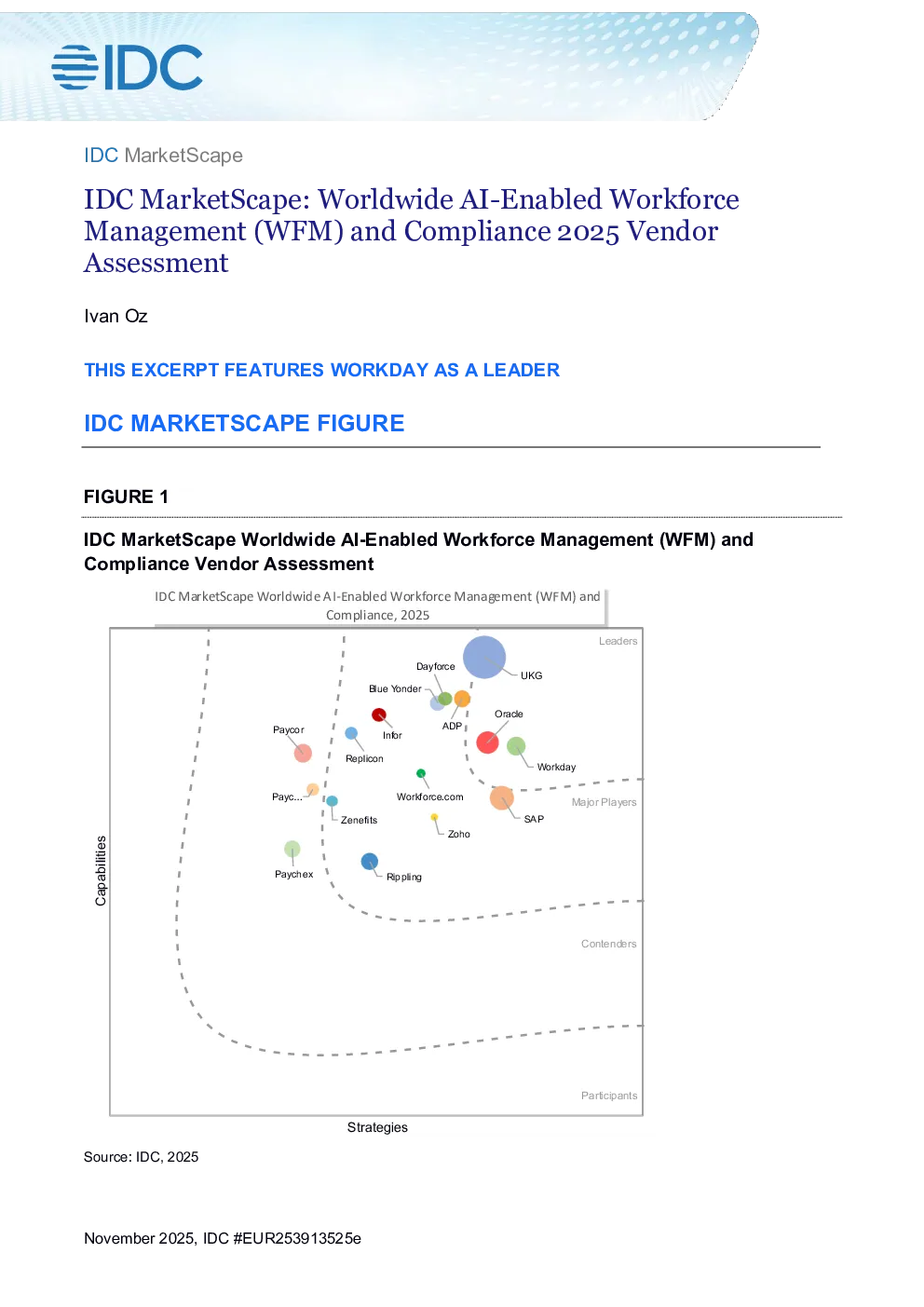
IDC MarketScape: Worldwide AI-Enabled WorkforceManagement (WFM) and Compliance 2025 VendorAssessment Ivan Oz THIS EXCERPT FEATURESWORKDAYAS A LEADER IDC MARKETSCAPE FIGURE FIGURE 1 IDC MarketScape Worldwide AI-Enabled Workforce Management (WFM) andCompliance Vendor Assessment Please see the Appendix for detailed methodology, market definition,and scoringcriteria. ABOUT THIS EXCERPT The content for this excerpt was taken directly from IDC MarketScape: Worldwide AI-Enabled Workforce Management (WFM) and Compliance 2025 Vendor Assessment(Doc # EUR253913525). IDC OPINION The Current State of Workforce Management In 2025, workforce management platformsrepresenta mature and standardized market.A majorityofsolutions are now delivered through cloud architectures with frequentrelease cadences. Hybrid or on-premises deployments remain primarily in regulated orinfrastructure-constrained environments. As a result, deployment mode has lostitscompetitive relevance, and buyers evaluate vendorsbased on theirreliability,configurability, and scalability within the cloud model. Functional scope is broadly consistent across providers. Core capabilities such as timecapture, attendance, absence management, and scheduling are well-established andstable. Differences appear in the sophistication of labor optimization, forecasting, andintraday re-planning. The ability to model complex constraints and manage multi-siteoperations defines the maturity of each platform and its suitability for large, distributedenvironments. Compliance remains the foundation of workforce management investment.The vastmajority ofplatforms incorporate embedded rules engines that reflect regional labordirectives, overtime thresholds, premiums, and collective agreements.The depth ofjurisdictional coverage varies, and only a limited number of vendors provide consistentcompliance automation across all operational regions. Integration with payroll, human capital management, and enterprise resource planningsystems has become a defining feature of mature platforms. Application programminginterfaces and standard connectors enable the exchange of time, absence, and paydata, although synchronization speed and reconciliation quality differ between vendors.The level of integration maturity directly influences payroll accuracy and the reliability ofworkforce cost reporting. User experience has reached a generally high standard. Mobile self-service for clocking,shift swaps, and leave requests is widely available, and managerial views consolidateexception management and approvals.Disparitiesremain regardinglocalization,accessibility, and the flexibility of role-specific configurations. The efficiency with which exceptions are resolved within the system is now the main determinant of usersatisfaction. AIfunctions are operational but remain narrow in scope. Typical deployments focus ondemand forecasting, anomaly detection, and rule or schedule suggestions. Autonomousscheduling without human validation is not yet common. Current AI use primarilyenhancesplanner efficiency rather than replacing manual decision-making. Reporting and analytics capabilities are mature for operational oversight but limited forstrategic workforce planning.The vast majority ofplatforms provide compliancedashboards and key performance indicators such as labor cost, coverage, utilization, andabsence. Broader analytics that connect workforce data to productivity or engagementoutcomes generally require external business-intelligence tools or additional dataintegration with human capital systems. Configurability is widely promoted,butexecutionvaries significantly. Administrators cantypically adjust rules for premiums, rotations, and qualifications, but the processes fortesting, version control, and promoting configuration changes are inconsistent. Theoperational cost of maintaining configuration has become a major factor in assessingthetotal cost of ownership. Industry specialization remains an important differentiator. Vendors serving sectors suchas retail, healthcare, manufacturing, and the public sector offer pre-configured templatesand compliance libraries that reduce implementation effort. Solutions capable ofmanaging local variations within centralized governance models show higher scalabilityand lower dependencyon services. Therefore,theworkforce management market hasentered a phase of functionalconvergence and operational maturity. Core capabilities are standardized, andcompetitive differentiation increasingly depends on integration quality, optimizationdepth, analytics extensibility, and the efficiency of ongoingconfiguration management. AIis established as an assistive component,butithas not yet achieved full autonomy inoperational decision-making. Strategic Direction of Workforce Management Vendors Vendors are gradually moving from workforce planning toward continuous orchestration.Their main goal is to make scheduling and forecasting more adaptive and predictive,using