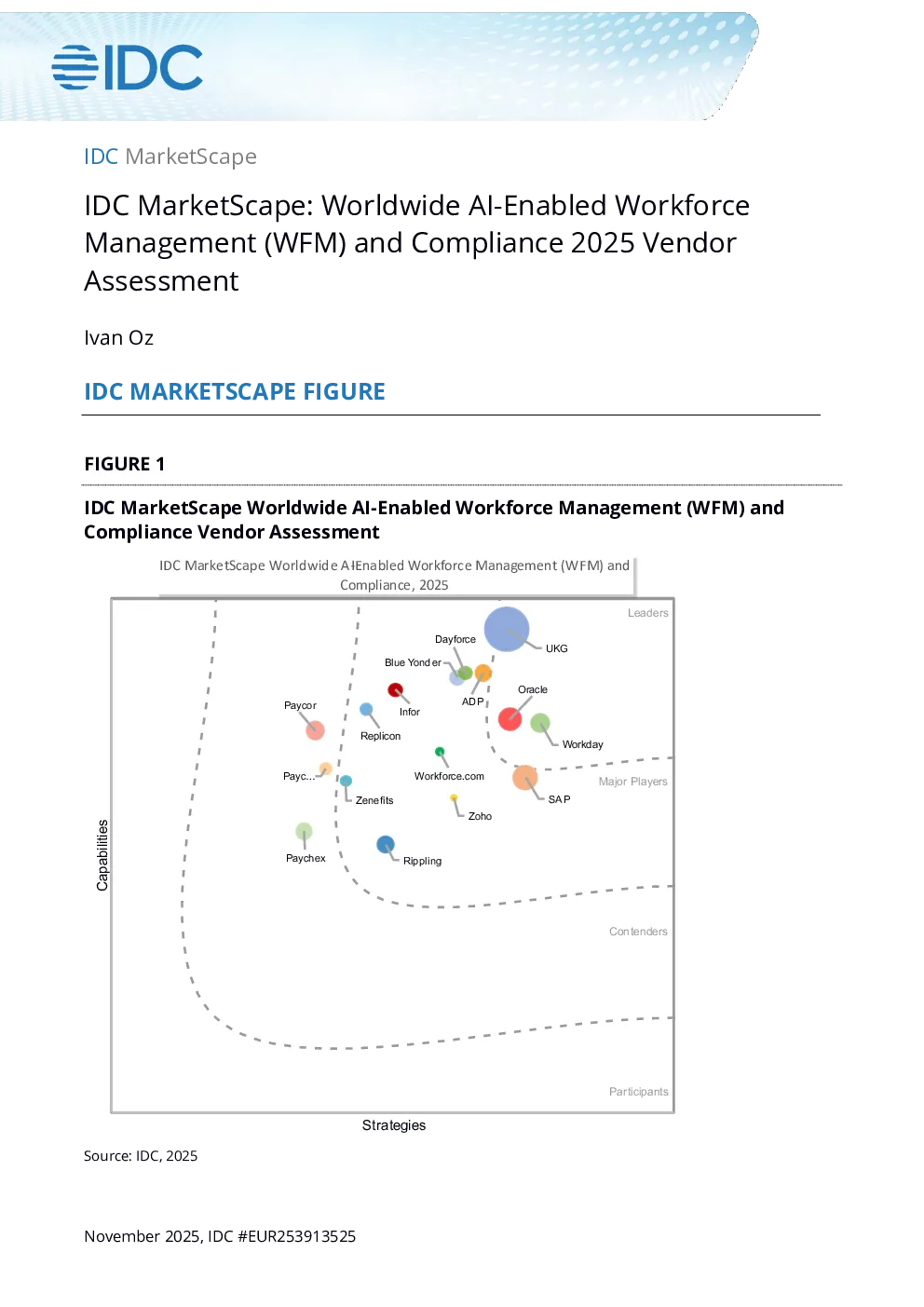
IDCMarketScape IDC MarketScape: Worldwide AI-Enabled WorkforceManagement (WFM) and Compliance 2025 Vendor Ivan Oz IDC MARKETSCAPE FIGURE IDC MarketScape Worldwide AI-Enabled Workforce Management (WFM) and Please see the Appendix for detailed methodology, market definition,and scoring IDC OPINION The Current State of Workforce Management In 2025, workforce management platformsrepresenta mature and standardizedmarket.A majorityofsolutions are now delivered through cloud architectures withfrequent release cadences. Hybrid or on-premises deployments remain primarily inregulated or infrastructure-constrained environments. As a result, deployment Functional scope is broadly consistent across providers. Core capabilities such astime capture, attendance, absence management, and scheduling are well-established and stable. Differences appear in the sophistication of labor Compliance remains the foundation of workforce management investment.The vastmajority ofplatforms incorporate embedded rules engines that reflect regionallabor directives, overtime thresholds, premiums, and collective agreements.The Integration with payroll, human capital management, and enterprise resourceplanning systems has become a defining feature of mature platforms. Applicationprogramming interfaces and standard connectors enable the exchange of time,absence, and pay data, although synchronization speed and reconciliation quality User experience has reached a generally high standard. Mobile self-service forclocking, shift swaps, and leave requests is widely available, and managerial viewsconsolidate exception management and approvals.Disparitiesremain regarding AIfunctions are operational but remain narrow in scope. Typical deployments focuson demand forecasting, anomaly detection, and rule or schedule suggestions.Autonomous scheduling without human validation is not yet common. Current AI Reporting and analytics capabilities are mature for operational oversight but limitedfor strategic workforce planning.The vast majority ofplatforms provide compliancedashboards and key performance indicators such as labor cost, coverage, utilization, Configurability is widely promoted,butexecutionvaries significantly. Administratorscan typically adjust rules for premiums, rotations, and qualifications, but theprocesses for testing, version control, and promoting configuration changes are Industry specialization remains an important differentiator. Vendors serving sectorssuch as retail, healthcare, manufacturing, and the public sector offer pre-configuredtemplates and compliance libraries that reduce implementation effort. Solutions Therefore,theworkforce management market hasentered a phase of functionalconvergence and operational maturity. Core capabilities are standardized, andcompetitive differentiation increasingly depends on integration quality, optimization Strategic Direction of Workforce Management Vendors Vendors are gradually moving from workforce planning toward continuousorchestration. Their main goal is to make scheduling and forecasting more adaptiveand predictive, using real-time data to balance staffing needs with business demand. Ongoing product developmentisfocusedon improvedforecasting accuracy anddecision support for managers. Some vendors are testing conversational orgenerative assistants to simplify configuration and scenario modeling. These tools Several vendors are extending their data models to include skills and well-beingindicators. This approach links workforce deployment with employee capacity andengagement, although practical adoption remains limited. Industry specialization Compliance capabilities are evolving from static rules to built-in logic. More vendorsare embedding regional labor requirements directly into workflows, which reducesmanual updates and improves accuracy. Over the next few years, vendor strategies Market Dynamics The workforce management market in 2025 is consolidating around a smaller groupof cloud providers with strong integrationcapabilities forpayroll and analyticsplatforms. Global vendors compete on scale and unified data models, while regional AIremains a differentiator, but maturity levels vary. Many vendors reference AI intheir marketing, while only a fewofferproven production-level automation inforecasting or scheduling. Buyers are increasingly focused on tangible results and Customer expectations continue to shift toward configurable automation.Organizations want to manage local labor rules and worker preferences through Analytics capabilities have become central to purchasing decisions. Buyers expectworkforce data to connect easily with payroll, HR, and financial systems to provideclear visibility into labor costs, utilization, and productivity. Vendors that deliver IDC MARKETSCAPE VENDOR INCLUSION CRITERIA This IDC MarketScape includes workforce management vendors that meet the ▪Product availability:The solution must be commercially available, activelysold, and suppo