全球储能:钠离子电池或将颠覆磷酸铁锂电池市场
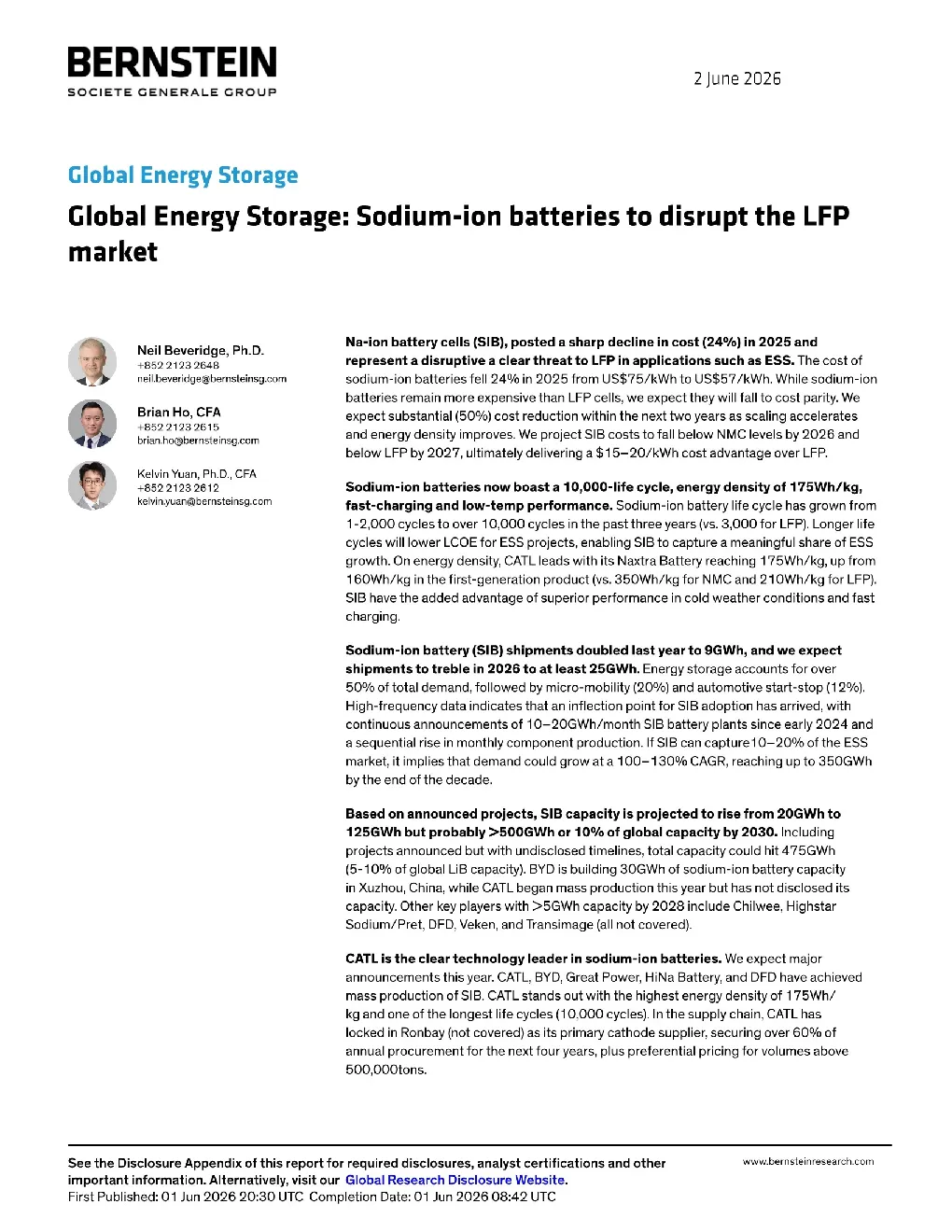
Global Energy Storage: Sodium-ion batteries to disrupt the LFpmarket represent a disruptive a clearthreatto LFPin applications such as ESS.The cost ofsodium-ion batteries fell24% in 2025fromUS$75/kWhto US$57/kWh.While sodium-ionbatteries remain more expensive than LFP cells, we expect they will fall to cost parity. Weexpect substantial (50%)costreduction within the nexttwoyears as scalingacceleratesand energy density improves. We project SIB costs to fallbelow NMC levels by 2026 andbelow LFP by 2027,ultimately delivering a $15-20/kWh cost advantage over LFP. +85221232648neil.beveridge@bernsteinsg.com +85221232615brian.ho@bernsteinsg.com +85221232612kelvin.yuan@bernsteinsg.com fast-chargingand low-tempperformance.Sodium-ion battery life cycle hasgrown from1-2,000 cycles to over 10,000 cycles in the past three years (vs.3,000 for LFP). Longer lifecycles will lower LCOEfor ESS projects, enabling SIB to capture a meaningful share of ESSgrowth.On energy density, CATL leads with its Naxtra Battery reaching 175Wh/kg, up from160Wh/kg in the first-generation product (vs.350Wh/kgfor NMC and 210Wh/kg for LFP).SiBhave the addedadvantageof superiorperformance incold weatherconditions and fastcharging. Sodium-ionbattery(SIB)shipmentsdoubled lastyearto9GWh,andweexpectshipmentstotreble in2026toatleast25GWh.Energy storageaccounts forover50% of total demand,followed by micro-mobility (20%)and automotive start-stop (12%)High-frequency data indicates that an inflection point for SiB adoption has arrived, withcontinuous announcements of 10-20GWh/month SIB battery plants since early 2024 anda sequential rise inmonthly component production.If SIB can capture10-20% of the ESSmarket, it implies that demand could grow at a 100-130% CAGR, reaching up to 350GWhbytheend ofthe decade Basedon announced projects, SIBcapacityisprojectedtorise from2oGWhtoprojects announced but with undisclosedtimelines,total capacity could hit 475GWh(5-10% of global LiB capacity).BYD is building 30GWh of sodium-ion battery capacityin Xuzhou, China, while CATL began mass production this year but has not disclosed itscapacity. Other key players with >5GWh capacity by 2028 include Chilwee, HighstarSodium/Pret, DFD, Veken, and Transimage (all not covered). CATLis the cleartechnologyleader in sodium-ion batteries. We expect majorannouncements this year. CATL, BYD, Great Power, HiNa Battery, and DFD have achievedmass production of SIB. CATL stands out with the highest energy density of 175Wh/kg and one of the longest life cycles (10,000 cycles). In the supply chain, CATL haslocked in Ronbay (notcovered)as its primary cathode supplier, securing over 60%ofannual procurement for the nextfour years,plus preferential pricing for volumes above500,000tons. higherproduction scale,sodium ionbatterycosts caneventuallyfall belowLFP,whichwe expectwill happen in thecoming twoyears. Low cost, longer cycle times and better charge retention in coldweather conditionsmake Na-ion batteries idealfor Essandsomeautomotiveapplications.Weexpectcommercializationofsodium-ionbatteriestobeoneofthemajoradvancesinthebattery industry overthe coming years.Sales are increasingly exponentially.The3-year 60GWh deal between CATLandNa-ion.The commercialization of sodium-ion batteries has significant implications.Firstly,it could mean a more widespreaddeploymentofbatteriesas theybecomecheaper.Secondlytheycould disrupttheLFPmarketforESSwhichhas implicationsexpected to enterlarge-scale mass production in 4Q.Testing suggests that it can operate underextreme low-temperatureconditions of around -5°C without any impact on charge retention. In our view, CATL remains the best way to play this themegiven their dominant position in this new technology. We are Outperform on CATL (A)and Market-Perform on CATL (H) EXHIBIT 1: year. This downward trend suggests that sodium-ion batteries could achieve cost parity with the widely adopted LFP chemistryas early as 2026 year end, a possibility reinforced by the recent increase in lithium carbonate spot prices. With lithium-ionbatteryprices expectedto rise in 2026,weanticipate an acceleration in SiBcommercialization.Sodium-ion batterycosts arecurrently similar withNMC and are expectedto reach parity withLFPby endof 2026,ultimately delivering a US$15-20/kWhcost advantage over LFP.Starting next year,as costs continueto fall, sodium-ion batteries are poised to move beyond a nicheproduct in the battery industryto play a more complementary role with othermajor chemistries and capture substantial marketshare,drivenbytheircostadvantage over lithium-ion alternatives. DEMANDTOMORETHANDOUBLEIN2O25 particular,monthlyproduction volumes of sodium-ion batteryelectrolytes and anodematerials have shown aclearinflectionpoint, signaling rising demand and strengthening industry traction. According to ouranalysis,global sodium-ionbatterydemand is expectedtomorethandouble in2025,reaching9Gwh.Atthe same time, demand for sodium-ion cathode materials is projected to triple, reachi