优步:与首席财务官炉边谈话及会议纪要
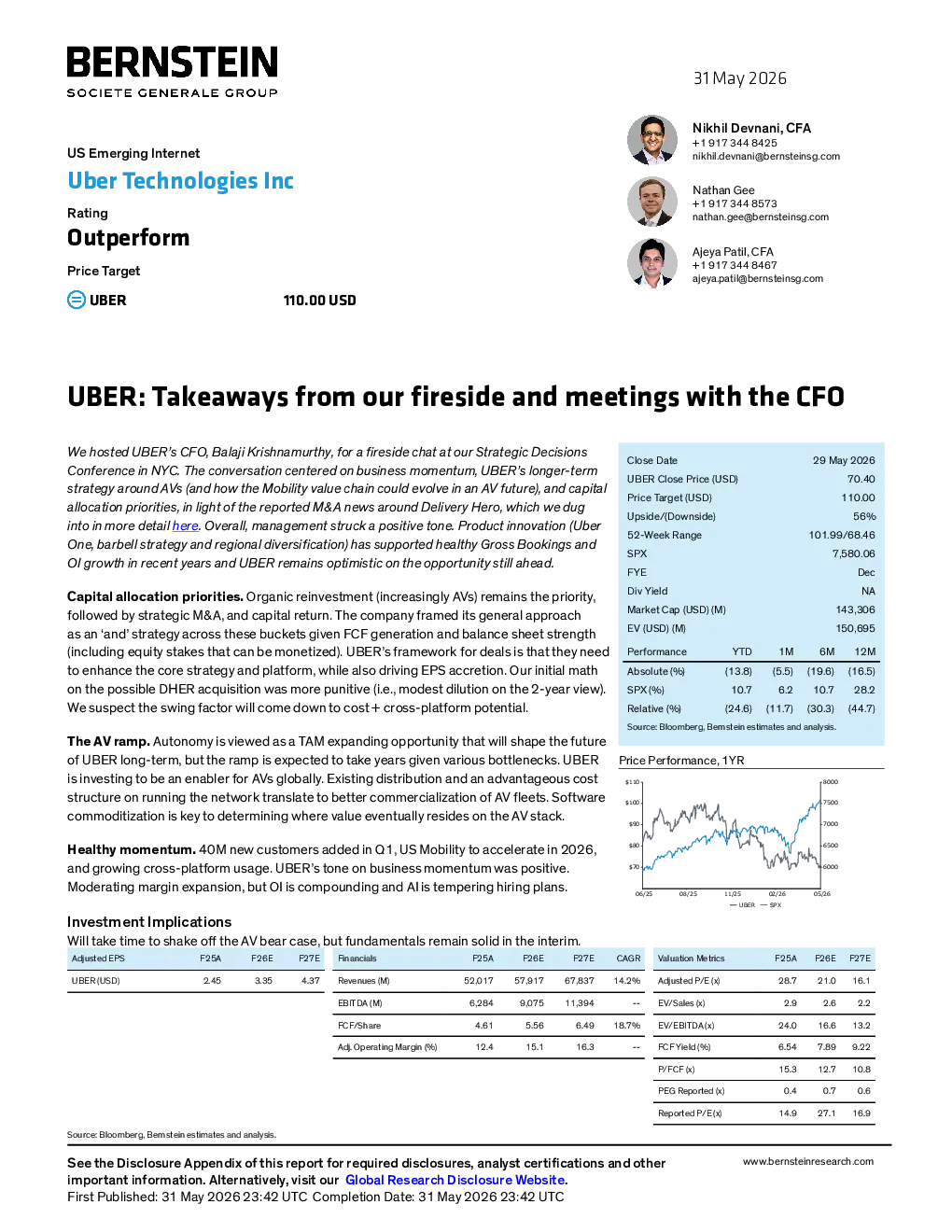
+1 917 344 8425nikhil.devnani@bernsteinsg.com尼基尔·德瓦纳尼,CFA 美国新兴互联网优步技术公司 Nathan Gee+1 917 344 8573nathan.gee@bernsteinsg.com 评级:表现优于 +1 917 344 8467ajeya.patil@bernsteinsg.com阿杰亚·帕蒂尔,CFA 目标价位 110.00 USD UBER 优步:与CFO围炉座谈及会晤的收获 我们在纽约市的战略决策会议上,邀请了优步首席财务官巴拉吉·克里希南穆提进行了一场围炉对话。对话重点围绕业务势头、优步在自动驾驶汽车(AV)方面的长期战略(以及自动驾驶未来移动性价值链可能如何演变),以及资本配置优先事项展开,背景是近期围绕递送英雄(Delivery Hero)的并购报道,我们在此处对其进行了更详细的探讨。总体而言,管理层传递出积极的基调。近年来,产品创新(优步一号、哑铃战略和区域多元化)支持了健康的总预订额和运营利润增长,优步对前方仍存在的机遇保持乐观。 70.40110.00Upside/(Downside)56%101.99/68.46SPX7,580.06FYEDecNA143,306150,695截止日期优步收盘价(美元)目标价位 (美元)52周区间股息率市值(美元)(百万)EV(美元)(百万)2026年5月29日 资本配置优先级。有机再投资(越来越多地涉及自动驾驶汽车)仍然是优先事项,其次是战略并购,以及资本回报。该公司将其总体方法描述为在这些类别中采用“并”策略,鉴于自由现金流产生和资产负债表实力(包括可变现的股权投资)。Uber的交易框架是,这些交易需要增强核心战略和平台,同时也要推动每股收益增长。我们对DHER可能收购的初步计算更为苛刻(即,对未来两年的适度摊薄)。我们推测,关键因素将取决于成本和跨平台潜力。 自动驾驶(AV)的扩展计划。自主性被视为一个技术采用(TAM)扩展的机会,它将长期塑造Uber的未来,但考虑到各种瓶颈,该扩展计划的实施预计需要数年时间。Uber正投资成为全球自动驾驶汽车的推动者。现有的分销渠道以及在运营网络上的有利成本结构有助于提升自动驾驶汽车队的商业化水平。软件的标准化是决定自动驾驶技术栈最终价值所在的关键因素。 健康势头。第一季度新增4000万用户,美国移动业务将于2026年加速,跨平台使用量持续增长。优步对业务势头持积极态度。利润率扩张有所放缓,但运营利润在复合增长,人工智能则在调节招聘计划。 投资启示 需要时间摆脱熊市阴影,但期间基本面依然稳固。 细节 我们与优步首席财务官巴拉吉·克里希南穆提进行炉边聊天和会议的要点 • 预计情况将延续。我们目前处于2024年投资者日所提供的三年框架管理的最后一年,业务仍按计划进行。展望未来,投资者应继续预期情况将延续。Balaji长期以来积极参与塑造Uber的战略,并负责运营出行和配送业务的损益,他无意进行重大变革,而是继续投资和创新,以推动健康的总预订额和运营利润增长。虽然Uber不会提供季度之后的指引,但其雄心似乎是尽可能长时间地维持中高 teens 的总预订额增长,同时持续扩大利润率。鉴于目前的较高起点和针对出行与配送增长机会的自有投资,预计利润率提升的速度将比往年有所放缓。我们认为,在强劲增长的基础上,运营利润存在上调的空间。 • 资本配置与并购框架……管理层 overarching 的资本配置策略如下:(1)有机再投资(目前包括 AV 投资);(2)战略性并购;(3)资本回报。在此框架内,并购的具体要求是:资产首先必须增强 Uber 的有机发展,扩大 TAM(潜在市场总额),并契合公司的核心战略。此外,任何交易都需要从监管审批和股东批准到整合环节都有清晰的路线图,并且要对调整后每股收益(adjusted EPS)产生正面影响,同时以合理的价格进行。虽然关于取舍(我们自己也提出过类似问题)有很多讨论,但 Balaji 将 Uber 的资本配置方法描述为一种“和”策略,即在三个核心原则之间都能坚持。我们认为 DHER 的任何潜在收购很可能主要依赖债务融资。将部分 80-90 亿美元的股权股份变现也是一种可能性(即,用于支持股票回购)。 • 以及 Delivery Hero。Uber 目前持有 Delivery Hero 约 37% 的股份,这使其能够参与公司未来任何战略决策。就该资产的吸引力而言,管理层指出了一些互补的地理区域,例如中东和阿根廷(移动业务强劲,但配送业务不显著),以及韩国(对 Uber 来说是新兴市场,配送业务可能是其最初的切入点)。我们在 Uber x DHER 深度分析中(附带预测损益表)提供了市场重叠的全面概述。从战略/长期来看,这很有趣,而且全球范围内还有稀缺的配送资产可以整合。我们的犹豫更多是关于时机和摊薄风险(我们估计第一年为 -MSD% 至 -HSD%,第二年为 -LSD%)。现阶段,我们尚未从公司获得详细信息,但考虑到 Uber 只想进行盈利性交易,我们可以想到两个关键因素来弥合我们的摊薄计算结果与该预期之间的差距。首先,我们的计算是基于 GAAP 每股收益并包含了交易摊销,虽然是非现金项目(将其加回将使调整后每股收益实现正向增长)。其次,也是更根本/重要的一点,协同效应——我们在初始计算中对研发和销售及管理费用进行了 10% 的简化处理,但考虑到 DHER 业务庞杂且具有整合历史,在 Uber 的控股下,可以论证进行更大规模的成本合理化和变现,这将改善预测经济指标。我们在这方面需要做更多工作。利用 Uber 的技术栈将非常重要,这有助于避免技术债务并推动产品创新,以及将这些资产无缝整合到会员套餐/跨平台推广中。 • 核心业务势头持续向好。总体而言,我们认为Uber在出行和配送两大业务板块的业务势头方面表现积极。用户获取漏斗似乎运行良好——2026年第一季度,Uber在新平台上新增了4000万用户,较三年前增长了40%,考虑到核心应用今天的规模和普及度,这一成绩令人印象深刻。在出行业务中,25%的新用户来自两端(即经济型和高端出行),向稀疏市场的拓展也扩大了业务机会。在用户群体层面,Balaji指出,得益于Uber One的采用,用户留存和参与度趋势强劲。Uber重申其对美国出行业务总预订额和2026年出行量加速增长的信心,主要受以下因素驱动:(1) 加利福尼亚州监管变化带来的保险成本节省;(2) 3月份保险续约的增幅在可控范围内;(3) 新增长引擎的强劲表现(包括经济型出行模式如Wait & Save、高端出行、企业版Uber,以及稀疏市场扩张速度是密集市场的两倍)。虽然燃油附加费值得关注,但似乎尚未对需求或供应趋势产生重大影响,平台正为司机提供支持。 • 跨平台使用尚处早期阶段。目前,符合资格的优步用户中,仅有约20%会定期同时使用出行与配送两大平台(优步一档会员中为40%,在顶尖市场中则超过25%)。优步至今观察到的跨平台使用情况,更多是公司建立起出行与配送服务后用户自然行为的结果,而非公司有组织的推动——后者现在才是重点。出行与配送领域的高质量独立服务提供了基础。随后是优步一档会员计划,以及对其进行的额外投资 这些细分市场内部的垂直领域(例如,杂货与零售),以及像通用搜索这样的新产品创新,可以进一步培养用户将消费集中到UBER的行为习惯。 • 自动驾驶汽车(AV)的规模化管理将自动驾驶汽车视为一种结构性供应释放,通过降低价格和提高可靠性,能够显著扩大整体交通出行市场。近期推出的包括在拉斯维加斯的Zoox(第三季度)和由YE26在湾区推出的Nuro,Wayve和Nvidia也在积极跟进。然而,规模化需要时间,在未来五年内,自动驾驶汽车可能仍将占行业总量的较小比例。为提供背景信息,目前自动驾驶汽车市场每年提供约5000万次行程,而Uber则提供150亿次行程,每年增长30亿次(我们估计Uber今年全球交通出行次数为125亿次)。传统拼车业务轻资产的特性,促成了Uber在早期约7年内每年规模扩大9倍。这对自动驾驶汽车来说更难,并且仍然存在一些障碍——(1)软件能力;(2)监管问题,几个蓝色州在劳工问题上持反对态度;(3)车队和仓库的物理基础设施;(4)原始设备制造商(OEM)合作伙伴关系;以及(5)融资。然而,展望2030年代,随着这些各种限制逐渐放宽,自动驾驶汽车预计将产生更深远的影响。 • 五层自动驾驶技术栈及优步的市场角色。优步视其为市场中的多层技术栈,包含不同的排列组合:(1) 面向消费者的网络,如优步;(2) 自动驾驶软件提供商;(3) 代工原始设备制造商(OEM);(4) 车队运营商和资产所有者;以及 (5) 融资合作伙伴。提供商可以选择专注于特定层级(例如,Wayve作为软件提供商),或进行全栈垂直整合(例如,特斯拉或Zoox)。优步将其在生态系统中的角色分为两个阶段。在第一阶段,优步更积极地参与其中,利用其资产负债表支持自动驾驶技术合作伙伴、OEM、早期基础设施建设,甚至通过优步自动驾驶解决方案收集现实世界数据(预计到2026年底将收集约200万英里/月)。值得关注的领域包括为自动驾驶公司提供股权融资和OEM交易——这些安排取决于与可转让汽车所有权的里程碑挂钩。在第二阶段,当生态系统开始运行时,优步预计将保持轻资产模式,车辆和物理基础设施将由第三方融资。收入的产生(优步在这方面有清晰的预期)、成本曲线、车辆生命周期和残值是解锁融资的关键决定因素,尽管相关的对话已经展开(参见桑坦德银行合作)。 • AI带来的益处正变得越来越具体。AI的采用规模迅速扩大(95%的工程师都在使用AI工具;超过10%的代码在工程师审查前就由AI自动生成)。虽然目前还难以精确追踪每次利用AI所带来的具体提升(例如,公司难以像对面向消费者的项目进行典型A/B测试那样追踪每项AI应用的具体效果),但生产力提升的大方向是积极的。这使优步能够调整2026年下半年的招聘计划,我们预计将看到固定成本得到有效利用。在面向消费者的方面,AI在客户支持(降低成本、改善结果)方面带来了早期效益,并能够实现新的面向消费者的体验(例如,购物车助手)。 附录 - 财务预测 图1:我们的Uber盈利模式 披露附录 I. 强制性披露 “Bernstein”或“公司”在这些披露中的指代关系如下:Bernstein Institutional Services LLC(自2024年4月1日起)、SanfordC. Bernstein & Co., LLC(2024年4月1日前)、Bernstein Autonomous LLP、BSG France S.A.(自2024年4月1日起)、盛博香港有限公司、Sanford C. Bernstein (Canada) Limited、Sanford C. Bernstein (India) Private Limited(印度证券交易委员会注册号:INH000006378)、Sanford C. Bernstein (Singapore) Private Limited、Sanford C. Bernstein Japan KK(サンフォード・C・バーンスタイン株式会社)以及受Société Générale Africa Technologies & Services雇佣、根据Bernstein与Société Générale之间达成的全球服务协议进行Bernstein研究的人员。 伯恩斯坦是法国兴业银行(SG)和联盟伯恩斯坦有限责任公司(AB)组建的合资企业的一部分。除非另有说明,根据本披露的目的,提及伯恩斯坦的“关联方”均指SG和AB及其各自的关联方。 评估方法 优步技术公司 我们采用 NTM P/FCF 18 倍与 DCF(使用 12% WACC 和 3% 终端增长率)相结合的 50/50 比例来评估 Uber。我们的目标价 110 美元是按完全稀释