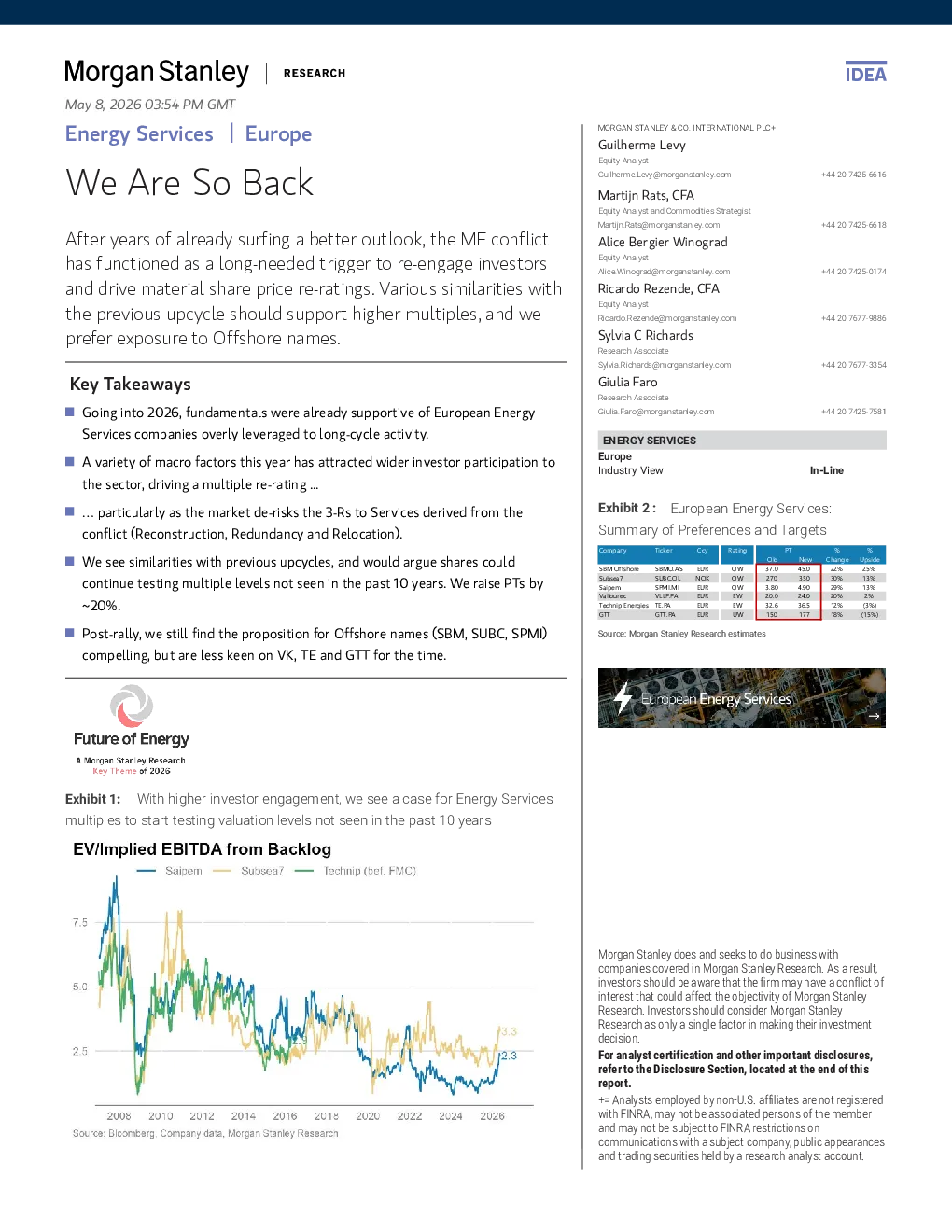
Energy Services| Europe We Are So Back Martijn Rats, CFAEquity Analyst and Commodities StrategistMartijn.Rats@morganstanley.com +44 20 7425-6618 After years of already surfing a better outlook, the ME conflicthas functioned as a long-needed trigger to re-engage investorsand drive material share price re-ratings. Various similarities with Alice Bergier WinogradEquity AnalystAlice.Winograd@morganstanley.com+44 20 7425-0174 Ricardo Rezende, CFAEquity AnalystRicardo.Rezende@morganstanley.com Key Takeaways Going into 2026, fundamentals were already supportive of European EnergyServices companies overly leveraged to long-cycle activity. Energy Services A variety of macro factors this year has attracted wider investor participation tothe sector, driving a multiple re-rating ... … particularly as the market de-risks the 3-Rs to Services derived from theconflict (Reconstruction, Redundancy and Relocation). We see similarities with previous upcycles, and would argue shares couldcontinue testing multiple levels not seen in the past 10 years. We raise PTs by Post-rally, we still find the proposition for Offshore names (SBM, SUBC, SPMI)compelling, but are less keen on VK, TE and GTT for the time. Exhibit 1:With higher investor engagement, we see a case for Energy Servicesmultiples to start testing valuation levels not seen in the past 10 years Morgan Stanley does and seeks to do business withcompanies covered in Morgan Stanley Research. As a result,investors should be aware that the firm may have a conflict ofinterest that could affect the objectivity of Morgan StanleyResearch. Investors should consider Morgan Stanley For analyst certification and other important disclosures,refer to the Disclosure Section, located at the end of thisreport. += Analysts employed by non-U.S. affiliates are not registeredwith FINRA, may not be associated persons of the memberand may not be subject to FINRA restrictions oncommunications with a subject company, public appearancesand trading securities held by a research analyst account. Back to Its Place in the Sun European Services have benefitted from a more supportivemacro backdrop in the past couple years ... In mid-2024 we published a note titledAre the Golden Years Back?in which wehighlighted the key factors supporting the case for a sustainable upcycle in the EnergyServices sector. Demand for long-cycle projects, supported by a renewed willingness to Through 2025 and into 2026, many of these fundamentals remained firmly in place, withoffshore activity in particular continuing to show strong momentum. Investor engagementwith the sector, however, remained largely limited to specialist investors, and despite the … but a broader re-rating required wider investorparticipation In 2026, however, a number of macro-driven themes brought the sector back into focus,attracting interest from a broader investor base and driving a meaningful re-rating in shareprices. As discussed inA Mix of Factors at Play, the reopening of Venezuela earlier this Since the start of the current conflict in the Middle East, investor attention on oil & gasinfrastructure has intensified. We highlight three emerging themes: Firstly, the reconstruction of damaged energy infrastructure in the Middle East.In theearly weeks of the conflict, several key pieces of energy infrastructure were reportedlydamaged, including two trains at Qatar’s Ras Laffan LNG facilities, Shell’s Pearl GTL plant, Exhibit 3:Rystad forecasts ~$46bn willbe needed to fix the energy infrastructuredamaged during the ongoing conflict, Estimates for the investment required to restore this infrastructure continue to vary, butRystad estimates that between $34bn and $58bn may be needed ($46bn at the mid-point), with the majority directed toward midstream and downstream facilities rather than Within our coverage, we believe Technip Energies is particularly well positioned to capturea share of this spending, given its existing presence in Qatar and involvement in the NFE,NFS, and NFW projects. Saipem has in recent years reduced its exposure to onshoreactivity in the region due to increasing competition from local and Asian contractors. Technip Energies also noted during its earnings call that a dedicated team has alreadybeen focused on the damaged Qatari trains, although management suggested that anyadditional work could be awarded under PMC contracts rather than traditional lump-sum Secondly, the conflict could accelerate investment in infrastructure redundancy.Sincethe conflict began, two pipelines in particular have come under increased focus: Saudi Exhibit 4:The importance of alternativeroutes from the UAE and Saudi has beenunder the spotlight since the start of the In our view, the conflict is likely to reinforce the strategic importance of alternative exportand offloading routes across the region. This could support additional investment ininfrastructure such as Iraq’s proposed Basra-Haditha pipeline (see Reuters articleher