东帝汶-风险上升,韧性未来:气候和健康脆弱性评估
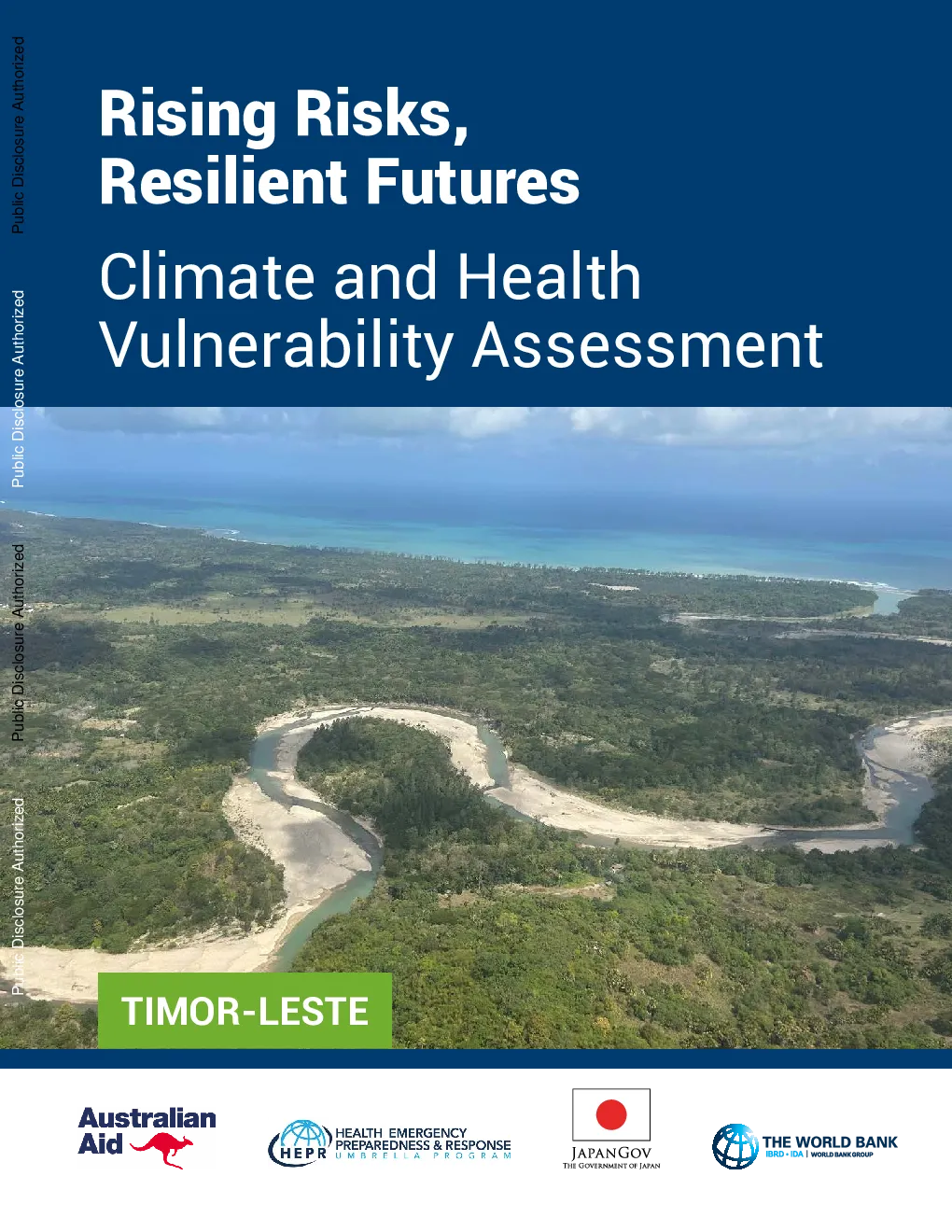
Climate and HealthVulnerability Assessment © 2026 International Bank for Reconstruction and Development/The World Bank 1818 H Street NWWashington DC 20433Telephone: 202-473-1000Internet:www.worldbank.org The findings, interpretations, and conclusions expressed in this work do not necessarily reflectthe views of the World Bank, its Board of Executive Directors, or the governments they represent. The World Bank does not guarantee the accuracy of the data included in this work. Theboundaries, colors, denominations, and other information shown on any map in this work do notimply any judgment on the part of the World Bank concerning the legal status of any territory, orthe endorsement or acceptance of such boundaries. Rights and Permissions The material in this work is subject to copyright. The World Bank encourages the dissemina-tion of its knowledge; thus this work may be reproduced, in whole or in part, for noncommercialpurposes, as long as full attribution to this work is given. Any queries on rights and licenses, including subsidiary rights, should be addressed toWorld Bank Publications, The World Bank Group, 1818 H Street NW, Washington, DC 20433, USA;fax: 202-522-2625; e-mail:pubrights@worldbank.org. Cover image: Landscape. Timor-Leste. Photo: Naoko Ohno / World Bank Rising Risks,ResilientFutures Climateand HealthVulnerabilityAssessment Contents List of AbbreviationsAcknowledgmentsExecutive SummaryKey Concepts and MetricsIntroduction SECTION IClimate Risks Rising Temperatures and Extreme HeatIntensifying Rainfall and Escalating Flood RiskLandslidesDroughtSea Level RiseTropical CyclonesLand Use ChangePolicy Implications SECTION IIThe Rising Burden of Climate-Sensitive Health Conditions andImpacts on Economic Growth and Human Capital 10 Vector-Borne Diseases (Dengue and Malaria)12Cardiovascular Diseases (Stroke and IHD)14Waterborne Diseases (Diarrheal Diseases)16Malnutrition (Stunting)17Heat-Related Illnesses18Respiratory Illnesses19Policy Implications20 SECTION IIIImpact of Climate Shocks on Health Infrastructure Facility AccessibilityFloodsLandslidesTropical CyclonesExtreme HeatExposure to Multiple Climate HazardsPolicy Implications SECTION IVHealth Service Pathways and Programs35 Vector-Borne Diseases36Cardiovascular Diseases (IHD and Stroke)37Waterborne Diseases (Diarrheal Diseases)38Malnutrition (Stunting)38Heat-Related Illnesses (Neonatal Mortality)39Respiratory Illnesses (LRIs and COPD)39Policy Implications39 SECTION VService Delivery Inputs to Strengthen System Resilience Infrastructure and FacilitiesElectricitySafe WaterWorkforcePharmaceutical, Medical, and Associated SuppliesDigital Infrastructure and RecordkeepingPolicy Implications 42424244454748 SECTION VIHealth System Enabling Structures and Functions 49 System Governance and Leadership50Regulation, Training, and Development of the Health Workforce50Financing, Financial Flows, and Payments51Policy Implications53 SECTION VIIRecommendations Action Area 1: Investing in Climate-Resilient Health Infrastructure57Action Area 2: Climate-Proofing Health Workforce Development58Action Area 3:Enhancing digital, financial management, procurement, and supplysystems for climate-related health risks60Action Area 4: Strengthening Health Emergency Preparedness and Response62 Conclusion Appendices Appendix A. Methodology64Appendix B. Technical Report: Climate Risks72Appendix C. Technical Report: Impact of Climate Shocks on Health Infrastructure84Appendix D. Technical Report: Impact on Climate-Sensitive Health Conditions104Appendix E. Prioritization of Recommendations117 References 118 Figures Figure 1Administrative Boundaries of Timor-LestexxFigure 2Population Exposure to Floods, 20504Figure 3Land Cover Changes, 2016–20248Figure 4Health System Tiers in Timor-Leste24Figure 5Seasonal Differences in Facility Accessibility26Figure 6Health Facility Exposure to 100-Year Floods (15+ cm), 2050 (SSP3-7.0)27Figure 7Municipality-Level Bivariate Proportional Exposure (Population and Health Facilities),100-Year Flood Levels of at Least 15 cm, 2050 (SSP3-7.0)28Figure 8Health Facility Exposure to Rainfall-Triggered Landslides, 2061–2100 (SSP5-8.5)29Figure 9Health Facility Exposure to Category 1 Wind Speeds (29 m/s), 300-Year Return Level in2015–2050 (SSP3-7.0)30Figure 10Health Facility Exposure to High Heat (35°C Heat Index) at Least 25 Days per Year, 2050 (SSP3-7.0)31Figure 11Health Facility Exposure to Multiple Hydrometeorological Hazards33Figure 12Proportion of Health Facilities with Connection to the Central Supply Electricity Grid,by Municipality and Facility Type43Figure 13Density of Health Professionals, by Municipality44Figure 14Percentage of Available and Functional Equipment in HPs, 2015 and 202447Figure 15Health Spending Share of GDP (%) and Per Capita Health Spending (US$) in Timor-Leste andPeer Countries52Figure 16MoH Budget Allocation 2018–2020, Nominal and Percent Values53Figure B.1Proportion of Population Exposed to High Heat