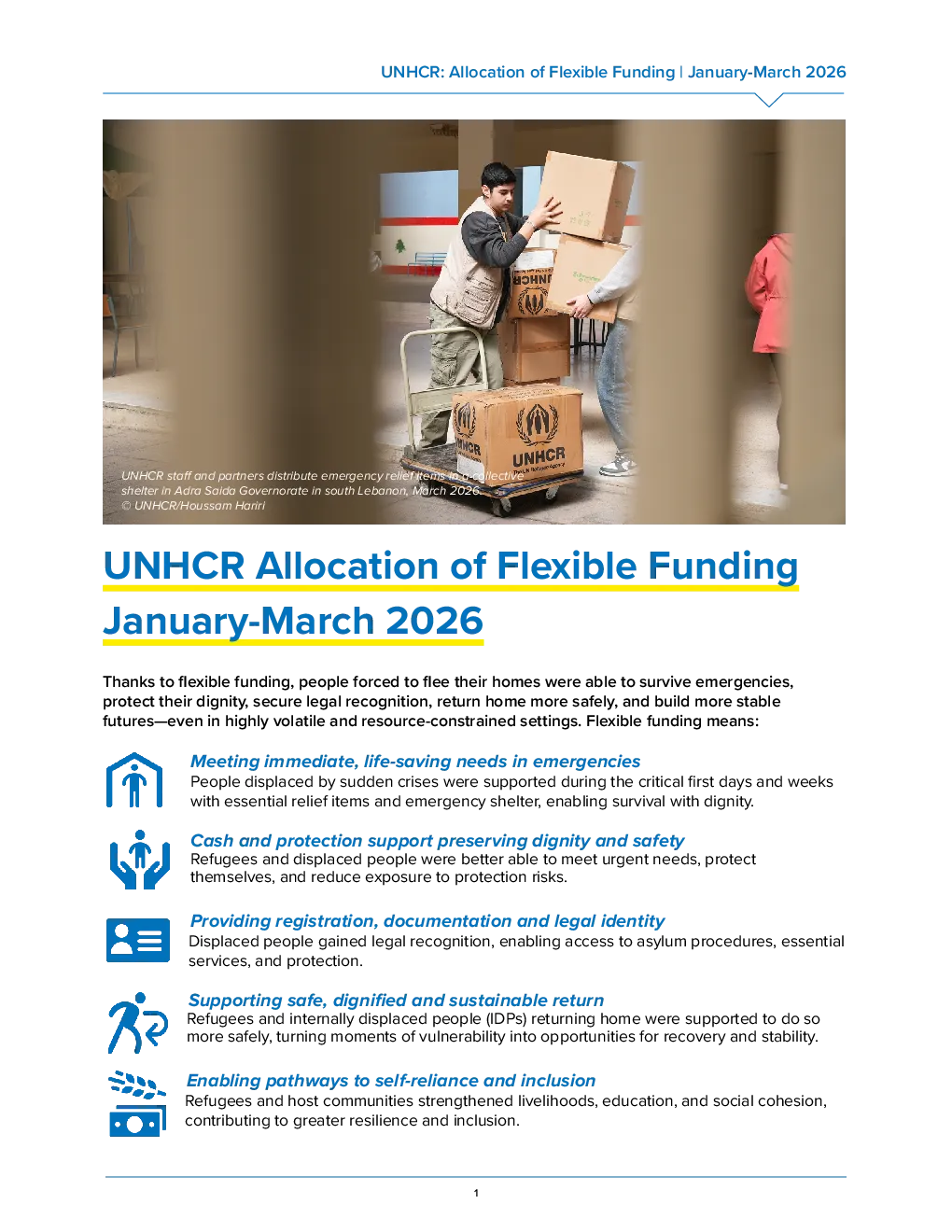
UNHCR Allocation of Flexible FundingJanuary-March 2026 Thanks to flexible funding, people forced to flee their homes were able to survive emergencies,protect their dignity, secure legal recognition, return home more safely, and build more stablefutures—even in highly volatile and resource-constrained settings. Flexible funding means: Meeting immediate, life-saving needs in emergenciesPeople displaced by sudden crises were supported during the critical first days and weeks with essential relief items and emergency shelter, enabling survival with dignity. Cash and protection support preserving dignity and safetyRefugees and displaced people were better able to meet urgent needs, protectthemselves, and reduce exposure to protection risks. Providing registration, documentation and legal identityDisplaced people gained legal recognition, enabling access to asylum procedures, essential services, and protection. Supporting safe, dignified and sustainable returnRefugees and internally displaced people (IDPs) returning home were supported to do so more safely, turning moments of vulnerability into opportunities for recovery and stability. Enabling pathways to self-reliance and inclusionRefugees and host communities strengthened livelihoods, education, and social cohesion, contributing to greater resilience and inclusion. Where Flexible Funding Made an Impact The following operations received the highest allocations of flexible funding during the first quarterof 2026. The examples below illustrate how UNHCR delivered protection and assistance across the Lebanon Flexible funding allocation: $28.9M Flexible funding supported the emergency response following the escalation of hostilities across Asiaand the Middle East beginning on 28 February 2026. Meeting immediate, life-saving needs in emergencies:•230,000 essential relief items distributed in collective shelters, reaching 83,000 displacedpeople. Cash and protection support preserving dignity and safety:•18,000 refugees received recurrent and one-off emergency protection cash assistance. •More than 7,500 people reached through awareness sessions and psychosocial support.•Approximately 28,000 people accessed protection services through Community DevelopmentCentres nationwide. Afghanistan Flexible funding allocation: $24.65M Flexible funding was critical to sustaining the response to large-scale returns from Iran and Pakistan,which began prior to 2026 and often occurring under adverse conditions, placing significant pressureon border reception and reintegration services. Protection support for the most vulnerable:•More than 8,000 vulnerable people identified and referred for protection case management through UNHCR feedback and response systems. Supporting safe, dignified and sustainable return:•70,000 refugees received UNHCR assistance upon return to Afghanistan, more than half ofwhom were women and girls. Uganda Flexible funding allocation: $20.82M Flexible funding supported essential protection and assistance for new arrivals, as well as nearly twomillion refugees hosted across settlements. UNHCR: Allocation of Flexible Funding | January-March 2026 •Regular water quality sampling conducted to guide chlorination and risk-mitigation measures. Enabling pathways to self-reliance and inclusion:•More than 18,000 refugee and host community children supported to attend primary school •3,500 teachers, school administrators, and staff received monthly incentives.•25,000 school kits distributed•More than 6,000 hectares of agricultural land secured across six sites through official landtenure agreements. Burundi Flexible funding allocation: $18.53M Flexible funding enabled UNHCR to respond to two concurrent emergencies: the arrival of more than100,000 refugees from the DRC in December 2025 and the return of Burundian refugee from Tanzaniabeginning in January 2026. Supporting safe, dignified and sustainable return:•62,000 Burundian refugee returnees from Tanzania provided reintegration support. Registration and documentation for refugees securing rights and access to services:•65,000 Congolese refugees relocated from border areas to Busuma refugee site.•65,000 Congolese refugees registered at Busuma refugee site. Syrian Arab Republic Flexible funding allocation: $17.63M Flexible funding enabled UNHCR and partners to rapidly support returnees, address immediateprotection and assistance needs, and strengthen reintegration responses amid rapidly evolvingconditions. Meeting immediate, life-saving needs:•25,000 individuals received emergency relief items. •8,000 individuals received targeted winter support.•Almost 300 families in north-east Syria supported with family tents and more than 3,500 familiesprovided with tarpaulins for emergency shelter.•1,000 houses assessed for shelter repair, to benefit 5,000 people. Supporting safe, dignified and sustainable return:•6,000 refugee returnee families received a one-off return and reintegration gran