您的浏览器禁用了JavaScript(一种计算机语言,用以实现您与网页的交互),请解除该禁用,或者联系我们。 [国际公共交通协会]:印度步入正轨:印度城市轨道交通的增长故事 - 发现报告

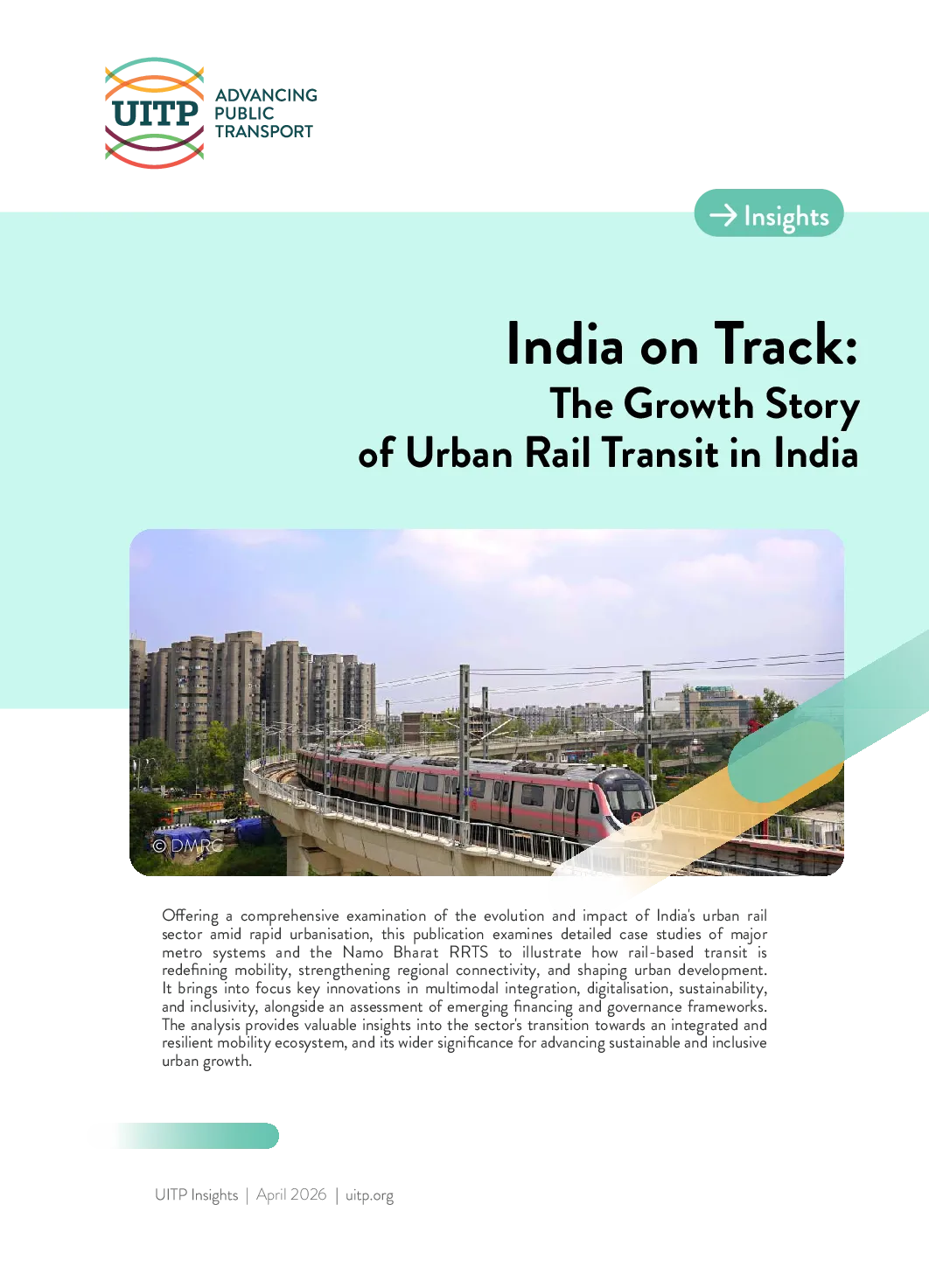
印度步入正轨:印度城市轨道交通的增长故事

报告封面

April 2026 01Introduction 21Conclusion – Way Forward 010203National Policy Shaping the Futureof Urban RailTrajectory of Urban Rail in IndiaThe New Era of Urban Rail in India 2326Metro DivisionRegional and Suburban Railways Divison26Light Rail/Trams Division23UITP at Members' Service 04 Case Studies 04Delhi Metro Rail CorporationLimited (DMRC) 07Bangalore Metro Rail CorporationLimited (BMRCL) – Namma Metro 1108Chennai Metro Rail Limited (CMRL)Kochi Metro Rail Limited (KMRL) 13Uttar Pradesh Metro Rail CorporationLimited (UPMRCL) - Lucknow Metro 15Maharashtra Metro Rail CorporationLimited – Maha Metro 1921Key Trends Observed in the CaseStudiesNational Capital Region TransportCorporation (NCRTC) Introduction India's transport landscape has undergone a significant transformation over the past fewdecades, driven by rapid urbanisation, economic growth, and the risingdemand forecient mobility solutions. This rapid urban expansion has been accompanied by challengessuch as trac congestion, air pollution, long commute times, and a declining quality of urbanlife. Over the years, intra-urban mobility in India has evolved from a system largely reliant onbuses, Intermediate Public Transport (IPT) such as auto-rickshaws (three-wheeled motorised Amongst the various modes of public transport, metro rail has emerged as a central element ofurban transport planning, providing fast, reliable, and high-capacity connectivity whilecontributing to more sustainable patterns of urban mobility. In this context, rail-based masstransit has become an important pillar of sustainable urban development. Theevolution of With India attaining the landmark milestone of surpassing 1,000 kilometres of metro railnetwork in January 2025, this paper presents an overview of the evolution, expansion, andtransformative impact of urban rail systems across the country. It further highlights selected Trajectory of Urban Rail in India National Policy Shaping the Future of Urban Rail A decisive acceleration in metro rail development in India occurred with the introduction ofthe Metro Rail Policy in 2017 . The policy defined metro rail as a fully segregated, rail-basediii mass transit system that may operate at grade, on elevated structures, or underground, andowing to its dedicated right-of-way and advanced system technology, it can support very highpassenger capacities of approximately 40,000–80,000 passengers per hour per direction(PPHPD). Monorails have been classified in the Policy as a type of metro rail that generallyoers lower capacities and entail higher maintenance costs; while regional rail has been definedas a passenger rail system serving a metropolitan area by connecting suburban and peripheral The Metro Rail Policy emphasised multimodal integration, value capture financing, and privatesector participation, while also linking metro approval to comprehensive mobility planning atthe city level. As a result, the pace of construction and commissioning increased substantially. across 26 cities in the country . This rapid expansion has positioned India as the third-largestmetro rail network in the world, behind only China and the United States of America .iv World Records Set by Metro Rail in India Delhi Metro made global history as the world’s rst railway network to earn carbon credits fromthe United Nations for cutting greenhouse gas emissionsviii.Hyderabad Metro Rail stands as the world’s largest PPP project in the metro rail sector, as of2025.Maha Metro seta Guinness World Record in Nagpur by constructing the world’s longestdouble-decker viaduct of 3.14 kilometres long, supporting both a highway yover and a metro 1. Delhi Metro Rail Corporation Limited (DMRC) Key transferable practices Financial resilience through revenue diversification:Reduce dependence on fare-boxrevenue by monetising real estate, station retail, advertising, parking, and consultancy servicesby transforming transit infrastructure into a sustainable, asset-backed revenue ecosystem.Climate-aligned and data-driven operations:Integrate renewable energy and carbon creditmechanisms, supported by strong digital integration and data-driven decision making formeasurable environmental and socio-economic impact reporting and clear long-termdecarbonisation targets.Inclusive and integrated urban mobility:Expand networks strategically to connect underservedareas with embedding universal accessibility to promote equitable, socially inclusive mobility. 2. Bangalore Metro Rail Corporation Limited (BMRCL) – NammaMetro Key transferable practices Environmentally sensitive infrastructure development:Implement strategies that blend in with the localenvironment like adopt high compensatory plantationratios, and integrate corridor greening, median gardens,and urban beautification to preserve ecological identity 3. Chennai Metro Rail Limited (CMRL)Chennai Metro has increasingly evolved into a critical component of the city's urban mobility Socio-economic and environ