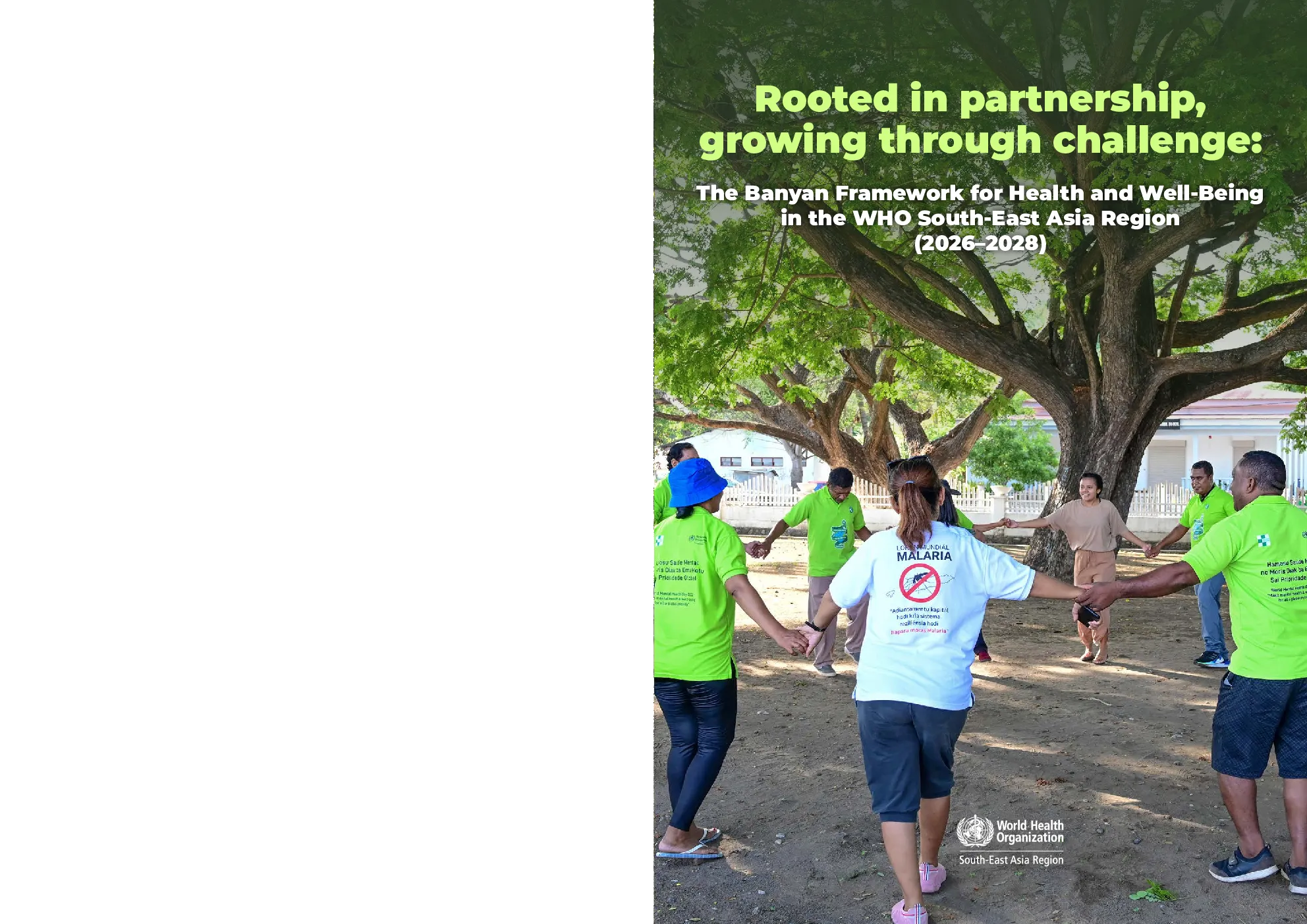
The Banyan Framework for Health and Well-Beingin the WHO South-East Asia Region(2026–2028) Rooted in partnership, The Banyan Framework forHealth and Well-Being in the Contents Executive summaryi PART 11 Why we must act1 Rooted in partnership, growing through challenge: The Banyan Framework for Health and Well-Being in the WHOSouth-East Asia Region (2026–2028) ISBN: 9789290222620 PART 220 © World Health Organization 2026 Some rights reserved. This work is available under the Creative Commons Attribution-NonCommercial-ShareAlike 3.0IGO licence (CC BY-NC-SA 3.0 IGO;https://creativecommons.org/licenses/by-nc-sa/3.0/igo). The Region’s roots: foundations for impact Under the terms of this licence, you may copy, redistribute and adapt the work for non-commercial purposes, providedthe work is appropriately cited, as indicated below. In any use of this work, there should be no suggestion that WHOendorses any specific organization, products or services. The use of the WHO logo is not permitted. If you adaptthe work, then you must license your work under the same or equivalent Creative Commons licence. If you create atranslation of this work, you should add the following disclaimer along with the suggested citation: “This translationwas not created by the World Health Organization (WHO). WHO is not responsible for the content or accuracy of thistranslation. The original English edition shall be the binding and authentic edition”. 24 times of challenge Where we reach, what we achieve30 Any mediation relating to disputes arising under the licence shall be conducted in accordance with the mediation rulesof the World Intellectual Property Organization. Suggested citation. Rooted in partnership, growing through challenge: The Banyan Framework for Health and Well-Being in the WHO South-East Asia Region (2026–2028). New Delhi: World Health Organization, Regional Office forSouth-East Asia; 2026. Licence: CC BY-NC-SA 3.0 IGO. Real-time responsiveness and renewal: 34 Cataloguing-in-Publication (CIP) data. CIP data are available athttp://apps.who.int/iris. Sales, rights and licensing. To purchase WHO publications, seehttp://apps.who.int/bookorders. To submit requests forcommercial use and queries on rights and licensing, seehttp://www.who.int/about/licensing. Third-party materials. If you wish to reuse material from this work that is attributed to a third party, such as tables, figuresor images, it is your responsibility to determine whether permission is needed for that reuse and to obtain permission PART 337 General disclaimers. The designations employed and the presentation of the material in this publication do notimply the expression of any opinion whatsoever on the part of WHO concerning the legal status of any country,territory, city or area or of its authorities, or concerning the delimitation of its frontiers or boundaries. Dottedand dashed lines on maps represent approximate border lines for which there may not yet be full agreement. Evaluating impact: the ‘Banyan Results Financing the impact: resource requirements All reasonable precautions have been taken by WHO to verify the information contained in this publication. However,the published material is being distributed without warranty of any kind, either expressed or implied. The responsibilityfor the interpretation and use of the material lies with the reader. In no event shall WHO be liable for damages arising Printed in India Executive summary A decisive period for health in South-East Asia The WHO South-East Asia Region enters 2026–2028 at a pivotal moment. Overthe past decade, countries of the Region have achieved measurable progress. Theaverage UHC Service Coverage Index increased from 53 to 68. Financial hardship inhealth declined. The Region has achieved more than 20 disease eliminations since Progressand These achievements reflect sustained political leadership, national investment and Yet the foundations remain under strain. More than 30% of the population continues to experience financial hardshipdue to health spending. The Region accounts for 34% of global tuberculosis (TB)cases and 40% of TB deaths. The probability of premature mortality from majornoncommunicable diseases (NCDs) remains 22.3%, the highest among WHO regions.Climate shocks are intensifying. Emergency risks are converging. Concessional The Banyan Framework Inspired by the banyan tree – a symbol of protection, resilience and shared strengthacross the Region – the Banyan Framework aligns WHO, Member States and partners It defines how collective effort will protect hard-won gains, strengthen resilienceand accelerate progress toward universal health coverage (UHC), health securityand the health-related Sustainable Development Goals (SDGs). It is well aligned withongoing discussions on global health architecture and the ambitions of the UN80Initiative, particularly its emphasis on greater efficiency, integration and impact Investment focuses on workforce,