CoreWeave (CRWV):实现2026年AOI指引需要哪些条件
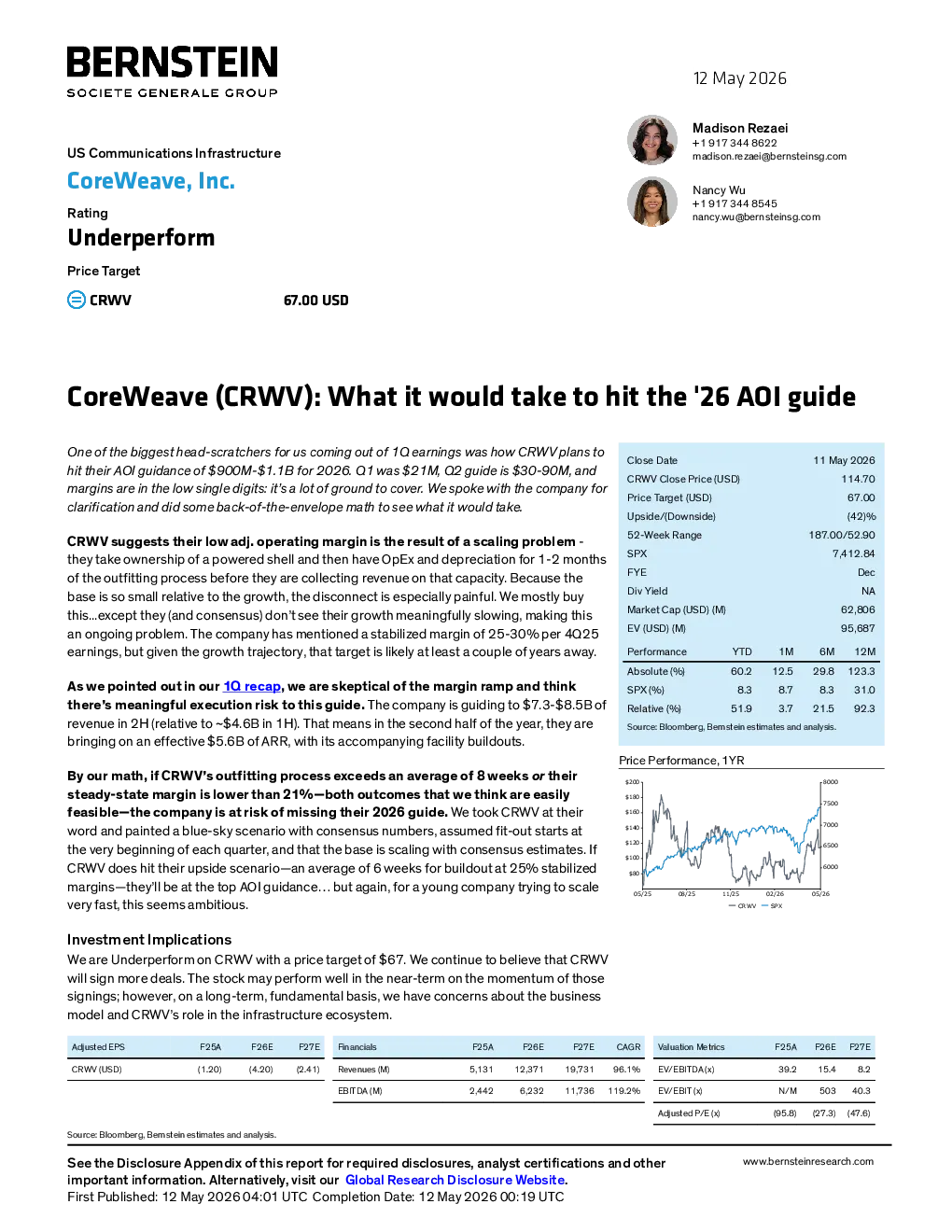
Madison Rezaei+1 917 344 8622madison.rezaei@bernsteinsg.com Nancy Wu+1 917 344 8545nancy.wu@bernsteinsg.com Price Target CRWV 67.00 USD CoreWeave (CRWV): What it would take to hit the '26 AOI guide One of the biggest head-scratchers for us coming out of 1Q earnings was how CRWV plans tohit their AOI guidance of $900M-$1.1B for 2026. Q1 was $21M, Q2 guide is $30-90M, andmargins are in the low single digits: it’s a lot of ground to cover. We spoke with the company forclarification and did some back-of-the-envelope math to see what it would take. Close Date11 May 2026CRWV Close Price (USD)114.70Price Target (USD)67.00Upside/(Downside)(42)%52-Week Range187.00/52.90SPX7,412.84FYEDecDiv YieldNAMarket Cap (USD) (M)62,806EV (USD) (M)95,687 CRWV suggests their low adj. operating margin is the result of a scaling problem-they take ownership of a powered shell and then have OpEx and depreciation for 1-2 monthsof the outfitting process before they are collecting revenue on that capacity. Because thebase is so small relative to the growth, the disconnect is especially painful. We mostly buythis...except they (and consensus) don’t see their growth meaningfully slowing, making thisan ongoing problem. The company has mentioned a stabilized margin of 25-30% per 4Q25earnings, but given the growth trajectory, that target is likely at least a couple of years away. As we pointed out in our 1Q recap, we are skeptical of the margin ramp and thinkthere’s meaningful execution risk to this guide.The company is guiding to $7.3-$8.5B ofrevenue in 2H (relative to ~$4.6B in 1H). That means in the second half of the year, they arebringing on an effective $5.6B of ARR, with its accompanying facility buildouts. By our math, if CRWV’s outfitting process exceeds an average of 8 weeksortheirsteady-state margin is lower than 21%—both outcomes that we think are easilyfeasible—the company is at risk of missing their 2026 guide.We took CRWV at theirword and painted a blue-sky scenario with consensus numbers, assumed fit-out starts atthe very beginning of each quarter, and that the base is scaling with consensus estimates. IfCRWV does hit their upside scenario—an average of 6 weeks for buildout at 25% stabilizedmargins—they’ll be at the top AOI guidance… but again, for a young company trying to scalevery fast, this seems ambitious. Investment Implications We are Underperform on CRWV with a price target of $67. We continue to believe that CRWVwill sign more deals. The stock may perform well in the near-term on the momentum of thosesignings; however, on a long-term, fundamental basis, we have concerns about the businessmodel and CRWV’s role in the infrastructure ecosystem. DETAILS One of the major questions we have gotten following CoreWeave's 1Q earnings call is the margin dynamic between the fit-outprocess and revenue recognition, and whether CoreWeave can reach its full-year guidance given the rapid ramp that companyguidance lays out. This timing mismatch creates a period where CoreWeave incurs substantial operating costs and capitaldepreciation before generating revenue, compressing near-term margins even as capacity scales. With multiple facilitiescoming online throughout the year, the phasing and duration of this pre-revenue expense period will largely determine whetherCoreWeave can achieve its profitability targets. In this note, we detail the mechanics of the OpEx-revenue lag and run the mathon how it could shape the feasibility of Coreweave’s full-year guidance. To our understanding, the contracting and revenue timeline is anchored to a forward delivery model where customeragreements and equipment procurement are locked in well ahead of site readiness.Upon signing a customer contract—often ~9-12 months prior to go-live—the company concurrently places purchase orders with OEMs (e.g., Dell, Quanta) to secureserver supply, mitigating component price volatility, while customers typically procure GPUs directly. Payment terms on serversare generally net 30-90, meaning cash outflow aligns with physical delivery, which typically occurs several weeks before thedata center shell is ready. In parallel, the powered shell is constructed and delivered shortly before installation, at which pointlease expense, power costs, site OpEx, and depreciation on non-server infrastructure all begin immediately. Once the powered shell is handed over, there is a total of 6–8 weeks before revenue recognition, including an initial ~3-week fit-out period to install networking and prepare the facility, followed by server deployment and testing. Server-relateddepreciation begins after installation, while an additional ~3 weeks is spent troubleshooting and optimizing performance, withon-site procurement teams enabling rapid replacement of faulty units. Revenue recognition begins roughly 6 weeks after sitedelivery, initially at ~80-90% of run-rate capacity in the first 1–2 weeks, ramping to ~99-100% utilization within the first month. By our math, if CRWV’s