China Economy: Global AI boom leads to stronger exports cycle
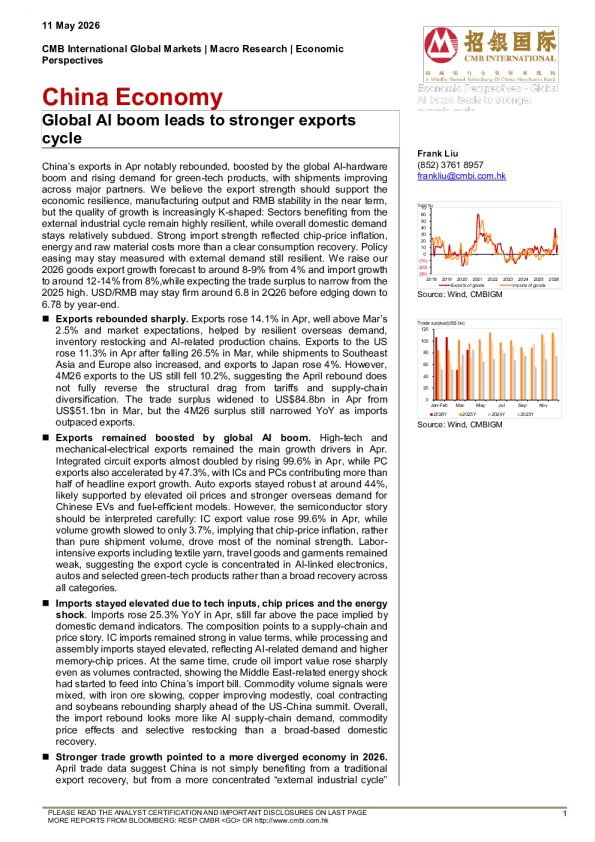
China Economy Global AIboom leads to stronger exportscycle Frank Liu(852) 3761 8957frankliu@cmbi.com.hk China’s exports in Apr notably rebounded, boosted bytheglobal AI-hardwareboom and rising demandforgreen-tech products, with shipments improvingacross major partners.We believe the export strength should support theeconomicresilience, manufacturing output and RMB stability in the near term,but the quality of growth is increasingly K-shaped:Sectors benefiting from theexternal industrial cycle remain highly resilient, while overall domestic demandstays relatively subdued.Strongimport strength reflected chip-price inflation,energyandraw material costsmore than a clearconsumption recovery. Policyeasing may stay measured with external demand stillresilient.We raise our2026 goods export growth forecast to around 8-9%from 4%and import growthto around12-14%from 8%,while expecting the trade surplus to narrow from the2025 high. USD/RMB may stay firm around 6.8 in 2Q26 before edging down to6.78 by year-end. Exports rebounded sharply.Exports rose 14.1% in Apr, well above Mar’s2.5%and market expectations,helped by resilient overseas demand,inventory restocking and AI-related production chains. Exports to the USrose 11.3% in Apr after falling 26.5% in Mar, while shipments to SoutheastAsia and Europe also increased, and exports to Japan rose 4%. However,4M26 exports to the US still fell 10.2%, suggesting the April rebound doesnotfully reverse the structural drag from tariffs and supply-chaindiversification.The trade surplus widened to US$84.8bn in Apr fromUS$51.1bn in Mar, but the 4M26 surplus still narrowed YoY as importsoutpaced exports. Exports remained boosted by global AI boom.High-tech andmechanical-electrical exports remained the main growth drivers in Apr.Integrated circuit exports almost doubledby rising 99.6% in Apr, while PCexports also acceleratedby 47.3%, with ICs and PCs contributing more thanhalf of headline export growth. Auto exports stayed robust at around 44%,likely supported by elevated oil prices and stronger overseas demand forChinese EVs and fuel-efficient models. However, the semiconductor storyshould be interpreted carefully: IC export value rose 99.6% in Apr, whilevolume growth slowedto only 3.7%, implying that chip-price inflation, ratherthan pure shipment volume, drove most of the nominal strength. Labor-intensive exportsincluding textile yarn, travel goods and garmentsremainedweak, suggesting the export cycle is concentrated inAI-linked electronics,autos and selected green-tech products rather than a broad recovery acrossall categories. Imports stayed elevateddue totech inputs, chip prices and the energyshock. Imports rose 25.3% YoY in Apr, still far above the pace impliedbydomestic demand indicators. The composition points to a supply-chain andprice story. IC imports remained strong in value terms, while processing andassembly imports stayed elevated, reflecting AI-related demand and highermemory-chip prices. At the same time, crude oil import value rose sharplyeven as volumes contracted, showing the Middle East-related energy shockhad started to feed into China’s import bill. Commodity volume signals weremixed, with iron ore slowing, copper improving modestly, coalcontractingand soybeans rebounding sharply ahead of the US-China summit. Overall,the import rebound looks more like AI supply-chain demand, commoditypriceeffects and selective restocking than a broad-based domesticrecovery. Stronger trade growth pointed toamore diverged economyin 2026.April trade data suggest China is not simply benefiting from a traditionalexport recovery, but from a more concentrated “external industrial cycle” driven byglobal AI-hardware boom andenergy-transition products.Theexport strengthshould support the economic resilience,manufacturingoutputand RMB stability in the near term, but it does not signal a broaddemand recovery, in our view. The same forces lifting exports are alsoraising imports, as chip-priceinflation and the energy shock push up theimport bill, while domestic demand remains uneven. China is exporting high-endmanufacturing capacity but importing cost pressure,leaving theeconomy more K-shaped rather than more balanced. Policy easing maystaymutedin the near term, especially with external demand still resilient,butwe believethe case for stronger domestic-demand support should risein 2H26 if the trade surplus narrows and property/consumption remain weak.We raise our 2026 goods export growth forecast to around 8-9% and importgrowth to around 12-14%, while expecting the trade surplus to narrow fromthe 2025 high. USD/RMB may stay firm around 6.8 in 2Q26 before edgingdown to6.78by year-end. Source:Wind,CMBIGM Source:Wind,CMBIGM Source:Wind,CMBIGM Source:Wind,CMBIGM Source:Wind,CMBIGM Source:Wind,CMBIGM Source:Wind,CMBIGM Source:Wind,CMBIGM Source:Wind,CMBIGM Source:Wind,CMBIGM Source:Wind,CMBIGM Source:Wind,CMBIGM Source:Wind,CMBIGM Source:Wind,CMBIGM Source:Wind,CMBIGM Sou