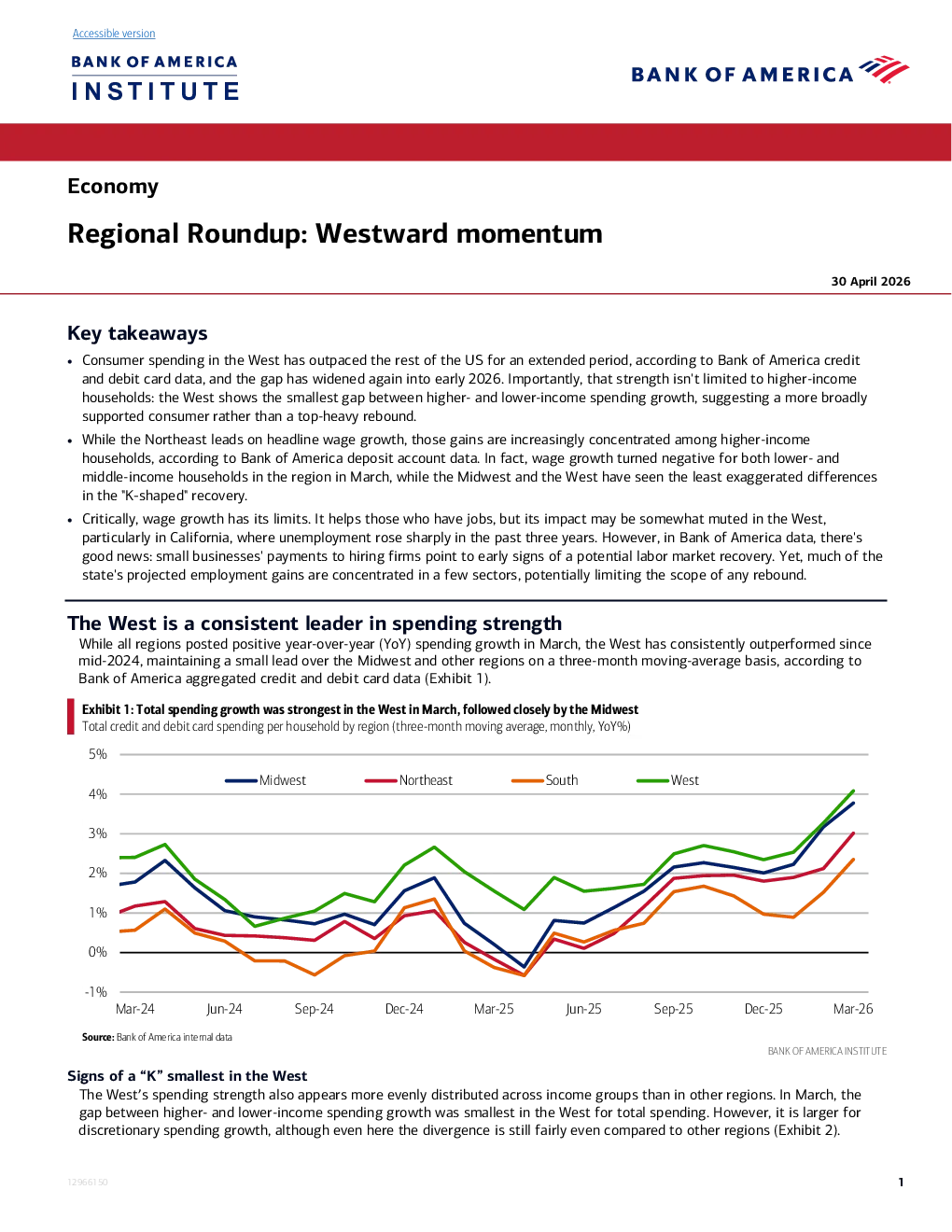
Regional Roundup: Westward momentum 30 April 2026 Key takeaways •Consumer spending in the West has outpaced the rest of the US for an extended period, according to Bank of America creditand debit card data, and the gap has widened again into early 2026. Importantly, that strength isn't limited to higher‑incomehouseholds: the West shows the smallest gap between higher‑and lower‑income spending growth, suggesting a more broadlysupported consumer rather than a top‑heavy rebound. •While the Northeast leads on headline wage growth, those gains are increasingly concentrated among higher‑incomehouseholds, according to Bank of America deposit account data. In fact, wage growth turned negative for both lower‑andmiddle‑income households in the region in March, while the Midwest and the West have seen the least exaggerated differencesin the "K-shaped" recovery. •Critically, wage growth has its limits. It helps those who have jobs, but its impact may be somewhat muted in the West,particularly in California, where unemployment rose sharply in the past three years. However, in Bank of America data, there'sgood news: small businesses' payments to hiring firms point to early signs of a potential labor market recovery. Yet, much of thestate's projected employment gains are concentrated in a few sectors, potentially limiting the scope of any rebound. The West is a consistent leader in spending strengthWhile all regions posted positive year‑over‑year (YoY) spending growth in March, the West has consistently outperformed since mid‑2024, maintaining a small lead over the Midwest and other regions on a three‑month moving‑average basis, according toBank of America aggregated credit and debit card data (Exhibit 1). Total credit and debit card spending per household by region (three-month moving average, monthly, YoY%) Signs of a “K” smallest in the WestThe West’s spending strength also appears more evenly distributed across income groups than in other regions. In March, the gap between higher‑and lower‑income spending growth was smallest in the West for total spending. However, it is larger fordiscretionary spending growth, although even here the divergence is still fairly even compared to other regions (Exhibit 2). What might be benefiting those out west? One important factor may be more muted pressure from energy prices (gasoline,natural gas, etc.) in the West. In fact, over the 12 months to March, energy prices rose most sharply in the Northeast and South,while increases were smaller in the Midwest and West (Exhibit 3). This trend should disproportionately benefit lower-incomeearners (read more inConsumer Checkpoint: The madness of March). Exhibit2:The difference between higher-income and lower-incomespending growth in March was greatest in the South and smallest inthe WestDifference between higher- and lower-income total and discretionary Exhibit3:Energy costs increased the most in the Northeast and theSouth Energy consumer price index by region for the 12 months ending inMarch (percent change, %) spending growth by region in March (percentage point, %) Wage growth in the Northeast turned negative for lower- and middle-income householdsAnother factor benefiting westerners may be wage gains. Although the region’s wage growth lagged the South and Northeast in March, Western wage growth has been relatively strong compared with other regions over much of the last three years (Exhibit4). Additionally, looking at wage growth by income suggests less of a gap between income groups in the West (Exhibit 5). Exhibit5:The “K” within wage growth was strongest in the South,but in the Northeast, both lower- and middle-income households’wage growth turned negativeWagegrowth by region in March (six-month moving average, YoY%, SA) Exhibit4:In March, wage growth was up 3.3% YoY in the NortheastWage growth by region (YoY%, seasonally adjusted (SA), six-monthmoving average) Early signs of a positive labor market reversal in the WestImportantly, our wage data only covers those who are employed. And crucially, the labor market in the West saw more deterioration than many other regions in the US over the past few years. In fact, in December 2025, there were nearly twounemployed persons for every open job in California, while the ratio was closer to 1.4 overall in the West (Exhibit 6). This standsin stark contrast to the summer of 2022, when there were nearly two open jobs for every unemployed person across the region. In our view, however, the West may be well-positioned for recovery. Whether that occurs depends on the labor supply anddemand picture. While labor demand might outstrip supply in some parts of the country, the West stands out for its ample laborsupply following an employment downturn over the past four years. Ratio of the number of unemployed persons compared to job openings (monthly, ratio, SA) The West sees signs of green shoots for small business hiring and short-term investmentBank of America small business