您的浏览器禁用了JavaScript(一种计算机语言,用以实现您与网页的交互),请解除该禁用,或者联系我们。 [美国银行]:区域综述:太阳在西方落山了吗? - 发现报告

区域综述:太阳在西方落山了吗?

公用事业 2025-06-01 美国银行 王英杰
报告封面

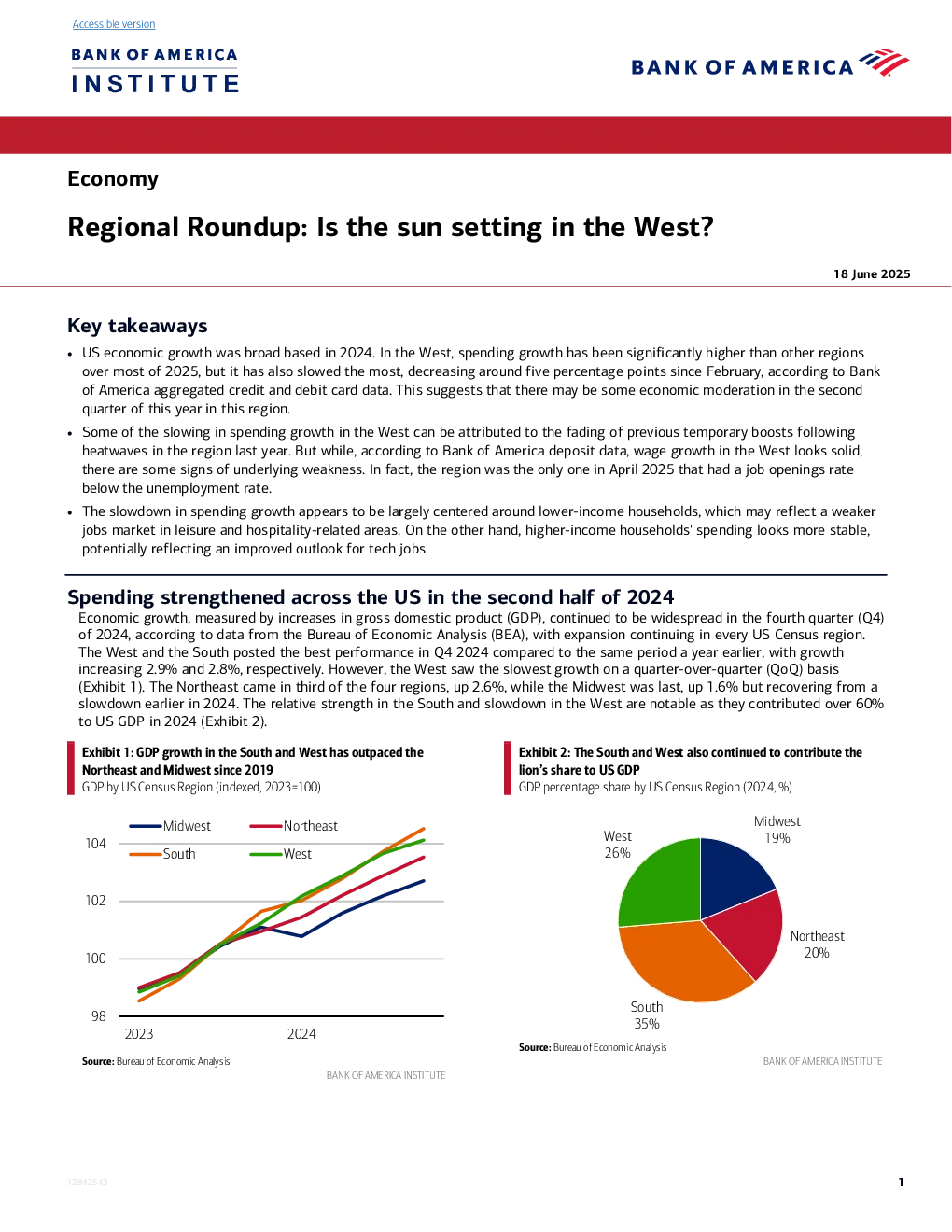
Regional Roundup: Is the sun setting in the West? 18 June 2025 Key takeaways •US economic growth was broad based in 2024. In the West, spending growth has been significantly higher than other regionsover most of 2025, but it has also slowed the most, decreasing around five percentage points since February, according to Bankof America aggregated credit and debit card data. This suggests that there may be some economic moderation in the secondquarter of this year in this region. •Some of the slowing in spending growth in the West can be attributed to the fading of previous temporary boosts followingheatwaves in the region last year. But while, according to Bank of America deposit data, wage growth in the West looks solid,there are some signs of underlying weakness. In fact, the region was the only one in April 2025 that had a job openings ratebelow the unemployment rate. •The slowdown in spending growth appears to be largely centered around lower-income households, which may reflect a weakerjobs market in leisure and hospitality-related areas. On the other hand, higher-income households' spending looks more stable,potentially reflecting an improved outlook for tech jobs. Spending strengthened across the US in the second half of 2024Economic growth, measured by increases in gross domestic product (GDP), continued to be widespread in the fourth quarter (Q4) of 2024, according to data from the Bureau of Economic Analysis (BEA), with expansion continuing in every US Census region.The West and the South posted the best performance in Q4 2024 compared to the same period a year earlier, with growthincreasing 2.9% and 2.8%, respectively. However, the West saw the slowest growth on a quarter-over-quarter (QoQ) basis(Exhibit 1). The Northeast came in third of the four regions, up 2.6%, while the Midwest was last, up 1.6% but recovering from aslowdown earlier in 2024. The relative strength in the South and slowdown in the West are notable as they contributed over 60%to US GDP in 2024 (Exhibit 2). Exhibit2:The South and Westalso continued to contribute thelion’s share to US GDPGDP percentage share by US Census Region (2024, %) Exhibit1:GDP growth in the South and WesthasoutpacedtheNortheast and Midwest since 2019GDP by US Census Region (indexed, 2023=100) So, has this pattern continued in the first half of this year? To better understand these economic trends, we examined Bank ofAmerica aggregated credit and debit card data to gain insight into the direction of consumer spending, which accounts foraround two-thirds of overall GDP in the US. Thus far, we find mixed results from quarter to quarter. Spending was considerably weaker so far in the second quarter of 2025 across all regionsMost notably, we see a broad-based slowdown in spending growth since February 2025 across all regions, suggesting some potential moderation in economic activity in the second quarter of this year. In the West, spending growth has been significantlyhigher than in other regions over most of 2025, but it has also slowed the most, decreasing around five percentage points sinceFebruary. As a result, while spending growth in the West was still the highest amongst the four regions in May 2025, the gap hasnarrowed considerably. While spending growth also slowed across all the other regions, it was from a much lower starting point(Exhibit 3). A multitude of factors came into play in the West. The region saw several temporary boosts to spending, followed by subsequentpaybacks. For example, one appears to be a recovery from widespread heat waves in the region throughout 2024, while thewildfires and subsequent rebuilding efforts likely pushed spending in 2025 Q1 higher. More recently, another factor affecting allregions was the boost from consumers seeking to buy ahead of potential price increases due to tariffs. Other factors included acontinued slowdown in gasoline prices and gasoline spending (read more about this topic in ourJune Consumer Checkpoint). Exhibit3:Despite a comparatively large slowdown in spendinggrowth, the West still had the strongest growth in MayCredit and debit card spending per household from Bank of America Exhibit4:Wage growth has largely mirrored spending growth andwas highest in the West in MayAfter-tax wage and salary growth by region, based on Bank of America aggregated consumer deposit data, %YoY, 3-month moving average,seasonally adjusted (SA) Data, 3-month moving average, seasonally-adjusted annual rate (SAAR)% Stress is building in the West’s already tight labor marketAnother factor that may be affecting spending is the labor market.Exhibit 4shows that based on Bank of America consumer deposit data, growth in after-tax wages and salaries has slowed across all four census regions since the beginning of the year,somewhat following the pattern of spending gains. However, one potential bright spot was that wage growth did tick up in Mayacross all regions except the Northeast. While after-tax wage growth in