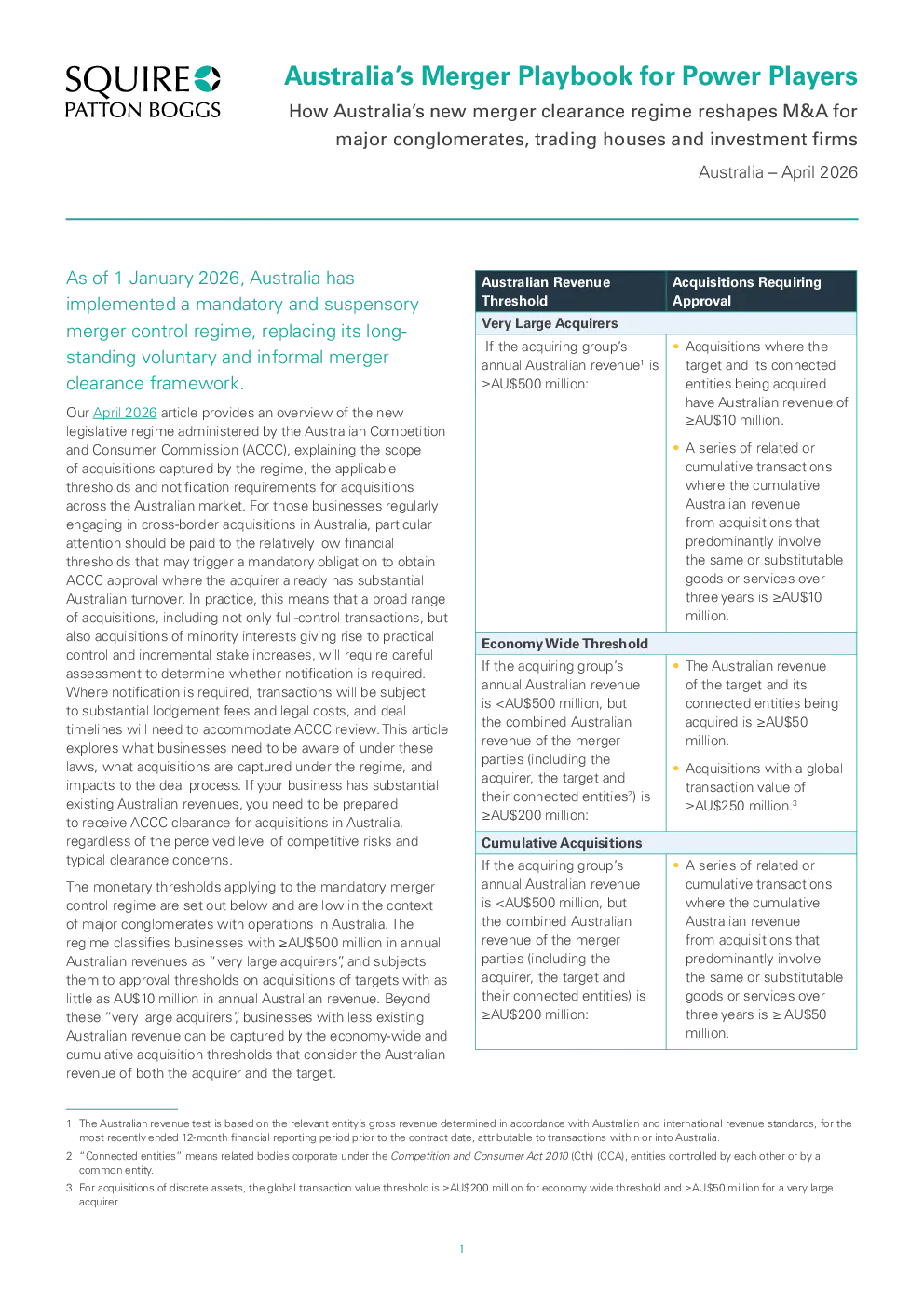
How Australia’s new merger clearance regime reshapes M&A formajor conglomerates, trading houses and investment firms Australia – April 2026 As of 1 January 2026, Australia hasimplemented a mandatory and suspensorymerger control regime, replacing its long- Our April 2026 article provides an overview of the newlegislative regime administered by the Australian Competitionand Consumer Commission (ACCC), explaining the scopeof acquisitions captured by the regime, the applicablethresholds and notification requirements for acquisitionsacross the Australian market. For those businesses regularlyengaging in cross-border acquisitions in Australia, particularattention should be paid to the relatively low financialthresholds that may trigger a mandatory obligation to obtainACCC approval where the acquirer already has substantial The monetary thresholds applying to the mandatory mergercontrol regime are set out below and are low in the contextof major conglomerates with operations in Australia. Theregime classifies businesses with ≥AU$500 million in annualAustralian revenues as “very large acquirers”, and subjects These revenue thresholds capture all Australian revenue ofthe acquiring entity and its subsidiaries, affiliates and otherconnected entities, meaning the combined annual revenueof the group’s entire Australian operations is under the If your business engages in the acquisition of businessesin Australia and is likely to meet the monetary thresholds, •New lodgement fees– The mandatory merger clearanceregime imposes new and significant lodgement fees onevery notifiable transaction, which will need to be factored Various international conglomerates with major diversifiedoperations spanning multiple sectors will invariably crossthese financial thresholds. Prominent examples of investor The lodgement fee for a “Phase 1” review is AU$56,800,payable on a mandatory basis where the regime is •Diversified trading houses and conglomerates– Largemultinational trading and industrial conglomerates thathold Australian interests across resources, commodities, If your transaction requires a Phase 2 review becausecompetition concerns do arise, subsequent lodgement fees •Global financial institutions and asset managers–Major international banks, insurance groups and assetmanagers with Australian banking licences, investment •Global technology, industrial and consumer groups – Large multinationals with Australian business services,technology, manufacturing or consumer goods operations. •Sovereign and state-backed investment vehicles–State-linked conglomerates and investment funds with Waiver applications (AU$8,300) and public benefitsassessments (AU$401,000) are also available and incur The business of many firms meeting these monetarythresholds is the acquisition of businesses, assets andother interests in Australia. If those acquisitions result inthe acquisition of control of an Australian target (refer toour previous article for a further explanation of control These fees are cumulative and nonrefundable. To date,the ACCC has granted 70 notification waivers (six denied)and approved 39 notifications in Phase 1, with only twonotifications being progressed to the in-depth Phase 2 •Additional advisory costs– In addition to lodgement fees,you will incur additional legal and advisory fees associatedwith the substantial competition analysis, market definitionwork, calculation of market shares and competitive For major conglomerates (i.e. with Australian revenue of atleast AU$500 million) operating in Australia, merger clearanceis required for acquisitions with as little as AU$10 millionin annual revenue. Any notifiable acquisition that proceedswithout ACCC clearance, a statutory exemption or waiver is •Timeline impact– The mandatory and suspensory regimefundamentally changes the transactional timetable forevery notifiable deal. An acquisition cannot close until 14 Based on available data, we understand there are hundredsof major conglomerates operating in Australia that will meetthese thresholds. These businesses, particularly thoseheadquartered in the US, the UK, Japan, Hong Kong andSingapore, invest billions into the Australian market annually.With these new merger clearance rules coming into effect,these firms, trading houses, banks, hedge funds and For Phase 1 reviews, businesses should build in up to 30business days for review, with the earliest possible approvalafter 15 business days. If a Phase 2 review is required,the ACCC is entitled to an additional 90 business days forreview, with the ability to extend. Notwithstanding these •Market information– This new mandatory noticeregime requires parties to be across key market datathat needs to be provided for review and approval. Thismeans that businesses need to be ready to describe thegoods and services most relevant to the transaction, theparties’ principal industries, and any horizontal, vertical orconglomerate overlaps. For very large acquirers that will