消费者检查站:三月的疯狂
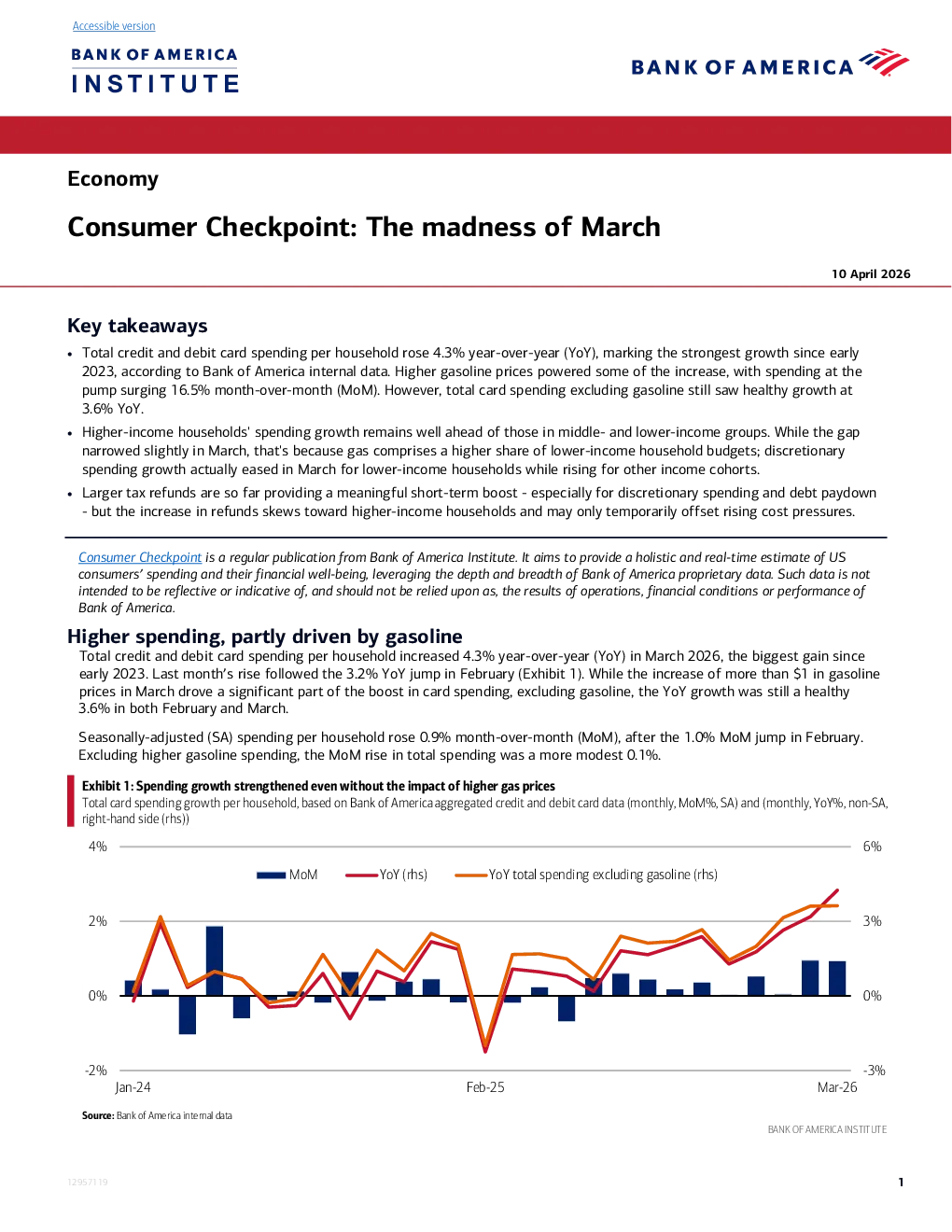
Consumer Checkpoint: The madness of March Key takeaways •Total credit and debit card spending per household rose 4.3% year-over-year (YoY), marking the strongest growth since early2023, according to Bank of America internal data. Higher gasoline prices powered some of the increase, with spending at the Higher-income households' spending growth remains well ahead of those in middle- and lower-income groups. While the gapnarrowed slightly in March, that's because gas comprises a higher share of lower-income household budgets; discretionary Larger tax refunds are so far providing a meaningful short-term boost - especially for discretionary spending and debt paydown- but the increase in refunds skews toward higher-income households and may only temporarily offset rising cost pressures. Consumer Checkpointis a regular publication from Bank of America Institute. It aims to provide a holistic and real-time estimate of USconsumers’spending and their financial well-being, leveraging the depth and breadth of Bank of America proprietary data. Such data is not Higher spending, partly driven by gasolineTotal credit and debit card spending per household increased 4.3% year-over-year (YoY) in March 2026, the biggest gain since early 2023. Last month’s rise followed the 3.2% YoY jump in February (Exhibit 1). While the increase of more than $1 in gasolineprices in March drove a significant part of the boost in card spending, excluding gasoline, the YoY growth was still a healthy Seasonally-adjusted (SA) spending per household rose 0.9% month-over-month (MoM), after the 1.0% MoM jump in February.Excluding higher gasoline spending, the MoM rise in total spending was a more modest 0.1%. Total card spending growth per household, based on Bank of America aggregated credit and debit card data (monthly, MoM%, SA) and (monthly, YoY%, non-SA, Looking at the composition of YoY card spending growth in March, rising gasoline spending accounted for only 0.8 percentagepoints (pp), while retail (excluding gas and restaurants) contributed nearly double that amount (Exhibit 2). Services spendingmade the strongest contribution to growth, at 1.9 pp. Diving deeper within overall services, discretionary spending has been solid Exhibit2:Increases in retail and services spending accounted forthe majority of YoY growth Contribution to YoY total credit and debit card spending growth bycategory, based on Bank of America card data (monthly, SA, percentagepoints contribution) Contribution to YoY services growth by discretionary services category(monthly, SA, percentage points contribution) Lower-income households trim discretionary spending as gas takes bigger biteLooking across income cohorts, lower-income households’total card spending rose to 2.2% YoY in March, narrowing the gap with other income groups for the second month in a row. By contrast, higher-income households’spending growth was much However, the rise in lower-income households’YoY card spending is largely because gasoline makes up a larger share ofspending for those with smaller incomes. Consequently, those with lower incomes curbed discretionary purchases (spendingoutside of groceries, utilities and gasoline) last month, and their YoY spending growth on discretionary goods dropped back Exhibit4:Higher-income households’ spending rose to 3.9% YoY inMarch compared to 2.2% YoY for lower-income households Exhibit5:YoYdiscretionary spendinggrowth was slightly moremuted for lower-income households compared to February Total credit and debit card spending per household, according to Bank ofAmerica card data, by household income terciles (3-month movingaverage, YoY%, SA) Discretionary card spending per household, according to Bank of Americacard data, by household income terciles (YoY%, SA) Beyond pain at the gas pump, another reason lower- and middle-income households may be tightening their belts: their earningsgrowth continues to lag behind those with higher incomes. Higher-income households’ after-tax wage and salary growth rose sharply in March, to 5.6% YoY – the fastest YoY growth sinceAugust 2021 – up from 4.2% in February, according to Bank of America deposit data. And while there was a rebound in middle-and lower-income households’ after-tax wage growth in March, it was smaller, to 2.0% and 1.0% YoY, respectively. As a result, Exhibit7: Thecurrent“K”shape in wage growth has unwound someof the previous relative gains of lower-income households Exhibit6:InMarch, higher-income households’ after-tax wagegrowth rose to 5.6% YoY, while lower-income households’ wage Lower-income households’ after-tax wages and salaries relative to thoseof higher-income households (yearly, index 2019=1) After-tax wage and salary growth by household income terciles, based onBank of America aggregated consumer deposit account data (3-monthmoving average, YoY%, SA) As noted in our March Employment Report, the gains among higher-income households are likely, in part, the result of bigg