小企业检查站:一个又一个冲击
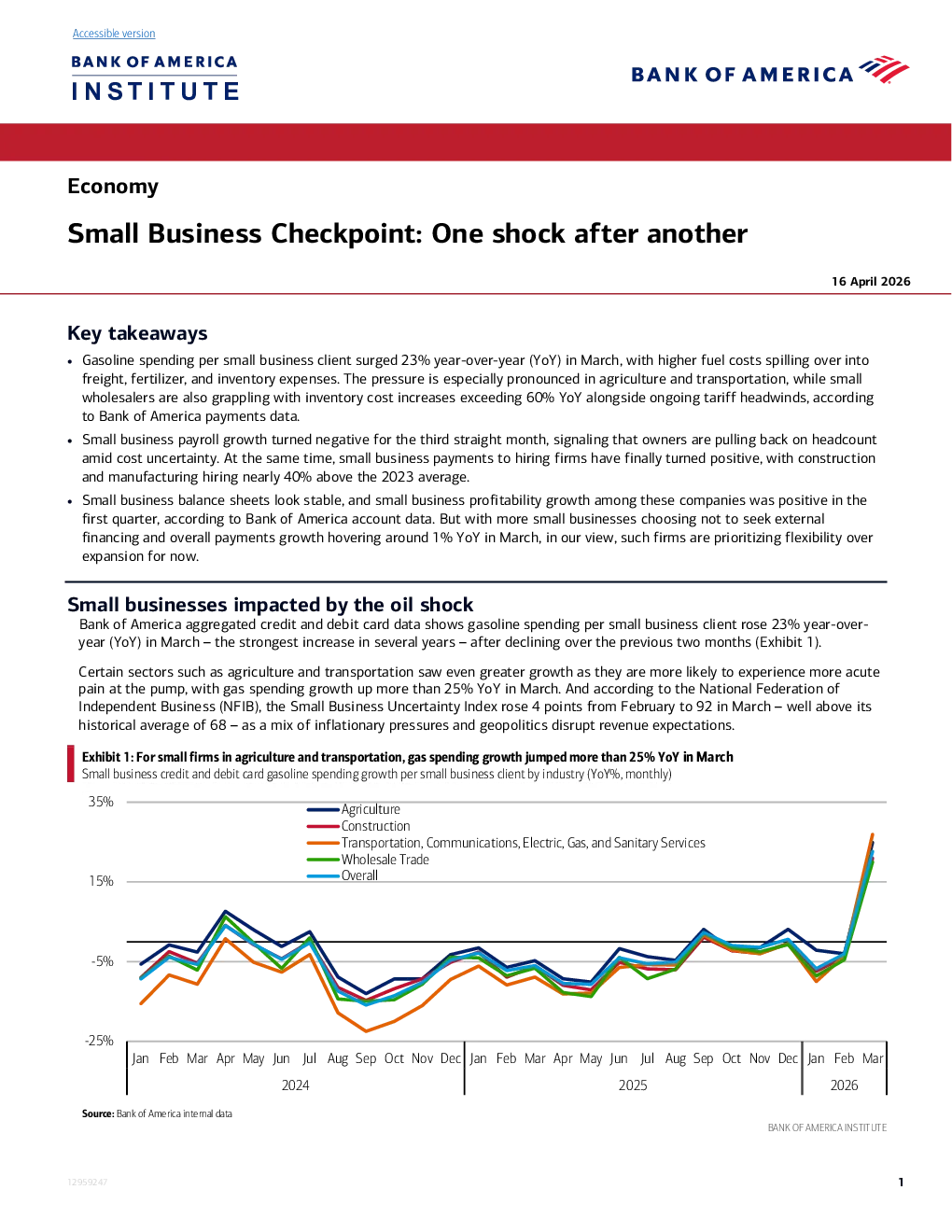
Small Business Checkpoint: One shock after another Key takeaways Gasoline spending per small business client surged 23% year-over-year (YoY) in March, with higher fuel costs spilling over intofreight, fertilizer, and inventory expenses. The pressure is especially pronounced in agriculture and transportation, while small Small business payroll growth turned negative for the third straight month, signaling that owners are pulling back on headcountamid cost uncertainty. At the same time, small business payments to hiring firms have finally turned positive, with construction Small business balance sheets look stable, and small business profitability growth among these companies was positive in thefirst quarter, according to Bank of America account data. But with more small businesses choosing not to seek external Small businesses impacted by the oil shockBank of America aggregated credit and debit card data shows gasoline spending per small business client rose 23% year-over- year (YoY) in March–the strongest increase in several years–after declining over the previous two months (Exhibit 1). Certain sectors such as agriculture and transportation saw even greater growth as they are more likely to experience more acutepain at the pump, with gas spending growth up more than 25% YoY in March. And according to the National Federation ofIndependent Business (NFIB), the Small Business Uncertainty Index rose 4 points from February to 92 in March–well above its Transportation, agriculture and construction most exposedBeyond direct fuel expenses, higher gasoline prices are feeding into broader cost structures, therefore raising transportation, input and inventory costs for many small businesses. Exhibit 2 shows that small businesses in transportation, agriculture andconstruction devote a noticeably larger share of their total credit and debit card spending to gasoline than other sectors. In fact, according to Bank of America small business account data, in March, both small transportation and agriculture firms sawa 0.4% increase in the share of gasoline expenditures relative to inflows (i.e. revenue)–this is double that of construction and Exhibit2:For small businesses in agriculture, construction and transportation, gas takes up a greater share of total credit and debit card spendingShare of gasoline spending in total small business credit and debit card spending (%) More than just oil – local farmers face fertilizer costs and other constraints Agricultural businesses are particularly exposed to disruptions from the war in the Middle East given commodities are tradedglobally, making transportation costs a large component of final prices, according to BofA Global Research. This creates a direct–and rapid–pass‑through from energy shocks to commodity prices. Since Operation Epic Fury (which began on February 28th) Exhibit4:Small agriculture businesses have seen deposit growthdecline at a faster rate than the overall rate since tariffs were Exhibit3: Since Operation Epic Fury, freight costs in the US surgednearly 50% for trucks and 11-17% for ocean transportation Small business deposit growth per client by industry (YoY%, monthly, 3-month moving average) Additionally, the blockage of the Strait of Hormuz is expected to further increase costs for farmers as this leads to fertilizersupply restrictions. In Bank of America small business payments data, small business deposit growth for agricultural businesses Wholesalers continue to face pressure on the tariff frontWholesalers, which face high transportation costs, are another group of small firms highly vulnerable to the oil shock and ongoing tariff pressures. In Bank of America small business payments data, small wholesalers’costs associated with inventory (i.e. distributors,truck/freight logistics and other delivery services) surged 62.6% YoY in March–the single largest monthly gain since the start ofour data series in 2020 (Exhibit 5). This surge is echoed in the latest NFIB report, with the number of owners planning inventoryinvestment in the coming months reaching the lowest level since May 2024. Additionally, of the small cohort of firms who pay One silver lining may be that these payments are starting to fall, and, according to BofA Global Research, lower tariff ratesfollowing the Supreme Court's reversal of tariffs imposed with the International Emergency Economic Powers Act are helping Exhibit6:Ofthe small subset of clients that pay directly, tariff costsremain up almost 95% from the 2024 average in March Inventory payments per small business client by wholesalers (YoY%,monthly) Customs and Border Protection (CBP) payments per small business client(indexed, 2024 average = 100, monthly) Labor market in limboUncertainty continues to be a prominent theme on Main Street, appearing in job reports and small employer sentiment. Payroll payments growth per small business client remained negative in March, marking three consecutive months of declines–