谁还在行动?
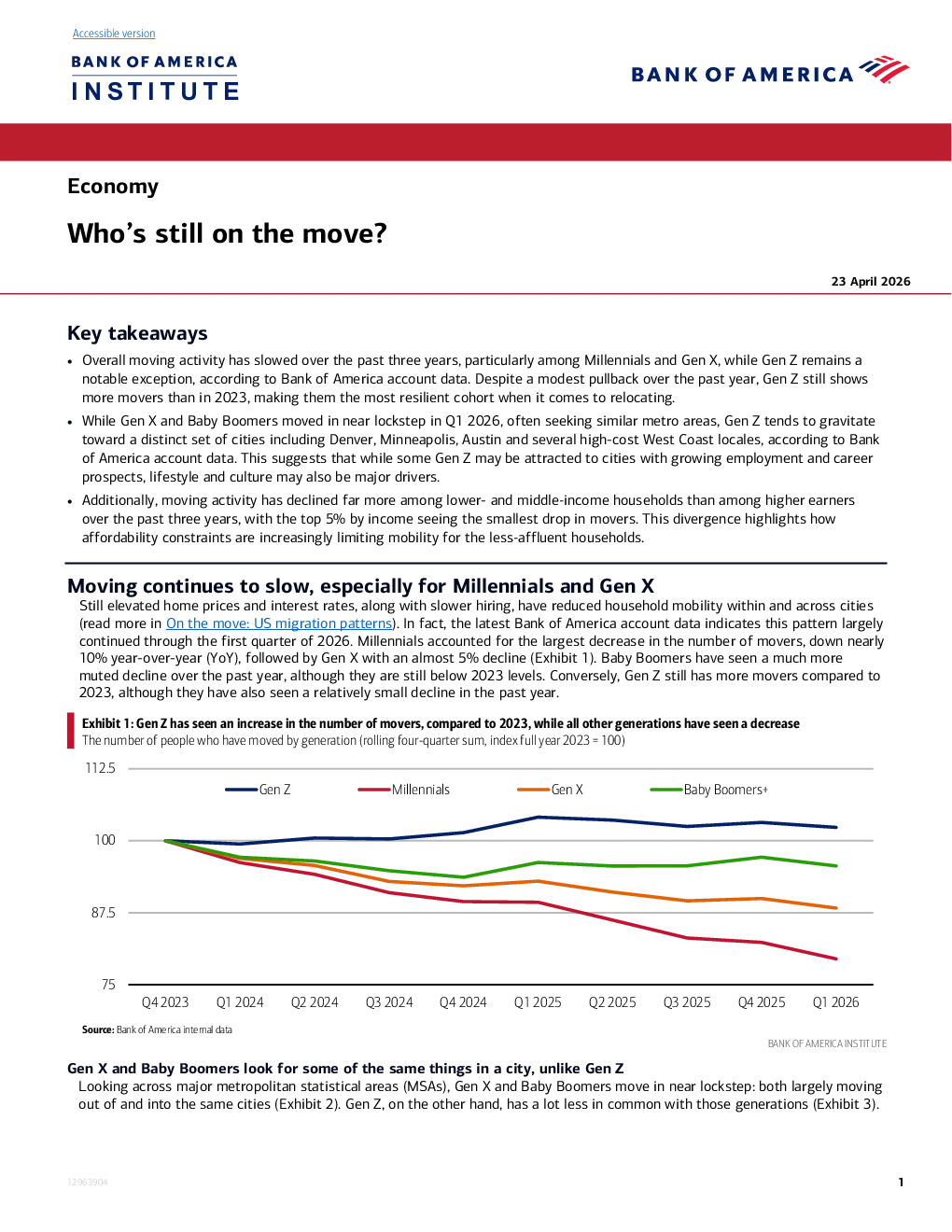
Who’s still on the move? Key takeaways Overall moving activity has slowed over the past three years, particularly among Millennials and Gen X, while Gen Z remains anotable exception, according to Bank of America account data. Despite a modest pullback over the past year, Gen Z still shows While Gen X and Baby Boomers moved in near lockstep in Q1 2026, often seeking similar metro areas, Gen Z tends to gravitatetoward a distinct set of cities including Denver, Minneapolis, Austin and several high-cost West Coast locales, according to Bankof America account data. This suggests that while some Gen Z may be attracted to cities with growing employment and career Additionally, moving activity has declined far more among lower- and middle‑income households than among higher earnersover the past three years, with the top 5% by income seeing the smallest drop in movers. This divergence highlights how Moving continues to slow, especially for Millennials and Gen X Still elevated home prices and interest rates, along with slower hiring, have reduced household mobility within and across cities(read more inOn the move: US migration patterns). In fact, the latest Bank of America account data indicates this pattern largelycontinued through the first quarter of 2026. Millennials accounted for the largest decrease in the number of movers, down nearly10% year-over-year (YoY), followed by Gen X with an almost 5% decline (Exhibit 1). Baby Boomers have seen a much more Gen X and Baby Boomers look for some of the same things in a city, unlike Gen ZLooking across major metropolitan statistical areas (MSAs), Gen X and Baby Boomers move in near lockstep: both largely moving out of and into the same cities (Exhibit 2). Gen Z, on the other hand, has a lot less in common with those generations (Exhibit 3). Exhibit3:Gen Z shows somedifferentiation in their location choiceswith Gen X and Baby Boomers Exhibit2:MSAs that are experiencing Gen X growthand decreasesare largely also seeing matching increases and decreases of Baby Population growth for Gen Z compared to combined Gen X and BabyBoomer population growth (Q1 2026, YoY%, each dot represents a majormetro area) Population growth for Gen X compared to Baby Boomers (Q1 2026,YoY%, each dot represents a major metro area) Gen Z is attracted to Denver, Minneapolis and Austin as well as more expensive metros in the WestExamining Bank of America account data through the first quarter of 2026 across metros with the largest divergences helps explain these differences (Exhibit 4). Notably, some cities with the largest relative growth in Gen Z populations compared witholder generations–such as Denver and Minneapolis–saw slight YoY declines in the number of jobs created in January 2026,according to data from the Bureau of Labor Statistics (BLS). In our view, this suggests factors besides the labor market (e.g., Also noteworthy, higher cost of living may not be as much of a deterrent for Gen Z, according to Bank of America internal data.New York City, San Francisco, Seattle and San Jose all saw increases in their Gen Z population in Q1 2026, while postingdecreases among Gen X and Baby Boomers. It’s possible that some Gen Z, being earlier in their careers, are more attracted to Surprisingly, Gen Z and Millennials weren’t leaving or targeting the same cities in the first quarter of 2026, at least not at similarrates (Exhibit 5). However, for those cities that are at the nexus of Gen Z and Millennial population growth, there could beimportant ramifications. For example, younger people are more likely to be renters (read more inWill younger-gen spending hit a So, which major metros saw an increase in both generations? In the South: Austin, Raleigh and Richmond stand out, while in theWest, tech hubs like Seattle and San Francisco also saw growth, along with a significant bump in Denver. In the Midwest and Exhibit5:Gen Z and Millennials also differ in location preference with no clear correlation with US Census RegionPopulation growth for Gen Z compared to Millennial population growth (Q1 2026, YoY%, each dot represents a major metro area) (Red = Northeast, Blue =Midwest, South = Orange, Green = West) A growing divergence in movers is developing across incomesLooking across incomes, a gap appears to be developing across income cohorts when it comes to moving. Moving activity fell more sharply over the past three years for lower- and middle-income households than for those with higher incomes, accordingto Bank of America internal data (Exhibit 6). Notably, higher earners tend to move more than any other group. In fact, the top The number of people who have moved by household income tercile (rolling four-quarter sum, index 2023 = 100) Perhaps unsurprisingly, those in the top five percent by income and the rest of the higher-income group that did move, largelymoved into and out of similar cities (Exhibit 7). Both groups left cities including San Francisco, San Jose, Boston, LA andWashin