您的浏览器禁用了JavaScript(一种计算机语言,用以实现您与网页的交互),请解除该禁用,或者联系我们。 [Berkeley]:加利福尼亚州保安人员的人口统计和工作特征 - 发现报告

加利福尼亚州保安人员的人口统计和工作特征

文化传媒 2026-04-23 Berkeley 一切如初
报告封面

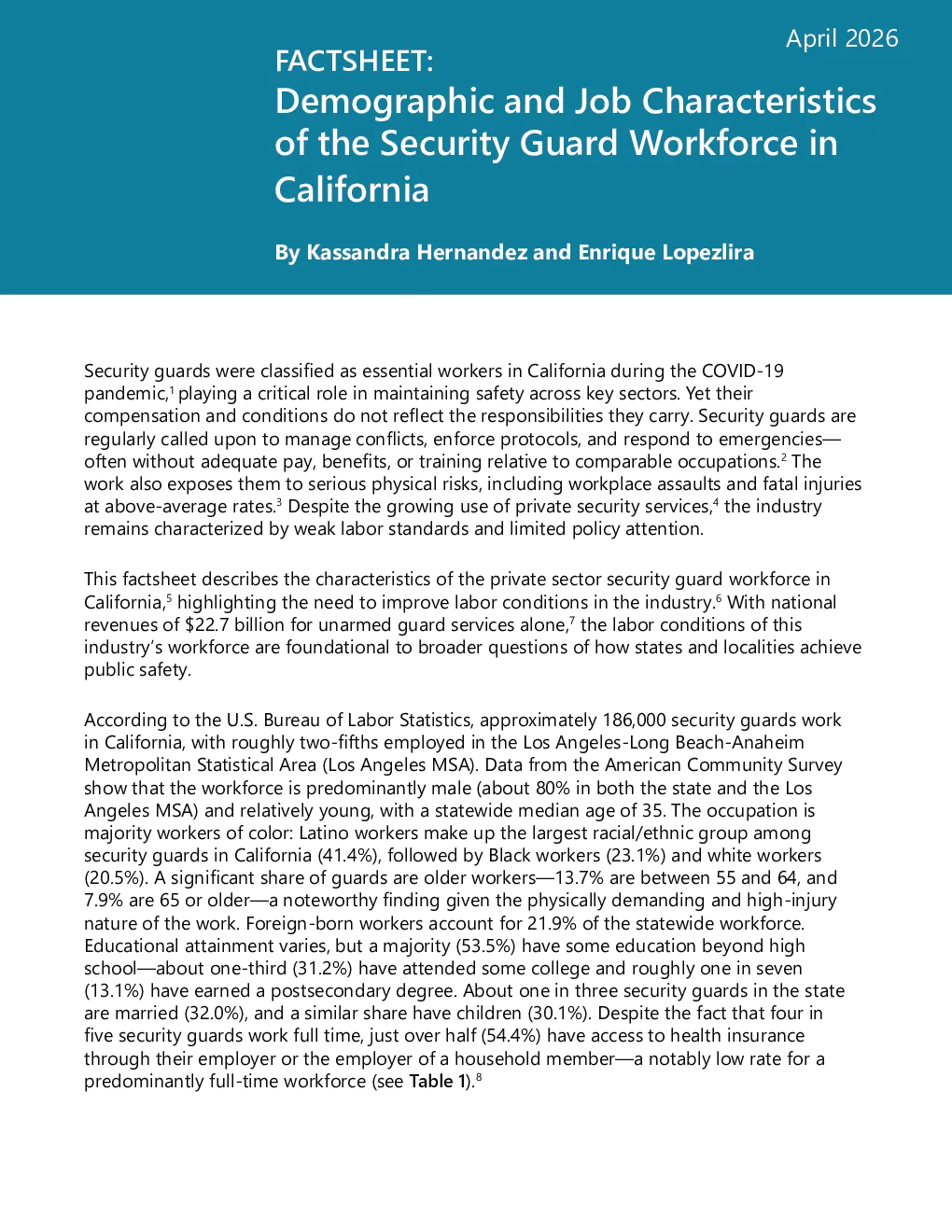
FACTSHEET:Demographic and Job Characteristicsof the Security Guard Workforce in By Kassandra Hernandez and Enrique Lopezlira Security guards were classified as essential workers in California during the COVID-19pandemic,1playing a critical role in maintaining safety across key sectors. Yet theircompensation and conditions do not reflect the responsibilities they carry. Security guards areregularly called upon to manage conflicts, enforce protocols, and respond to emergencies—often without adequate pay, benefits, or training relative to comparable occupations.2The This factsheet describes the characteristics of the private sector security guard workforce inCalifornia,5highlighting the need to improve labor conditions in the industry.6With nationalrevenues of $22.7 billion for unarmed guard services alone,7the labor conditions of this According to the U.S. Bureau of Labor Statistics, approximately 186,000 security guards workin California, with roughly two-fifths employed in the Los Angeles-Long Beach-AnaheimMetropolitan Statistical Area (Los Angeles MSA). Data from the American Community Surveyshow that the workforce is predominantly male (about 80% in both the state and the LosAngeles MSA) and relatively young, with a statewide median age of 35. The occupation ismajority workers of color: Latino workers make up the largest racial/ethnic group amongsecurity guards in California (41.4%), followed by Black workers (23.1%) and white workers(20.5%). A significant share of guards are older workers—13.7% are between 55 and 64, and7.9% are 65 or older—a noteworthy finding given the physically demanding and high-injurynature of the work. Foreign-born workers account for 21.9% of the statewide workforce. This table provides statistics for all private security guards in California, along with the LosAngeles-Long Beach-Anaheim MSA, and the Bay Area. Data are useful for understanding Sample size constraints at the Los Angeles and Bay Area levels restrict our ability to reportstatistics as detailed as the statewide values.9Security guards in the Los Angeles MSA aresimilarly predominantly male (80.4%) and have a median age of 35. Latino workers accountfor the largest share of the security guard workforce in the Los Angeles MSA (46.2%), followedby Black workers (24.1%) and white workers (17.8%). Foreign-born workers make up 23.3% ofthe Los Angeles MSA security guard workforce. About four in ten (40.2%) have attended somecollege or hold an A.A., and about one in eight (12.8%) hold a B.A. or more. Part-time work is The Bay Area security guard workforce shares some of these characteristics but differs inimportant ways. The workforce is similarly male-dominated (79.5%) with a slightly older medianage of 36. As in Los Angeles and statewide, Latino workers make up the largest racial/ethnicgroup in the Bay Area (29.5%), though the Latino-to-Black ratio is nearly 1:1 in the Bay Areacompared to almost 2:1 in Los Angeles. Asian workers are also a substantially larger share ofthe Bay Area security guard workforce (22.2%) than in Los Angeles (8.2%) or statewide (10.1%),reflecting the region’s broader demographic composition. Foreign-born workers are a larger Bay Area guards have better health insurance access than their counterparts in Los Angeles orstatewide, with 63.8% covered through an employer or union—though this still leaves more Table 2presents annual earnings and hourly wages for security guards in the Los Angeles MSA,the Bay Area, and California statewide. In California, security guards earn a median annualincome of $38,371 and a median hourly wage of $20.09, substantially below the median wage Earnings are somewhat higher in the Bay Area, where security guards have a median annualincome of $46,833 and a median hourly wage of $23.97. Even so, these earnings remain farbelow those of the typical Bay Area worker, whose median hourly wage is $42.71. Security We define a low-wage worker as someone paid less than two-thirds of the median hourly wagefor all full-time workers in the region. Based on this benchmark, the low-wage threshold is$18.78 statewide and $18.17 in the Los Angeles MSA. Nearly half of security guards statewide(44.5%) are low-wage workers, as are about four in ten (41.1%) in the Los Angeles MSA. Theshare is considerably higher in the Bay Area, where 68.3% of security guards fall below the About four in five security guards in California (81.3%) earn below the MIT Living Wage fortheir region, as do 81.9% in the Los Angeles MSA and 79.8% in the Bay Area. The MIT LivingWage estimates the hourly wage required for a full-time worker to cover basic living costs —$30.48 per hour statewide, $30.79 in the Los Angeles MSA, and $35.07 in the Bay Area, for a This table provides earnings statistics for all private security guards in California, the LosAngeles MSA, and the Bay Area. Data are useful for understanding how security guardscompare to all other workers in and across each region. For example, half of the