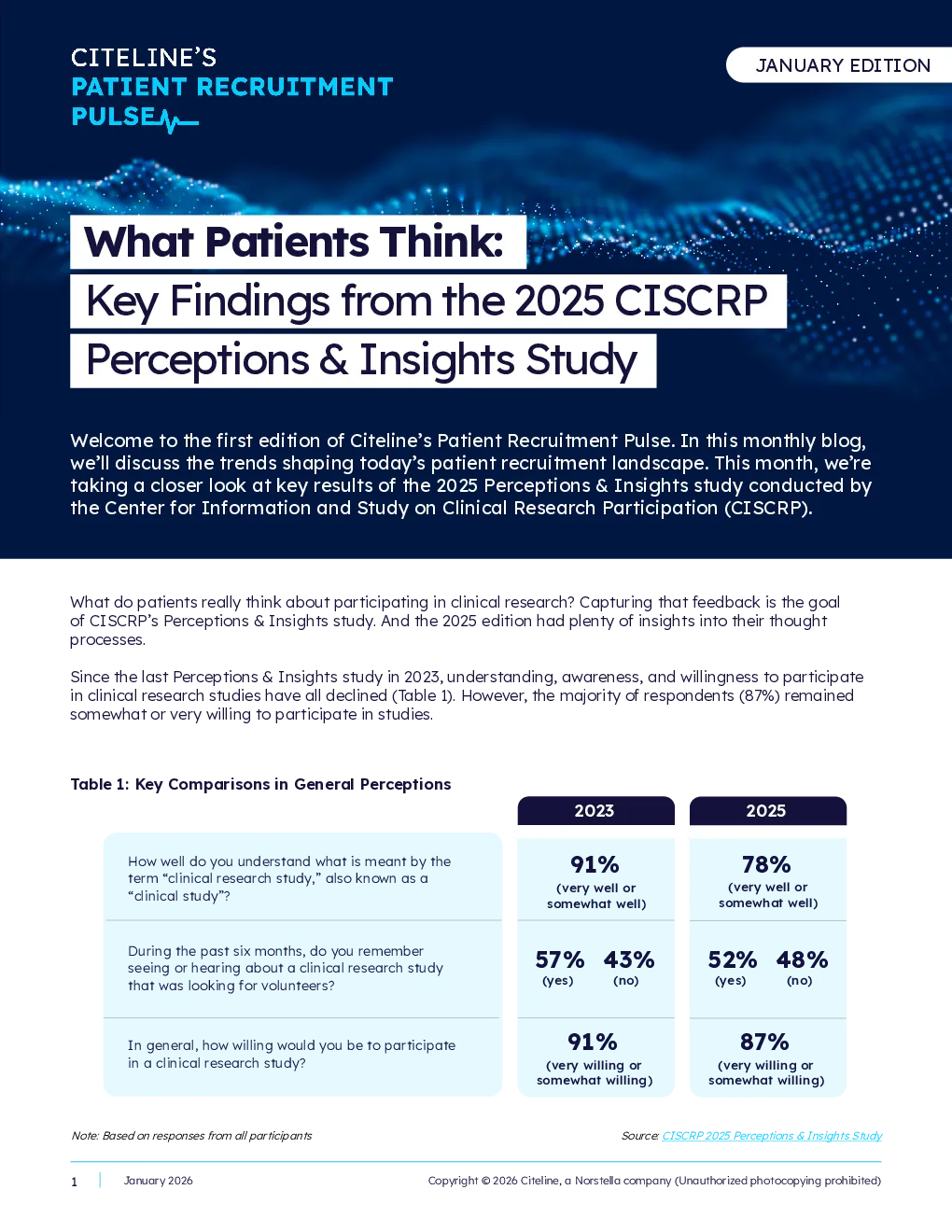
What Patients Think: Key Findings from the 2025 CISCRPPerceptions & Insights Study Welcome to the first edition of Citeline’s Patient Recruitment Pulse. In this monthly blog,we’ll discuss the trends shaping today’s patient recruitment landscape. This month, we’retaking a closer look at key results of the 2025 Perceptions & Insights study conducted bythe Center for Information and Study on Clinical Research Participation (CISCRP). What do patients really think about participating in clinical research? Capturing that feedback is the goalof CISCRP’s Perceptions & Insights study. And the 2025 edition had plenty of insights into their thoughtprocesses. Since the last Perceptions & Insights study in 2023, understanding, awareness, and willingness to participatein clinical research studies have all declined (Table 1). However, the majority of respondents (87%) remainedsomewhat or very willing to participate in studies. There continues to be a disconnect between how patients want to hear about clinical research studies (fromdoctors) and how they actually find out about them (online). Figures 1 and 2 give the breakdown. Among those who responded they would prefer to see or hear about studies online, the top preferred onlineresource was social media, with Facebook named by those respondents as their preferred social mediaplatform by a wide margin. Similarly, those who actually did see or hear about a clinical research study onlinecited social media as their top source for the information, most often through Facebook. CISCRP also split out responses from those who had participated in a clinical research study. Among thoserespondents, 22% said they found out about the study online and 16% from their own doctor (Figure 3). Of therespondents who found out about the study online, 48% discovered it through social media, with 80% of thoselearning about it on Facebook. A majority of respondents (81%) say they would be at least somewhat interested in attending a communityevent to learn more about clinical studies. These events include a local health fair or event organized by acommunity or patient advocacy group. A matter of trust According to the study, pharma continues to struggle with trustworthiness. When asked how much theytrusted pharmaceutical companies that sponsor, design, and conduct clinical research studies, only 18%responded they trusted pharma “a lot,” while 28% responded with “not too much” or “not at all.” Theencouraging news is that 54% said they trusted these companies “some,” meaning there is room for pharmato build trust. The survey provided several options for ways in which pharma companies conducting research can increaserespondents’ trust, and Table 2 lists the five that got the most mentions. Table 2: What, if anything, might increase your trust in pharmaceutical companies that are conductingclinical research studies?(Select all that apply) When it comes to AI, study respondents felt strongly that use of AI in clinical research studies needs to bedisclosed to participants (Figure 4). But interestingly, the majority expressed at least some comfort with theirhypothetical clinical research data being analyzed by AI (Figure 5). Figure 4: How important is it for pharmaceutical companies and academic institutions to make it clearif and how they have used AI as part of a clinical research study? Figure 5: If some of the data collected during a clinical research study was being analyzed by AI, howcomfortable would you be knowing that AI was being used in this way? When respondents were asked what information they would be most interested in receiving after completingtheir participation in a clinical research study, 81% said they would want their individual study results. Whenasked to rank what would be most likely to keep them enrolled in a clinical research study, being able to seetheir own medical test results came in at No. 4. By contrast, only 35% of those who had actually participated in a clinical study reported having receivedreports or updates on the results once they had completed the study. Of those respondents, 47% said theyreceived their individual study results (Table 3). In conclusion So, what does this mean for study sponsors? When creating a patient recruitment plan, sponsors may want to include healthcare practitioner outreachefforts, since many patients would prefer to hear about clinical trials from their physician. They should alsoconsider holding or participating in community events as a way to reach potential clinical trial patients. Andsponsors should plan to provide trial participants with their individual study results, as doing so may make adifference in their decision to participate. As for building trust, the more open and direct a sponsor can be with patients about the risks and benefits oftheir clinical trial, the more likely they’ll be to trust the sponsor enough to consider participating. Being openabout the use of AI in the trial also increases sponsor trus