您的浏览器禁用了JavaScript(一种计算机语言,用以实现您与网页的交互),请解除该禁用,或者联系我们。 [欧洲风能协会]:2025欧洲风电行业劳动力研究报告 - 发现报告

2025欧洲风电行业劳动力研究报告

综合 2026-01-08 欧洲风能协会 肖峰
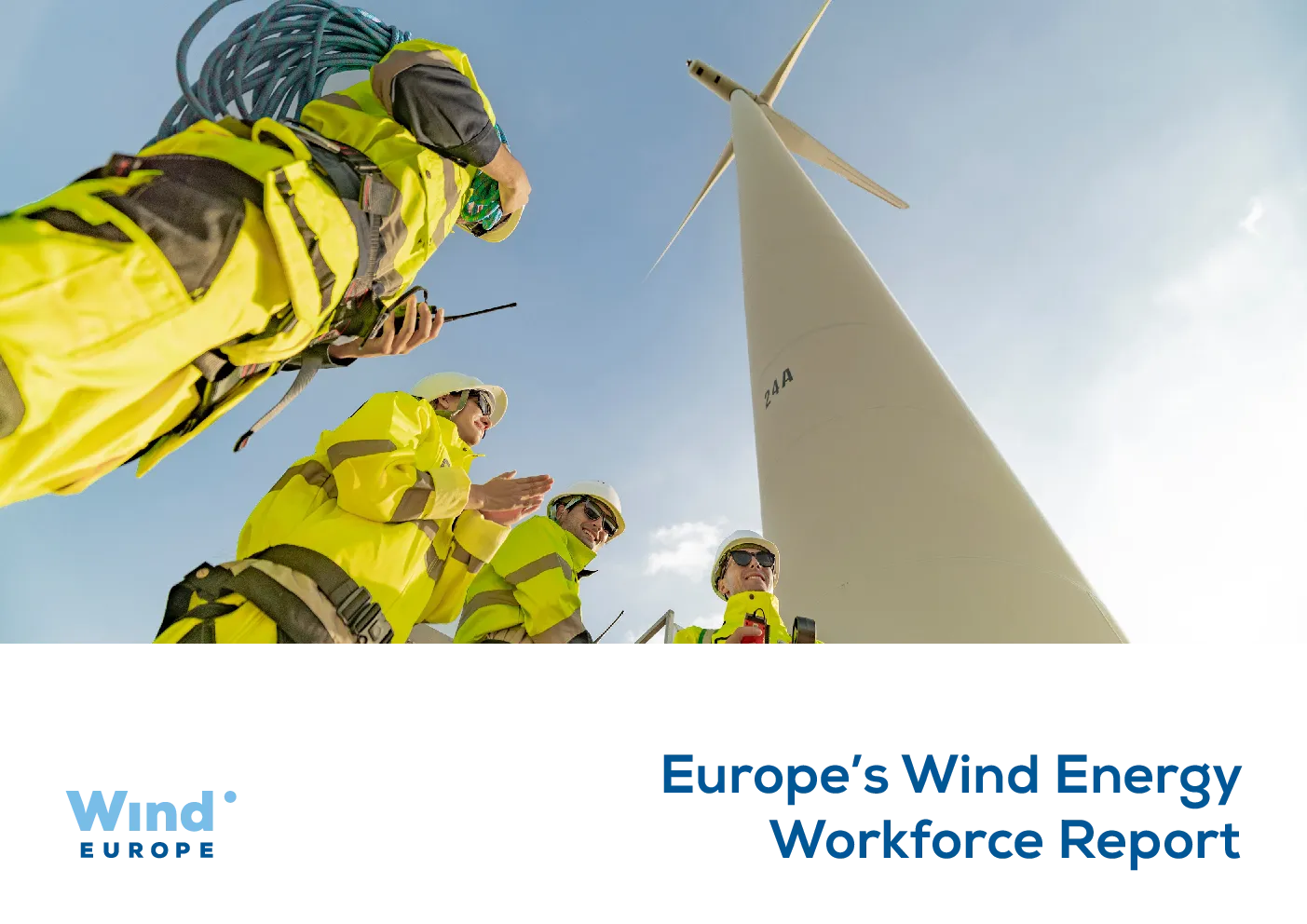
报告封面

Europe’s Wind EnergyWorkforce Report Published in December 2025 windeurope.org TEXT AND ANALYSIS:Mariana BatistaGuy Brindley CONTRIBUTIONS:Giles DicksonPierre TardieuOliver Wykes EDITOR:Rory O’Sullivan DISCLAIMER DESIGN:Laia MiróLin Van de Velde This publication contains opinions collatedfrom discussions with WindEuropemembers, partners and other organisations.Neither WindEurope nor its membersor partners, nor their related entities orother organisations are, by means of thispublication, rendering professional adviceor services. Neither WindEurope nor itsmembers or partners shall be responsiblefor any loss whatsoever sustained by anyperson who relies on this publication. PHOTOS:Shutterstock ACKNOWLEDGEMENTS:WindEurope acknowledges the kind cooperation of the following associationsand institutions:Deloitte, QBIS, Global Wind Organisation MORE INFORMATION:policy@windeurope.org Contents Executive summary7 1.Wind energy employment in 202411 1.1Introduction111.2Methodology111.3Total number of wind energy jobs in Europe 2024121.4Direct jobs in the European wind energy industry131.5Gender15 2.Breaking down workforce composition17 2.1Introduction172.2Critical jobs in 2024172.3Critical jobs by project phase19 3.Road to 203021 3.1Wind energy development to 2030213.2Workforce in 203021 4.1Job gaps25 5.1Overview295.2Summary29 6.Best practices in the wind energy sector Executive summary 2030 employment figures Europe’s wind energy sector is pivotal for energy security,competitiveness and as a source of employment. In 2024wind energy supported 442,800 jobs across Europe1, a clearsign of its growing economic and social importance. Toensure training and investment are targeted effectively, it isvital that our workforce data is accurate and up to date. Thewind industry must work to fill critical roles at every stage ofthe wind farm lifecycle - and to allocate resources and planstrategically for our future workforce. Direct employment spans five phases in a turbine lifecycle:development and project management, manufacturing,installation, operation and maintenance, and decommission-ing. Manufacturing is the largest employer, with nearly halfof all direct jobs (100,050). Over 250 factories across Europeproduce turbine components, bringing high-value jobs andsupporting a resilient supply chain. By 2030 wind energy employment in Europe is projected toreach 607,000—a 36% increase. This growth assumes thatEurope installs an average of 30 GW a year between 2025and 2030. In the EU-27 wind energy employment is expected to growfrom 360,000 today to 483,000 by 2030. This growth is basedon an average of 22 GW being installed annually to reach350 GW by 2030, still short of the EU’s 425 GW target2. Acute shortages 2024 employment figures The sector faces a critical shortage of engineers, technicians,project managers, and specialised operators. Identifyingpriority roles at every stage of the lifecycle is vital fortargeted training and resource allocation. Reliable workforcedata informs policy, guides investment, and ensures skills areavailable where and when they are needed. Closing the skills gaps and securing a steady pipeline ofqualified workers is key to meeting these ambitions. Of the 442,800 jobs in 2024, 210,700 (48%) were directlyemployed by companies in the wind industry. A further232,100 (52%) were employed indirectly, in roles wherethe wind industry interacts with other sectors of theeconomy. This distribution is a reminder of wind energy’sbroad economic footprint, driving activity well beyond coremanufacturing and installation. Key actions for success To address this, WindEurope carried out a detailed studymapping 235 job profiles across the wind farm lifecycle. Thereport introduces a harmonised job classification in line withinternational classification systems and highlights the roleswith the largest projected skills gaps. The aim is to supportstrategic workforce planning and policy development. Meeting Europe’s wind energy ambitions will require urgentaction. That means strategic workforce planning, targetedskills investment, and a bold push to make renewablecareers attractive and accessible. Success will hinge onstrong collaboration between industry, Government, andeducation—ensuring the right people, with the right skills,are in the right place at the right time. Onshore wind accounts for 161,300 direct and 185,500indirect jobs. Offshore wind accounts for 49,400 direct and46,600 indirect jobs. Installed capacity Critical jobs and gaps 2024job figures •Key roles today include turbine technicians, electrical tech-nicians, materials engineers, project managers, assemblytechnicians, welders and grid connection specialists.•By 2030 critical shortages are expected in blade tech-nicians, field engineers, and pre-assembly supporttechnicians.•These gaps show that the current workforce cannot meetfuture demand.•Filling them will mean targeted recruitment from adjacentsectors and upskilling or