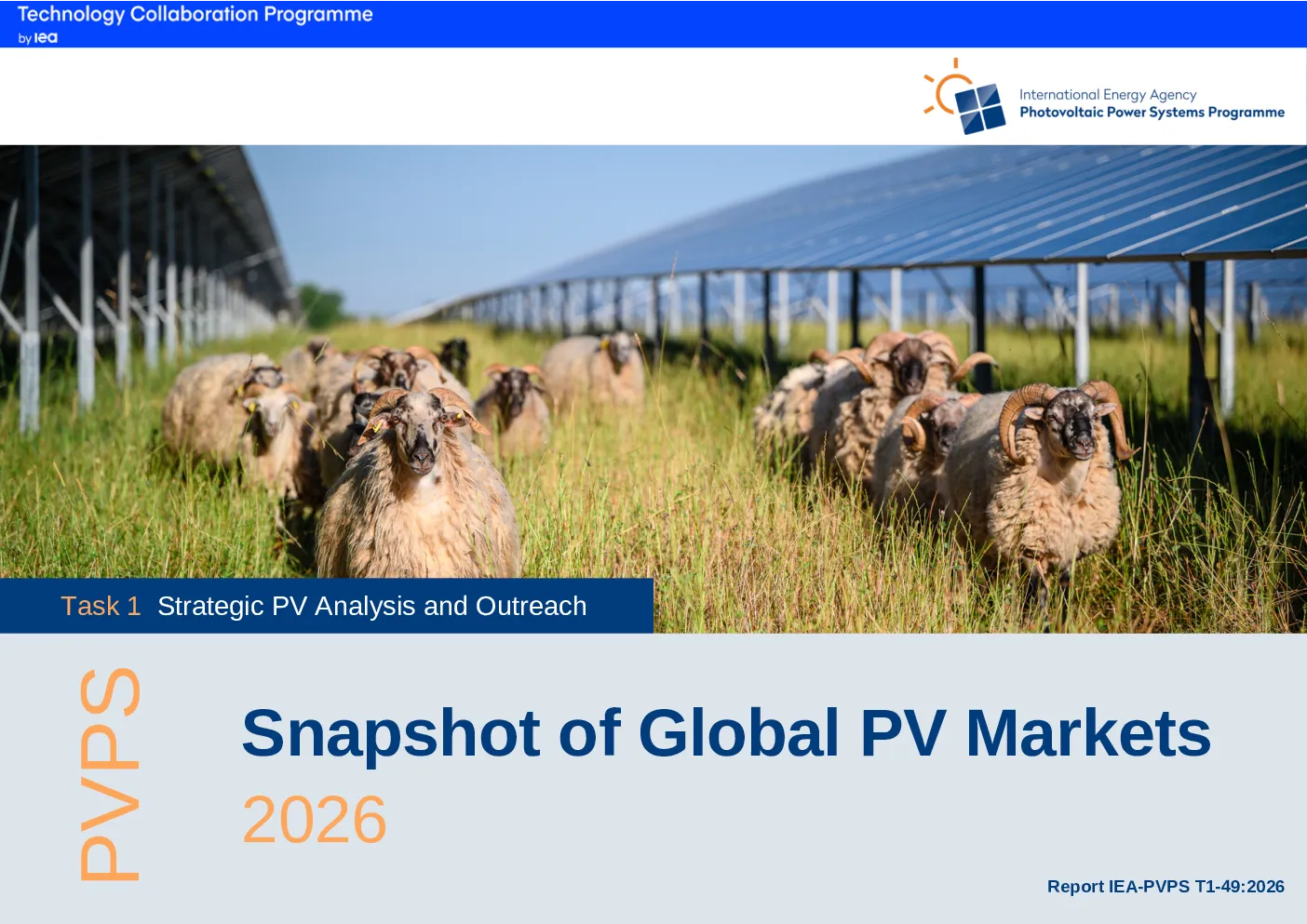
SnapshotofGlobalPVMarkets2026 ReportIEA-PVPST1-49:2026 IEA PVPS Task 1–Strategic PV Analysis and Outreach April-2026 What is IEA PVPS TCP? What is IEA PVPSTask1? DISCLAIMER The IEA PVPS TCP is organised under the auspices of theInternational Energy Agency (IEA) but is functionally and legallyautonomous. Views, findings and publications of the IEA PVPSTCP do not necessarily represent the views or policies of theIEA Secretariat or its individual member countries The objectiveof Task 1 of the IEA Photovoltaic Power SystemsProgramme is promoting and facilitating the exchange anddissemination of information on the technical, economic,environmental and social aspects of PV power systems. Task1activities support the broader PVPS objectives:tocontribute to cost reduction of PV power applications, toincrease awareness of the potential and value of PV powersystems, to foster the removal of both technical and non-technical barriers and to enhance technology co-operation. The International Energy Agency (IEA), founded in 1974, is anautonomous body within the framework of the Organizationfor Economic Cooperation and Development (OECD). TheTechnology Collaboration Programme (TCP) was createdwitha belief that the future of energy security andsustainabilitystartswithglobalcollaboration.Theprogramme is made up of 6.000 experts across government,academia, and industry dedicated to advancing commonresearch and the application of specific energy technologies. COPYRIGHT STATEMENT This content may be freely used, copied and redistributed,provided appropriate credit is given(please refer to the‘Suggested Citation’). The exception is that some licensedimages may not be copied, as specified in the individual imagecaptions. The IEA Photovoltaic Power Systems Programme (IEA PVPS)is one of the TCP’s within the IEA and was established in 1993.Themission of the programme is to“enhance theinternational collaborative efforts which facilitate the role ofphotovoltaic solar energy as a cornerstone in the transition tosustainable energy systems.” In order to achieve this, theProgramme’s participants have undertaken a variety of jointresearch projects in PV power systems applications. Theoverall programme is headed by an Executive Committee,comprised of one delegate from each country or organisationmember, which designates distinct ‘Tasks,’ that may beresearch projects or activity areas. Authors Main authors: Melodie del’Epine, BecquerelInstitute FranceGuillermo Dominguèz, Becquerel InstituteIzumi Kaizuka,RTS Corporation, JapanArnulfJäger-Waldau,EC-JRCIEA PVPS Task 1 members SUGGESTED CITATION De l’Epine, M., Dominguez, G., Kaizuka, I., Jäger-Waldau, A.,(2026) A Snapshot of Global PV Markets (Report No. T1-49:2026). IEA PVPS Task 1. https://iea-pvps.org/snapshot-reports/snapshot-2026/ DOI: 10.69766/WXLW1389 COVER PICTURE Data: IEA PVPS reporting countriesEC-JRCBecquerel Institute 22 MW system in Les Essards, FranceCredits: ABO Energy France SARL The IEA PVPS participating countries are Australia, Austria,Belgium,Canada,China,Denmark,Finland,France,Germany,India,Israel,Italy,Japan,Korea,Lithuania,Malaysia,Morocco,the Netherlands,Norway,Portugal,South Africa, Spain, Sweden, Switzerland, Thailand, Türkiye,the United Kingdomand the United States of America. TheEuropean Commission, Solar Power Europeandthe SolarEnergy Research Institute of Singapore are also members. Editor: Melodie de l’Epine,IEA PVPSTask 1Co-Manager TABLE OF CONTENTS EXECUTIVE SUMMARY penetration rises, system-level effects such as curtailment,negative prices and grid constraintsare becoming moreprominent, influencing both market dynamics and investmentconditions. Policy and market frameworks are evolving in response tothese developments. While PV remains highly competitive,policy design is increasingly shifting from deploymentsupport towards integration, with greater emphasis onstorage, flexibility, market-based remuneration and gridmanagement. At the same time, support for distributed PV isbeingadapted to reflect higher penetration levels,withincreasingfocus on self-consumption,load shifting andsystem value. Persistentglobal manufacturing overcapacity and lowmodule prices continued to support deployment in 2025,while placing sustained pressure on manufacturers. Thisdivergence between strong market growth and constrainedindustrial profitability remains a defining feature of the sector.In parallel, policies aimed at supporting local manufacturinghave continued to develop, although their effectiveness variesacross regions. Marketstructure remained differentiated by segment.Centralised installations accounted for approximately60%of new capacity, supported by continued deployment oflarge-scale projects, particularly in China, India and severalemerging markets. Distributed PV also expanded, driven byself-consumption and prosumer activity,and remainedstructurally important in a growing numberof countries. At thesame time, the increasing scale of installa