您的浏览器禁用了JavaScript(一种计算机语言,用以实现您与网页的交互),请解除该禁用,或者联系我们。 [联邦快递]:2026年B2B商业趋势:人工智能、数据与信任引领增长新纪元 研究报告 - 发现报告

2026年B2B商业趋势:人工智能、数据与信任引领增长新纪元 研究报告

信息技术 2026-04-02 联邦快递 淘金 曹艳平
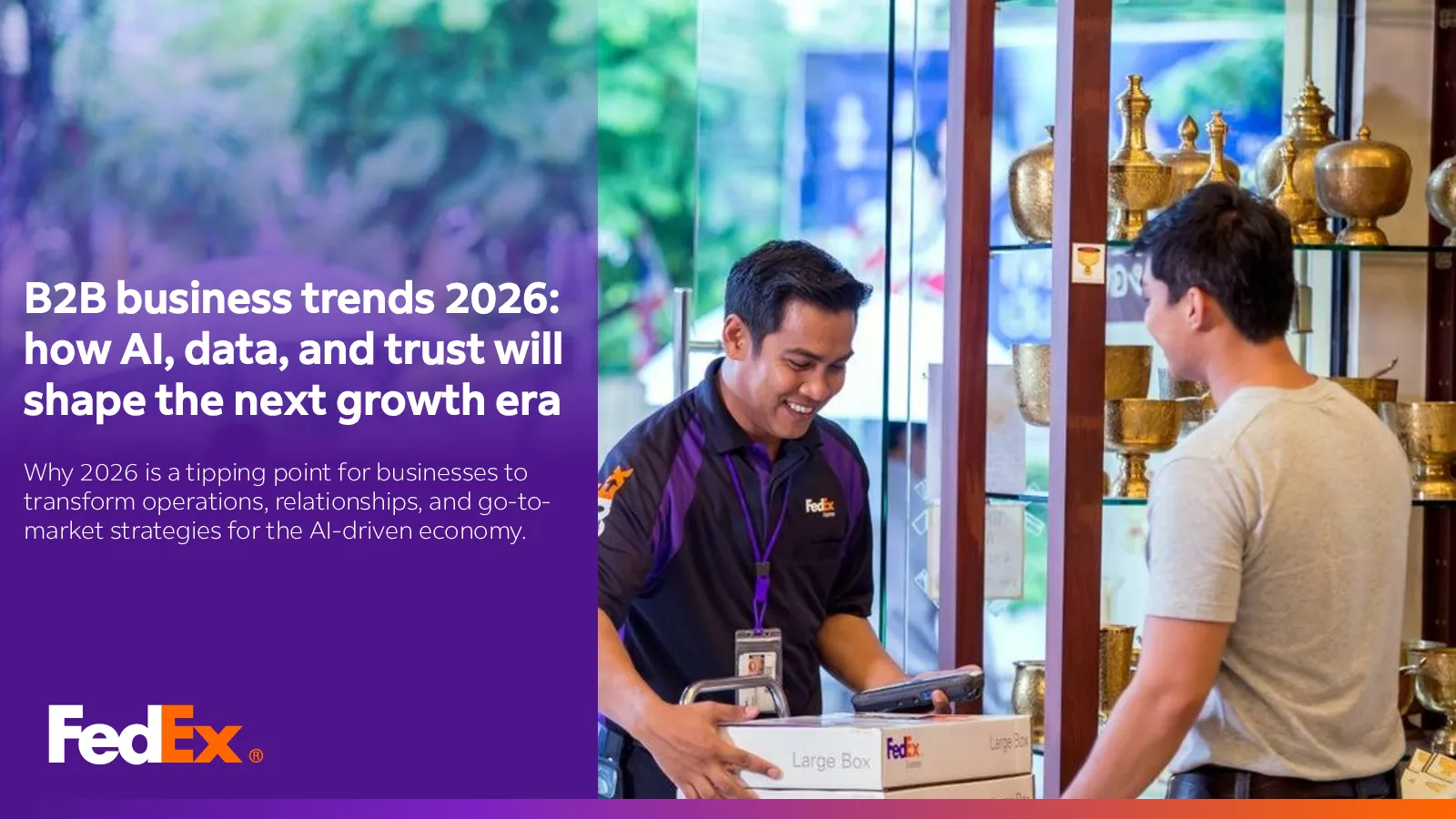
报告封面

Why 2026 is a tipping point for businesses totransform operations, relationships, and go-to- The future in motion: harnessing 2026trends for competitive edge Methodology To deliver a comprehensive thought leadership report on the dynamic future of the businesslandscape, FedEx worked with C Space toanalyze industry data as well as communities of Sources and references are diligently footnoted to provide transparency and credibility to theinsights presented. Our methodology ensures a rich and nuanced exploration of the 2025 businesslandscape, to highlight the key takeaways and trends to consider going into 2026. Thisreport provides thoughtful and actionable takeaways throughout,empowering readers to leverage these insights and grow your business. For more information about how FedEx can support your business throughout theyear,visit our Small Business Resources Center. The four pillars smart businesses must prioritize for 2026 Click on a topic below to jump to the insights! Resilient supply chains: 3AI democratization:Accessible AI tools are becoming a standard part ofbusiness operations, enabling companies of all sizes toautomate tasks, gain real-time insights, and improve 1Intelligent ecosystems using automation, AI, and digitalplatforms will boost efficiency, cut costs, improve Data and automation: 4Big Data and AI will transform decision-making andefficiency through advanced analytics, automating tasks, 2Enhanced competitiveness by adopting digital self-service portals and AI-driven personalization will help to Supply chain management is evolving intoan intelligent, self-optimizing ecosystem What does this meanfor your business? Automation, AI, and digital platforms are merging to enhance supply chain resilience,adaptability, and responsiveness, transforming how goods move, and decisions are made. Leading companies will transformsupply chains by integrating AI andautomation, setting new standards for Automation and AI accelerate responsiveness: Digital platforms build real-time visibility: AI and automation enable self-adjusting supplynetworks that optimize labor and speed delivery. IoT-enabled sensors and Digital-twin simulations**enable proactive risk management, inventoryrebalancing, and real-time shipment rerouting. Forward-thinking businesses will useAI in supply management to automatetasks and gain predictive insights, 80% of companies in 2025 reportimproved end-to-end supply-chain visibilitythrough digital of logistics firms report positive ROI from warehouseautomation2. Organizations that adopt digitalplatforms for supply chain visibility willachieve significant efficiency and costsavings, aligning innovations with 57% of supply-chain leaders* use AI to predict demand,prevent disruptions, and improve accuracy¹. Digital-twin simulations**deliverup to10% efficiency gainsand30% cost savings³. IoT-enabled sensorsdetect60%+of potential disruptions earlier2. *Supply chain leaders are defined as respondents with strategic and operationalresponsibility in supply chain, manufacturing, or operations roles. Multi-sourcing, near-shoring, and AIrouting are embraced for stability What does this meanfor your business? The rise of flexible supplier networks, and shared logistics partnerships signalsa new era ofagile, data-driven supply chainsdesigned to anticipate disruption rather than react to it. Companies that embrace adaptablesupplier networks can better handlegeopolitical changes and seize new havediversified supplierstooffset tariffs and disruptions¹58% business leaders citegeopoliticalriskas a growing concern¹ Innovative partnerships for sharedlogistics will be vital, cutting costs,speeding up deliveries, and improving Collaboration and flexible supplier networks as emerging growth drivers: Firms are shifting fromlinear to segmented networks, combiningoffshore, nearshore,friendshore, and onshoresourcing² ³.Companies are partnering acrosssuppliers, customers, and competitors to build agile and sustainable supply chains4. Strategic collaborations that providevalue-added services like tieredsavings and cash-flow support are key Amazon and FedEx relationship:Expands Amazon’s residential delivery for large Businesses are adopting new tools,partnerships, and strategies to managechallenges and uncertainty What does this meanfor your business? Tariffs and geopolitical tensions are pushing businesses to adapt through new sourcing Leading companies will diversifysupplier networks and regionalizesupply chains, especially in Mexico and Business planning checklist: Where to source?: Many business are shifting sourcingfromChinatoSoutheast Asia, Mexico, or local suppliers¹, or are usingwarehousing, flexible capacity,andscenario planningtomanage shocks²,³. Industry leaders will integrate scenarioplanning and agile contracting intotheir operations to quickly adapt tochanges in tariffs or geopolitics, using ✓Diversify suppliers✓Use digital customs tools✓Partner with logi