您的浏览器禁用了JavaScript(一种计算机语言,用以实现您与网页的交互),请解除该禁用,或者联系我们。 [国际货币基金组织]:产业政策制度:经济发展的基础(英) - 发现报告

产业政策制度:经济发展的基础(英)

报告封面

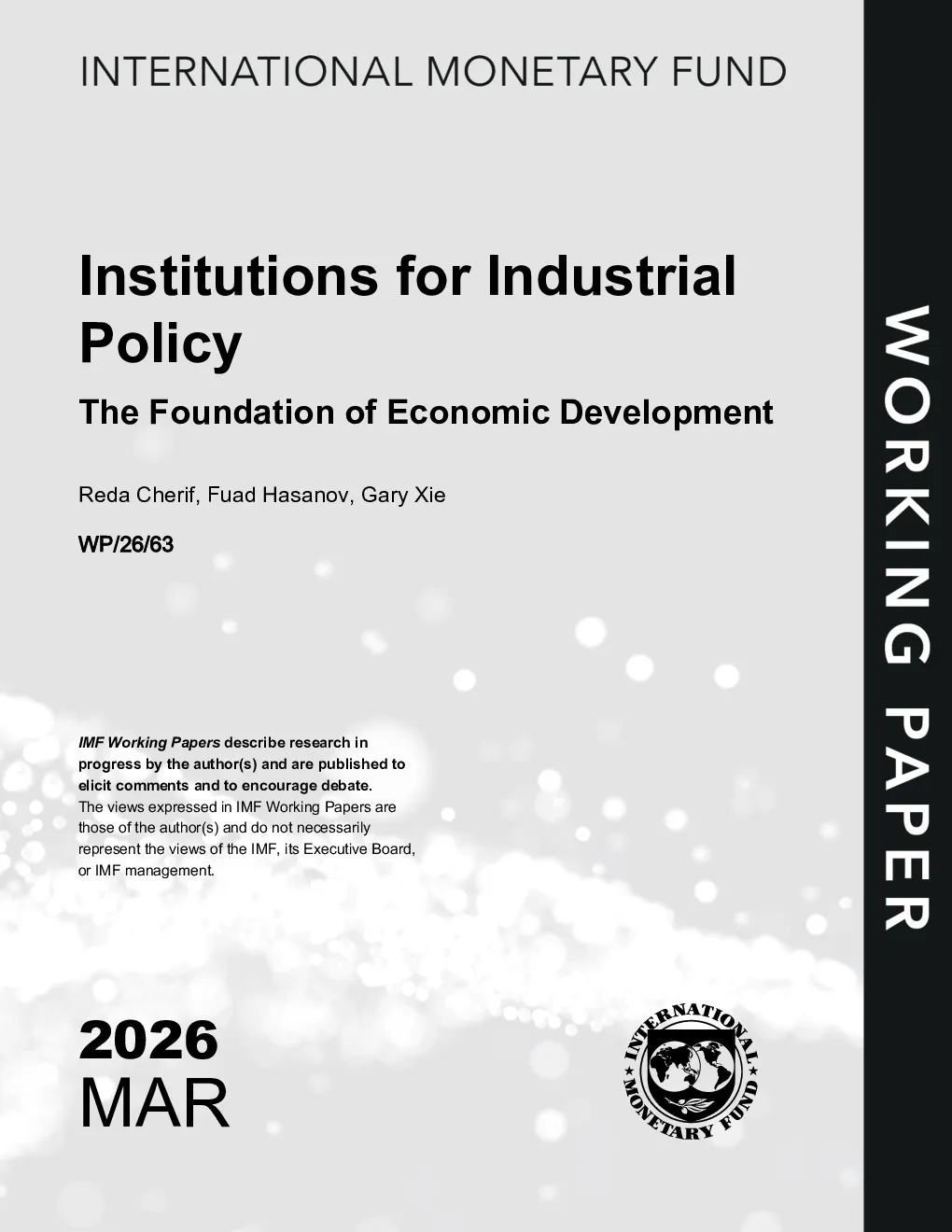
Institutions for IndustrialPolicy The Foundation of Economic Development Reda Cherif, Fuad Hasanov, Gary Xie WP/26/63 IMF Working Papersdescribe research inprogress by the author(s) and are published toelicit comments and to encourage debate.The views expressed in IMF Working Papers arethose of the author(s) and do not necessarilyrepresent the views of the IMF, its Executive Board,or IMF management. 2026MAR IMF Working Paper Institute for Capacity Development Institutions for Industrial Policy: The Foundation of Economic DevelopmentPrepared by Reda Cherif, Fuad Hasanov, Gary Xie* Authorized for distribution by Oussama KanaanMarch 2026 IMF Working Papersdescribe research in progress by the author(s) and are published to elicitcomments and to encourage debate.The views expressed in IMF Working Papers are those of theauthor(s) and do not necessarily represent the views of the IMF, its Executive Board, or IMF management. ABSTRACT:We propose an institutional architecture for the successful implementation of industrial policyinspired by the Asian Miracles—Japan, Korea, Taiwan Province of China, Singapore, and Hong Kong SAR.The key institutional arrangement is a leading agency, accumulating sector-specific knowledge throughcontinuous experimentation and feedback from markets, to design the sector- and context-appropriate packageof policies, which isa prioriunknown, and coordinate its implementation. We also postulate a 4A model ofinstitutional features of the leading agency: Ambition-Agency, Autonomy, Accountability, and Adaptability. Wedraw strong parallels with the rise of independent central banks, inferring concrete steps to achieve thesecharacteristics. RECOMMENDED CITATION:Cherif, R., F. Hasanov, and G. Xie. 2026.Institutions for Industrial Policy: TheFoundation of Economic Development. IMF Working Paper WP/26/63. Washington, DC: International MonetaryFund. Institutions for Industrial Policy: The Foundation of Economic Development Prepared by Reda Cherif, Fuad Hasanov, Gary Xie Contents Introduction ......................................................................................................................................................... 5 Institutions for Industrial Policy ...................................................................................................................... 10Hardware: The Institutional Structure........................................................................................................... 10Sector Targeting and Coordination .............................................................................................................. 11A Leading Agency as the House of Knowledge or “Metis” .................................................................... 15The Political Economy of the Leading Agency............................................................................................. 19The Role of the Leading Agencies in the Asian Miracles ...................................................................... 20Mandates............................................................................................................................................... 22The Long Run Focus............................................................................................................................. 23Economy-wide Goals............................................................................................................................ 24Structural Transformation...................................................................................................................... 25Internal Organizational Structure ................................................................................................................. 25Political Economy Challenges...................................................................................................................... 29Software: The 4As Model of Institutional Features for Effective Action ....................................................... 31Ambition-Agency ................................................................................................................................... 31Autonomy .............................................................................................................................................. 36Accountability ........................................................................................................................................ 40Adaptability............................................................................................................................................ 44Case Studies ..................................................................................................................................................... 48Building a Silicon Dragon: Taiwan Province of China’s Semiconductor Industry......................................... 48Ambition-Agency .................