全球软件:生成式AI 401:智能体(深入解析)
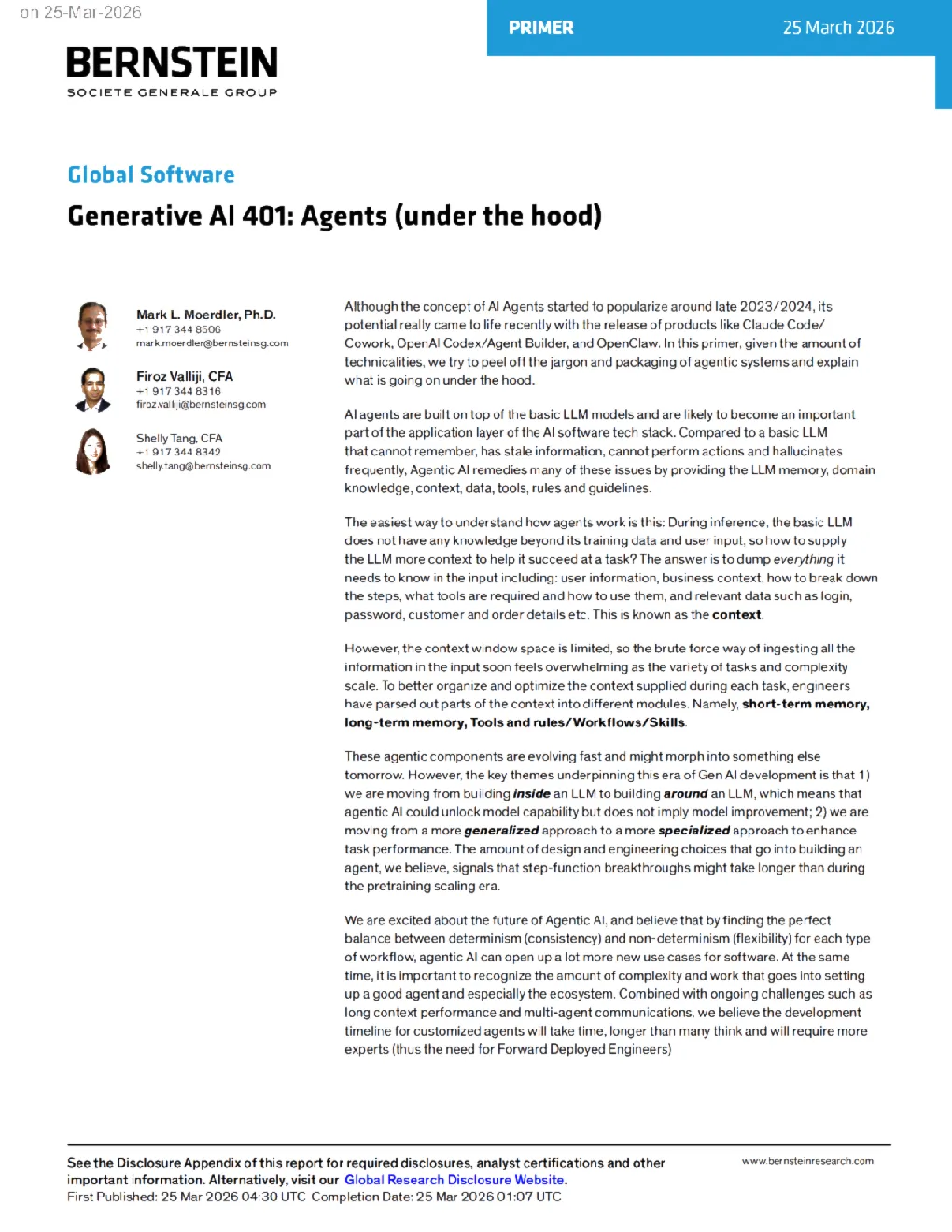
Generative Al 401: Agents (under the hood) Although the concept of Al Agents started to popularize around late 2023/2024, itspotential really came to life recently with the release of products like Claude Code/Cowork, OpenAl Codex/Agent Builder, and OpenClaw. In this primer, given the amount oftechnicalities, we try to peel off the jargon and packaging of agentic systems and explainwhat is going on under the hood. Mark L. Moerdler, Ph.D.+19173448506mark.moerdler@bernsteinsg.com Firoz Vallji, CFA+19173448316firoz.vallji@bernsteinsg.com Al agents are built on top of the basic LLM models and are likely to become an importantpart of the application layer of the Al software tech stack. Compared to a basic LLMthat cannot remember, has stale information, cannot perform actions and hallucinatesfrequently, Agentic Al remedies many of these issues by providing the LLM memory, domainknowledge, context, data, tools, rules and guidelines. Shelly Tang. CFA+19173448342shelly.tang@bernsteinsg.com The easiest way to understand how agents work is this: During inference, the basic LLMdoes not have any knowledge beyond its training data and user input, so how to supplythe LLM more context to help it succeed at a task? The answer is to dump everything itneeds to know in the input including: user information, business context, how to break downthe steps, what tools are required and how to use them, and relevant data such as login,password, customer and order details etc. This is known as the context. However, the context window space is limited, so the brute force way of ingesting all theinformation intheinputsoonfeelsoverwhelmingasthevarietyoftasksand complexityhave parsed out parts of the context into different modules. Namely, short-term memory,long-termmemory,Toolsandrules/Workflows/Skills. These agentic components are evolving fast and might morph into something elsetomorrow. However, the key themes underpinning this era of Gen Al development is that 1)we are moving from building inside an LLM to building around an LLM, which means thatagentic Al could unlock model capability but does not imply model improvement; 2) we aretask performance. The amount of design and engineering choices that go into building anagent, we believe, sig nals that step-function breakthroughs might take longer than duringthe pretraining scaling era. We are excited about the future of Agentic Al, and believe that by finding the perfectbalance between determinism (consistency) and non-determinism (flexibility) for each typeof workflow, agentic Al can open up a lot more new use cases for software. At the sametime,it is important to recognize the amount of complexity and work that goes into settinglong context performance and multi-agent communications, we believe the developmenttimeline for customized agents will take time, longer than many think and will require moreexperts(thustheneedforForwardDeployedEngineers) BERNSTEINTICKERTABLE INVESTMENTIMPLICATIONS Agentic Al represents the next wave of innovation in Generative Al technology and is likely to become an important part of theapplication layer of the Al software tech stack (versus LLM's and agentic development tools which will become part of the Paaslayer). We will see more agents to be rolled out at the application software companies in our coverage. We believe havingcustomer data and domain knowledge expertise are key advantages for these companies, but in some use cases buildingagentic Al could require a lot more efforts than many imagined so it is likely to take longer. Unlike pure LLM where compute is predominantly GPU-based, many of the agentic steps will be performed on the CPU's. Asagentic Aladoption increases we should see an increase in CPU consumption -a possible tailwind for the hyperscalers suchas Microsoft and Oracle within our coverage, driving both additional revenue and incrementally higher gross margins for Alworkloads overtraining orpure inferencing. Building effective agents also require significant groundwork in data infrastructure. Hence, we see many names in ourwill also use more data driving an incremental tailwind for Cloud database vendors such as Microsoft, Oracle, MongoDB andSnowflake. The complexity of building Agents is also driving the need for more high level consultants and Forward Deployed Engineers asdiscussed in Forward Deployed Engineering (FDE): Where Al software meets the real world. Table Of Contents High-level Summary and lingering food for thoug ht..3How did we go from the 2022 ChatGPT to agents today?.6A very stripped-down way of looking at agent....7Memory: Keeping track of history.9Memory: Retrieve additional knowledge.11Tools and MCP: Enable actions.Agent Tool schema....13What is an MCP?...15How LLMs know when and which tool to call...17Workflow/skills/system prompts: Improve accuracy and efficiency..19 DETAILS After ChatGPT's meteoric rise to popularity in late 2022/early 2023, many have wondered what the next killer product /capabi