您的浏览器禁用了JavaScript(一种计算机语言,用以实现您与网页的交互),请解除该禁用,或者联系我们。 [联合国]:冲突及其冲击波:阿拉伯地区危机升级——基于情景的评估 - 发现报告

冲突及其冲击波:阿拉伯地区危机升级——基于情景的评估

2026-03-19 联合国 Aaron
报告封面

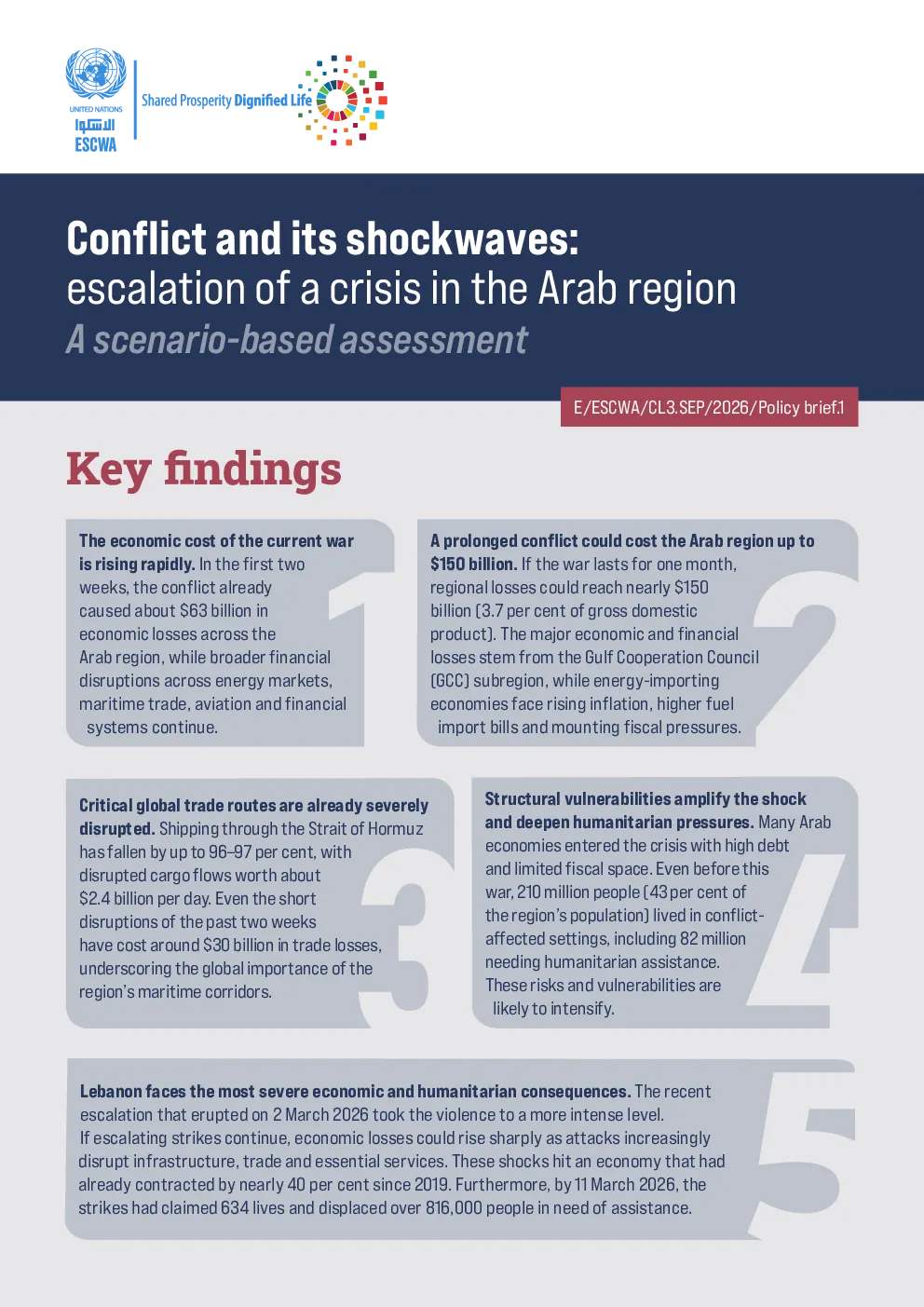
E/ESCWA/CL3.SEP/2026/Policy brief.1 Key findings A prolonged conflict could cost the Arab region up to$150 billion.If the war lasts for one month, The economic cost of the current waris rising rapidly.In the first twoweeks, the conflict alreadycaused about $63 billion ineconomic losses across theArab region, while broader financialdisruptions across energy markets,maritime trade, aviation and financialsystemscontinue. regional losses could reach nearly $150billion (3.7percent of gross domesticproduct). The major economic and financiallosses stem from the Gulf Cooperation Council(GCC) subregion, while energy-importingeconomies face rising inflation, higher fuelimport bills and mounting fiscal pressures. Structural vulnerabilities amplify the shockand deepen humanitarian pressures.Many Arabeconomies entered the crisis with high debtand limited fiscal space. Even before thiswar, 210 million people (43percent ofthe region’s population) lived in conflict-affected settings, including 82 millionneeding humanitarian assistance.These risks and vulnerabilities arelikely to intensify. Critical global trade routes are already severely disrupted.Shipping through the Strait of Hormuzhas fallen by up to 96–97percent, withdisrupted cargo flows worth about$2.4 billionperday. Even the shortdisruptions of the past two weekshave cost around $30 billion in trade losses,underscoring the global importance of theregion’s maritime corridors. Lebanon faces the most severe economic and humanitarian consequences.The recentescalation that erupted on 2 March 2026 took the violence to a more intense level.Ifescalating strikes continue, economic losses could rise sharply as attacks increasinglydisrupt infrastructure, trade and essential services. These shocks hit an economy that hadalready contracted by nearly 40percent since 2019. Furthermore, by 11 March 2026, thestrikes had claimed 634 lives and displaced over 816,000 people in need of assistance. Introduction Escalating war and its shockwaves, including the waraffecting Lebanon, represent a major geopoliticalshock with significant socioeconomic implicationsfor the Arab region. The current conflict risksdisrupting energy markets, maritime trade routes,aviation networks, supply chains and financial flows,and heightening humanitarian pressures. Given theregion’s central role in global energy production andtransport corridors, instability can rapidly transmit through global markets while affecting livelihoodsand economic activity. The present brief provides a scenario-basedassessment of the potential impacts of the war onArab economies, examining how different durationsand intensities of hostilities could affect energy,trade, logistics systems, financial markets andregional economic stability. 1. Pre-existing structural vulnerabilitiesshaping the impact of war The socioeconomic impact of conflict in the Arabregion is amplified by pre-existing structuralvulnerabilities across the region, including in GCCcountries and major economies such as Egypt. Theregion occupies a strategic position in global energymarkets and international transport networks, makingit particularly sensitive to geopolitical disruptionsaffecting maritime trade routes and energy flows. prolonged geopolitical disruptions while maintainingsocial spending and economic stability. Humanitarian and social vulnerabilities are alsosignificant. Prior to the current escalation, conflict-affected Arab countries were home to approximately210 million people, representing about 43percentof the region’s population.1Among them, 82 millionrequired humanitarian assistance.2Moreover, the regionhosted 31.1 million internally displaced persons (IDPs),accounting for roughly 40percent of the global IDPpopulation,3and 6.2 million refugees, about 20percentof the global refugee population.4Humanitarian needshave also risen steadily, increasing from 59 millionpeople in need in 2018 to 82 million in 2026.5 The GCC subregion hosts some of the world’slargest oil and gas exporters and contains criticalmaritime chokepoints linking Asian, Europeanand African markets. The Strait of Hormuz alonehandles around 20 million barrels of oilperday,representing roughly one quarter of globalseaborne oil trade. Together with the Red Seacorridor, these routes form essential arteriesfor global energy and goods trade. Disruptionsto these corridors can rapidly increase shippingcosts, insurance premiums and supply-chain risks,while generating inflationary pressures and fiscalchallenges across many Arab economies. Humanitarian response efforts depend heavilyon a relatively concentrated donor base. In 2025,humanitarian assistance from GCC countries reachedapproximately $4.44 billion, with Qatar, SaudiArabia and the United Arab Emirates making mostcontributions. Overall, GCC donors provided about43percent of total humanitarian aid received by Arabconflict-affected countries.6 At the same time, many Arab countries face limitedfiscal space, high public deb