亚洲洞察|中国月度观察:2月数据前瞻
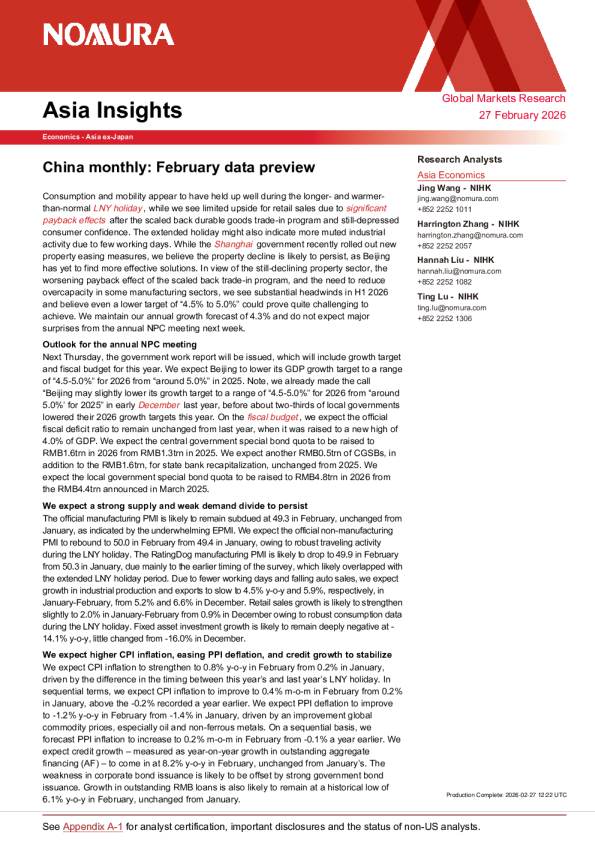
Global Markets Research27 February 2026 Asia Insights Economics - Asia ex-Japan Research Analysts China monthly: February data preview Asia Economics Jing Wang - NIHKjing.wang@nomura.com+852 2252 1011 Consumption and mobility appear to have held up well during the longer- and warmer-than-normalLNY holiday, while we see limited upside for retail sales due tosignificantpayback effectsafter the scaled back durable goods trade-in program and still-depressedconsumer confidence. The extended holiday might also indicate more muted industrialactivity due to few working days. While theShanghaigovernment recently rolled out newproperty easing measures, we believe the property decline is likely to persist, as Beijing Harrington Zhang - NIHKharrington.zhang@nomura.com+852 2252 2057 Hannah Liu - NIHKhannah.liu@nomura.com+852 2252 1082 Ting Lu - NIHKting.lu@nomura.com+852 2252 1306 Outlook for the annual NPC meetingNext Thursday, the government work report will be issued, which will include growth target and fiscal budget for this year. We expect Beijing to lower its GDP growth target to a rangeof “4.5-5.0%” for 2026 from “around 5.0%” in 2025. Note, we already made the call“Beijing may slightly lower its growth target to a range of “4.5-5.0%” for 2026 from “around5.0%’ for 2025” in earlyDecemberlast year, before about two-thirds of local governmentslowered their 2026 growth targets this year. On thefiscal budget, we expect the officialfiscal deficit ratio to remain unchanged from last year, when it was raised to a new high of We expect a strong supply and weak demand divide to persist The official manufacturing PMI is likely to remain subdued at 49.3 in February, unchanged fromJanuary, as indicated by the underwhelming EPMI. We expect the official non-manufacturingPMI to rebound to 50.0 in February from 49.4 in January, owing to robust traveling activityduring the LNY holiday. The RatingDog manufacturing PMI is likely to drop to 49.9 in Februaryfrom 50.3 in January, due mainly to the earlier timing of the survey, which likely overlapped withthe extended LNY holiday period. Due to fewer working days and falling auto sales, we expect We expect higher CPI inflation, easing PPI deflation, and credit growth to stabilizeWe expect CPI inflation to strengthen to 0.8% y-o-y in February from 0.2% in January, driven by the difference in the timing between this year’s and last year’s LNY holiday. Insequential terms, we expect CPI inflation to improve to 0.4% m-o-m in February from 0.2%in January, above the -0.2% recorded a year earlier. We expect PPI deflation to improveto -1.2% y-o-y in February from -1.4% in January, driven by an improvement globalcommodity prices, especially oil and non-ferrous metals. On a sequential basis, weforecast PPI inflation to increase to 0.2% m-o-m in February from -0.1% a year earlier. We Production Complete: 2026-02-27 12:22 UTC February data preview Official manufacturing PMI in February: 49.3 (January: 49.3) Official non-manufacturing PMI in February: 50.0 (January: 49.4) RatingDog manufacturing PMI in February: 49.9 (January: 50.3)We expect the official manufacturing PMI to remain weak at 49.3 in February, unchanged from January, owing to the reduced number of working days. The later- and longer-than-usual LNY holiday that reduced working days in February should weaken businessactivity. China’s EPMI, a non-seasonally adjusted leading indicator of the official PMI, We expect the official non-manufacturing PMI to rebound to 50.0 in February from 49.4 inJanuary, in view of strong traveling activity during the longer- and warmer- than-usual LNYholiday. But this momentum may not last long due to the ongoing austerity rule thatdiscourages government officials from dining out, still falling home prices, and limited We expect the RatingDog manufacturing PMI (formerly Caixin manufacturing PMI), whichsurveys more SMEs and exporters in the eastern coastal region of China, to drop to 49.9in February from 50.3 in January, due to less working days during the survey which could Industrial production growth in January-February: 4.5% y-o-y (December: 5.2%) We expect industrial production (IP) growth to drop to 4.5% y-o-y in January-Februaryfrom 5.2% in December, due mainly to fewer working days and falling auto sales. Thenumber of working days is 37 in January-February, one day fewer than January-February The weekly operating rate of cement factories dropped to 3.2pp above last year’sJanuary and February average levels from 5.0pp above its year earlier level inDecember.The weekly cement shipment-to-output ratio improved to 6.5pp above last year’sJanuary and February average level from 0.0pp above its year earlier level inDecemberGrowth in weekly steel rebar output at major steel mills rebounded to 1.3% in Januaryand month-to-date February, up from -12.7% in December.The operating rate of asphalt factories dropped to 1.7pp below its year earlier level in Export growth in January-February