聚焦国内Robotaxi,技术与商业化进度领先
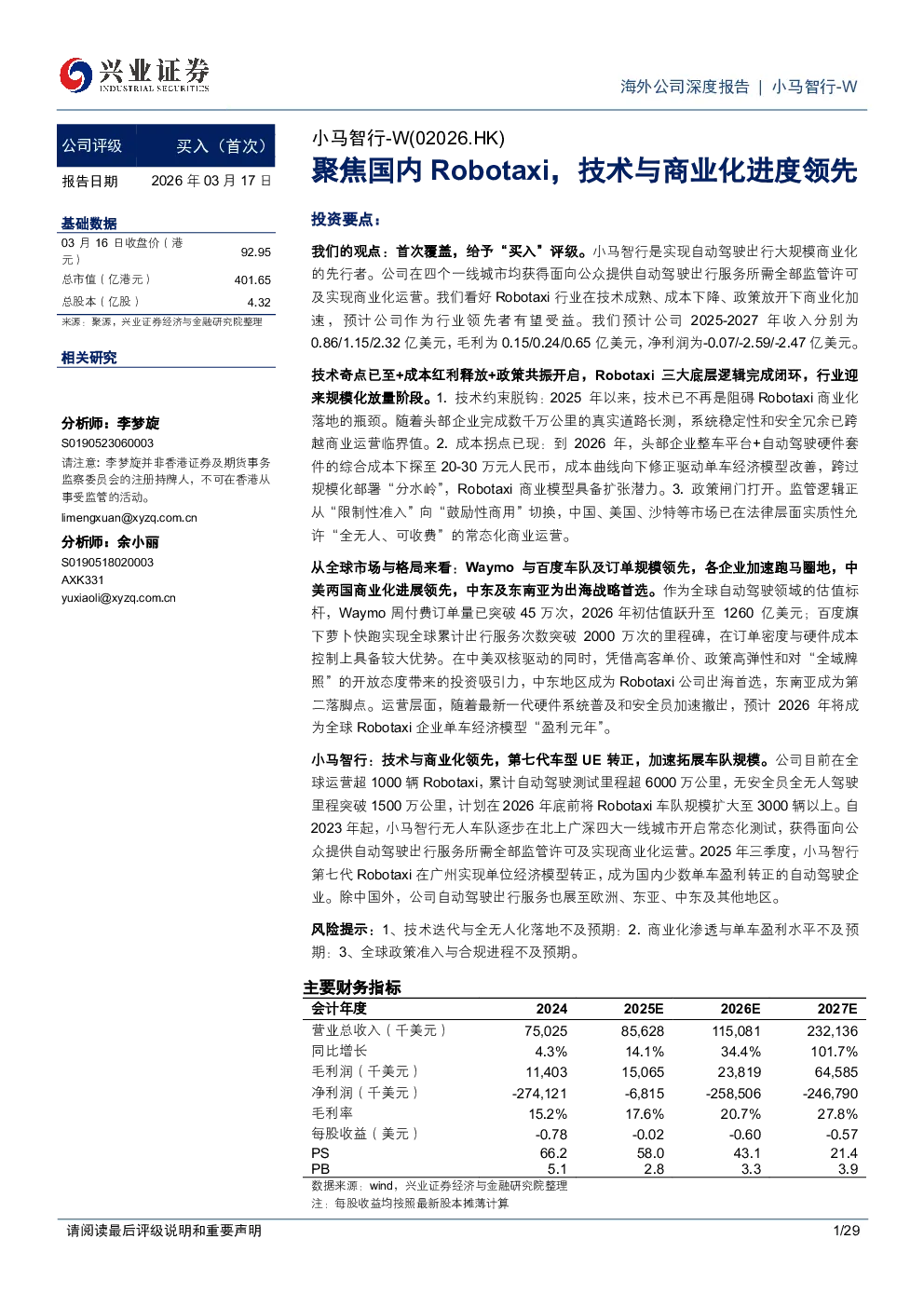
公司评级买入(首次) 聚焦国内Robotaxi,技术与商业化进度领先 报告日期2026年03月17日 投资要点: 我们的观点:首次覆盖,给予“买入”评级。小马智行是实现自动驾驶出行大规模商业化的先行者。公司在四个一线城市均获得面向公众提供自动驾驶出行服务所需全部监管许可及实现商业化运营。我们看好Robotaxi行业在技术成熟、成本下降、政策放开下商业化加速 , 预 计 公 司 作 为 行 业 领 先 者 有 望受 益。 我 们 预 计 公 司2025-2027年 收 入 分 别 为0.86/1.15/2.32亿美元,毛利为0.15/0.24/0.65亿美元,净利润为-0.07/-2.59/-2.47亿美元。 相关研究 技术奇点已至+成本红利释放+政策共振开启,Robotaxi三大底层逻辑完成闭环,行业迎来规模化放量阶段。1.技术约束脱钩:2025年以来,技术已不再是阻碍Robotaxi商业化落地的瓶颈。随着头部企业完成数千万公里的真实道路长测,系统稳定性和安全冗余已跨越商业运营临界值。2.成本拐点已现:到2026年,头部企业整车平台+自动驾驶硬件套件的综合成本下探至20-30万元人民币,成本曲线向下修正驱动单车经济模型改善,跨过规模化部署“分水岭”,Robotaxi商业模型具备扩张潜力。3.政策闸门打开。监管逻辑正从“限制性准入”向“鼓励性商用”切换,中国、美国、沙特等市场已在法律层面实质性允许“全无人、可收费”的常态化商业运营。 分析师:李梦旋S0190523060003请注意:李梦旋并非香港证券及期货事务监察委员会的注册持牌人,不可在香港从事受监管的活动。limengxuan@xyzq.com.cn 分析师:余小丽S0190518020003AXK331yuxiaoli@xyzq.com.cn 从全球市场与格局来看:Waymo与百度车队及订单规模领先,各企业加速跑马圈地,中美两国商业化进展领先,中东及东南亚为出海战略首选。作为全球自动驾驶领域的估值标杆,Waymo周付费订单量已突破45万次,2026年初估值跃升至1260亿美元;百度旗下萝卜快跑实现全球累计出行服务次数突破2000万次的里程碑,在订单密度与硬件成本控制上具备较大优势。在中美双核驱动的同时,凭借高客单价、政策高弹性和对“全域牌照”的开放态度带来的投资吸引力,中东地区成为Robotaxi公司出海首选,东南亚成为第二落脚点。运营层面,随着最新一代硬件系统普及和安全员加速撤出,预计2026年将成为全球Robotaxi企业单车经济模型“盈利元年”。 小马智行:技术与商业化领先,第七代车型UE转正,加速拓展车队规模。公司目前在全球运营超1000辆Robotaxi,累计自动驾驶测试里程超6000万公里,无安全员全无人驾驶里程突破1500万公里,计划在2026年底前将Robotaxi车队规模扩大至3000辆以上。自2023年起,小马智行无人车队逐步在北上广深四大一线城市开启常态化测试,获得面向公众提供自动驾驶出行服务所需全部监管许可及实现商业化运营。2025年三季度,小马智行第七代Robotaxi在广州实现单位经济模型转正,成为国内少数单车盈利转正的自动驾驶企业。除中国外,公司自动驾驶出行服务也展至欧洲、东亚、中东及其他地区。 风险提示:1、技术迭代与全无人化落地不及预期:2.商业化渗透与单车盈利水平不及预期:3、全球政策准入与合规进程不及预期。 PONY.AI(02026.HK)Stock Connect (SH/SZ)Focused on the domestic Robotaxi market,both technology and commercializationprogress are leading. Investment Highlights: Our View: Initiating coverage with a "Buy" rating.Pony.ai is a pioneer in achieving large-scalecommercialization of autonomous mobility. The company has obtained all necessary regulatory permits toprovide autonomous mobility services to the public and has achieved commercial operations across all fourfirst-tier cities. We are optimistic about the accelerated commercialization of the Robotaxi industry driven bytechnological maturity, falling costs, and policy liberalization; as an industry leader, the company is expectedto benefit. We forecast the company’s revenue for 2025–2027 to be $0.86/$1.15/$2.32 billion, gross profitto be $0.15/$0.24/$0.65 billion, and net profit to be-$0.07/-$2.59/-$2.47 billion, respectively. Analyst:LI Mengxuan S0190523060003Pleasenote:Li Mengxuan is not aregistered licensee with the Hong KongSecuritiesand Futures Commission(SFC) and is not authorized to engage inregulated activities in Hong Kong.limengxuan@xyzq.com.cn With the arrival of the technological singularity, the release of cost dividends, and the onset of policyresonance, the three underlying logics of Robotaxi have achieved a closed loop, ushering theindustry into a stage of large-scale deployment.1.Decoupling of technical constraints: Since 2025,technology has no longer been the bottleneck hindering the commercial implementation of Robotaxis. Asleading companies complete tens of millions of kilometers of real-world road testing, system stability andsafety redundancy have crossed the critical threshold for commercial operation.2.The cost inflection pointhas emerged: By 2026, the combined cost of vehicle platforms and autonomous driving hardware suites forleading companies will drop to RMB 200,000–300,000. The downward correction of the cost curve is drivingthe Unit Economic (UE) model of individual vehicles into positive territory, crossing the "watershed" for large-scale deployment and giving the Robotaxi business model significant expansion potential.3.The policygates have opened: Regulatory logic is shifting from "restrictive access" to "encouraged commercialization."Markets such as China, the United States, and Saudi Arabia have substantially permitted "fully driverless,fee-charging" normalized commercial operations at the legal level. Analyst:YU XiaoliS0190518020003AXK331yuxiaoli@xyzq.com.cn Regarding the global market and landscape: Waymo and Baidu lead in fleet size and order volume,with companies accelerating their efforts to seize market share. China and the U.S. lead incommercialization progress, while the Middle East and Southeast Asiaare the preferred choices forinternational expansion strategies.As the global valuation benchmark for autonomous driving, Waymo'sweekly paid orders have exceeded 450,000, with its valuation jumping to $126 billion in early 2026. Baidu’s Apollo Go reached a milestone of over 20 million cumulative global rides, possessing significantadvantages in order density and hardware cost control. While driven by the China-U.S. dual-core, the MiddleEast has become the top choice for Robotaxi expansion due to high average order values, high policyelasticity, and the investment appeal of an open attitude toward "full-region licenses," with Southeast Asiaserving as the secondary destination. On the operational level, with the popularization of the latest hardwaresystems and the accelerated removal of safety drivers, 2026