亚洲宏观洞察:焦点全在霍尔木兹海峡
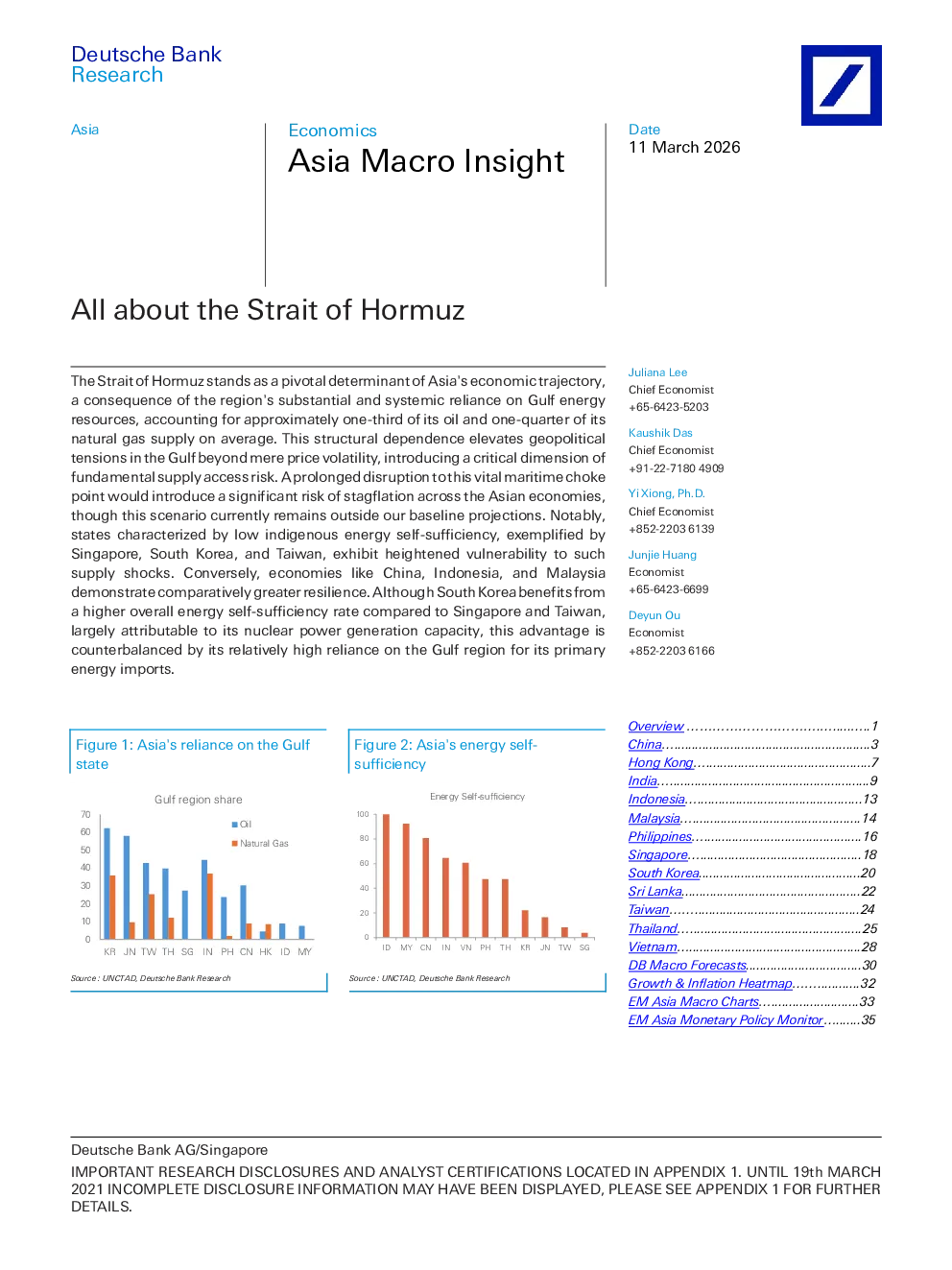
Asia Asia Macro Insight All about the Strait of Hormuz Juliana Lee The Strait of Hormuz stands as a pivotal determinant of Asia's economic trajectory,a consequence of the region's substantial and systemic reliance on Gulf energyresources, accounting for approximately one-third of its oil and one-quarter of itsnatural gas supply on average. This structural dependence elevates geopoliticaltensions in the Gulf beyond mere price volatility, introducing a critical dimension offundamental supply access risk. A prolonged disruption to this vital maritime chokepoint would introduce a significant risk of stagflation across the Asian economies,though this scenario currently remains outside our baseline projections. Notably, Chief Economist Kaushik DasChief Economist Yi Xiong, Ph.D.Chief Economist Junjie HuangEconomist Deyun OuEconomist Source : UNCTAD, Deutsche Bank Research Source : UNCTAD, Deutsche Bank Research Overview While some Asian economies, like Thailand, Vietnam, and the Philippines, exhibita relatively high pass-through of crude oil price shocks to CPI inflation, others likeChina, India, and Indonesia manage this through regulated prices. In contrast,Hong Kong, Singapore, South Korea, and Taiwan often utilize their higher tax Juliana Lee As noted earlier, central bank responses could vary significantly, depending on theextent of oil price rise. In a more severe scenario where surging oil prices sharplyweaken their currencies, central banks in Indonesia (BI), the Philippines (BSP), and A more benign scenario with elevated oil prices, not high enough to raise growthconcerns, could lead the Monetary Authority of Singapore (MAS) to tighten moreaggressively and Bank Negara Malaysia (BNM), Bank of Korea (BoK), and ReserveBank of India (RBI) to bring forward their rate hikes. Conversely, the Bank of Thailand The People's Bank of China (PBoC) will continue to utilize structural monetary policytools to direct the economy. While we have refrained from adjusting our monetarypolicy outlook given the volatile geopolitical situation, governments across the Regardless of the immediate outcome, the current geopolitical environment willleave a lasting mark on Asia's approach to energy security, likely prompting greater Source : IEA (CC BY 4.0), Deutsche Bank Research Source : CEIC, Deutsche Bank Research Source : CEIC, Deutsche Bank Research China Yi Xiong Government Work Plan On the first day of the National People's Congress, Premier Li Qiang delivered areport on the government's work plan. We believe that the policy signals from the 2026 growth target is lowered slightly to 4.5% - 5% range.This is in line with ourprevious expectations. It is worth noting that the government once again reiteratedthe long-term goal of doubling per capita GDP by 2035 from 2020. According to ourestimates, this requires China's average annual economic growth rate to remainabove 4% for the next decade. The government stated that this adjustment to the The government maintained budgetary deficit target at 4%, while the overalldeficit may drop slightly from last year. We estimate this year's aggregate fiscaldeficit at 8.7% (compared to 9% last year). Specifically, the government maintainedultra-long-term special national bonds and local special bonds unchanged (atCNY1.3 tr and CNY4.4 tr, respectively), while reducing special CGBs for bank The government will maintain its current "moderately loose" monetary policystance, with a greater emphasis on promoting a reasonable recovery in prices. Itwill "flexibly and efficiently utilize various tools such as reserve requirement ratio(RRR) cuts and interest rate reductions", which we think implies that the use of RRRcuts and interest rate reductions will depend on economic outcomes and in Source : Deutsche Bank Research, CEIC Service consumption replaces goods consumption as the focus for boostingdomestic demand. The government will adopt a series of measures, such asinterest rate subsidies, consumer vouchers, deregulation, increased holidays, and Anti-involution remains a policy priority with some changes to the approach.Regulating local government investment promotion and subsidy practices is seenascrucial for curbing overcapacity expansion and excessive competition.Additionally, the government once again mentionedstrengthening anti-monopoly Openingup and RMB internationalization.The government emphasizedexpandingopening up in service industries such as telecommunications,biotechnology, and hospitals, encouraging foreign reinvestment in China. It will Iran shock and China If the world economy faces energy shortages and rising inflation as a result of theIran Shock, it is not necessarily bad for China – an economy struggling with excess While China's reliance on imported oil is high, its overall energy mix issignificantly less dependent on oil than other major economies.Fossil fuelsconstitute only about a quarter of the country's total energy consumption, a figuresub