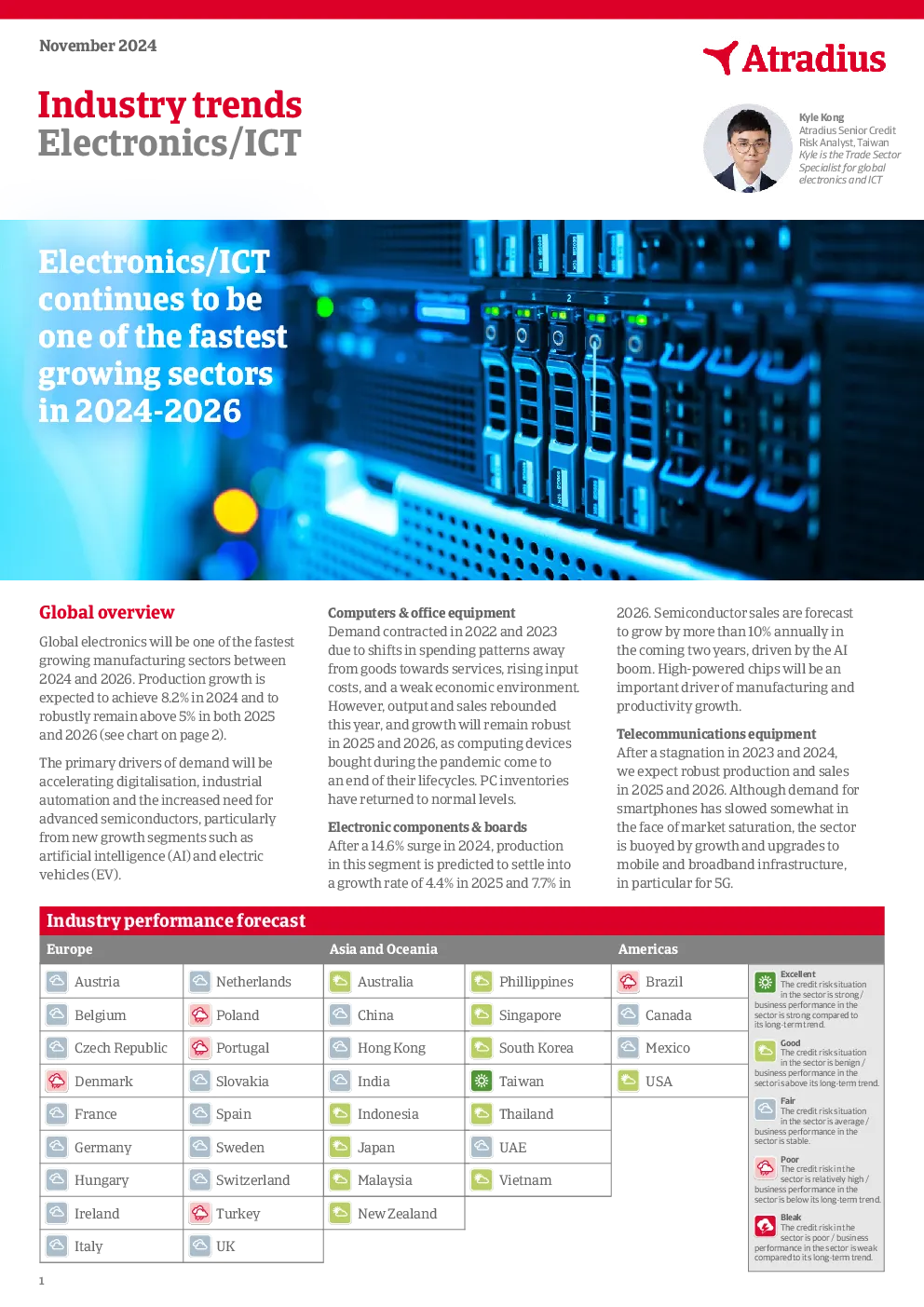
Kyle KongAtradius Senior Credit Risk Analyst, TaiwanKyle is the Trade SectorSpecialist for globalelectronics and ICT Electronics/ICTcontinues to beone of the fastestgrowing sectorsin 2024-2026Electronics/ICTcontinues to beone of the fastestgrowing sectorsin 2024-2026 Global overview 2026. Semiconductor sales are forecastto grow by more than 10% annually inthe coming two years, driven by the AIboom. High-powered chips will be an Computers & office equipment Demand contracted in 2022 and 2023due to shifts in spending patterns awayfrom goods towards services, rising inputcosts, and a weak economic environment.However, output and sales reboundedthis year, and growth will remain robust Global electronics will be one of the fastestgrowing manufacturing sectors between2024 and 2026. Production growth isexpected to achieve 8.2% in 2024 and to Telecommunications equipment After a stagnation in 2023 and 2024,we expect robust production and salesin 2025 and 2026. Although demand forsmartphones has slowed somewhat inthe face of market saturation, the sector The primary drivers of demand will beaccelerating digitalisation, industrialautomation and the increased need foradvanced semiconductors, particularly Electronic components & boards After a 14.6% surge in 2024, productionin this segment is predicted to settle intoa growth rate of 4.4% in 2025 and 7.7% in Industry trendsElectronics/ICT Constraints and downside risks Strengths and growth drivers Market saturation.In some advanced economies, the marketfor certain ICT products (e.g., personal computers, tablets and High-tech expansion.Electronics/ICT is an innovative andtechnology-driven industry. In particular, the semiconductor US-China tensions.Trade issues have spilled over to technology.Both the Trump and Biden administrations have imposedregulations to prevent Chinese companies from acquiring USsemiconductor manufacturing technologies and equipment. Expanding semiconductor production.This is a strategic target inthe US, EU and Asia. Legislation has been passed recently to support Growth of digitalisation, automation, AI and electric vehicles. Accelerating digitalisation, industrial automation, and increaseddemand for advanced semiconductors from new growth segmentslike artificial intelligence and EVs will all help the ICT industry Growing ‘chip nationalism’.In addition to technologicaldivergences, (e.g. in 5G deployment), chip nationalism could leadto inefficient production processes and increased production costs, Taiwan issue.Given the global importance of Taiwanesesemiconductor production an escalation of the current tensions Electronics/ICT outlookAmericas USA Potential impacts of the Trumpadministration’s economic policies Semiconductor output to drive robust If the incoming Trump administrationimplements its fiscal policy proposals(substantial tax cuts, including reducing thecorporate tax rate to 15%), this would benefitUS technology businesses, as a considerablenumber of them are highly leveraged andcapital-intensive. An increase of tariffson Chinese imports to 60% would havefar-reaching consequences. According to We expect US electronics and computerproduction to increase by 6.6% in 2024,followed by increases of 2.9% in 2025 and5.2% on 2026. After growing by 9.5% this year The credit risk in the sectoris relatively high / businessperformance in the sector Growth is being driven by the electroniccomponents and boards subsector, whichwe expect to expand by 8.3% this year andby 4.5% in 2025. Cloud computing andstorage, automated data processing, and The credit risk in the sector ispoor / business performancein the sector is weak compared In the medium-term semiconductorinvestment and production will be boostedby the 2022 CHIPS and Science Act. The Act issupported by USD 40 billion in subsidies anda 25% tax credit to promote manufacturing athome, as well as USD 13 billion of investment US production of telecommunicationsequipment has grown strongly in recentyears due to upgrades to broadbandinfrastructure and to 5G mobile systems. Precision instruments are still the largestelectronics subsector in the US. Aftertwo years of decline, production in thissegment is forecast to return to growth (1.8% Electronics/ICT outlookAsia Pacific China Japan / South Korea / Taiwan High-tech goods enjoy growth, although USrestrictions present a downside risk High-tech is a key sector for China, so UStariffs are likely to have a deep impact The growth of high-tech goods will be robustin these East Asian markets in 2024 and2025 (see chart above). Both South Koreaand Taiwan benefit from the current highdemand for semiconductors. Japan has China produces more than half of theworld’s electronic goods, computers andtelecommunications, and the industry’sfortunes inevitably reflect global demand.We expect Chinese electronics andcomputer production to increase by 11.3%in 2024 and by 5.2% in 2025. Increasingworldwide demand for computersand offic