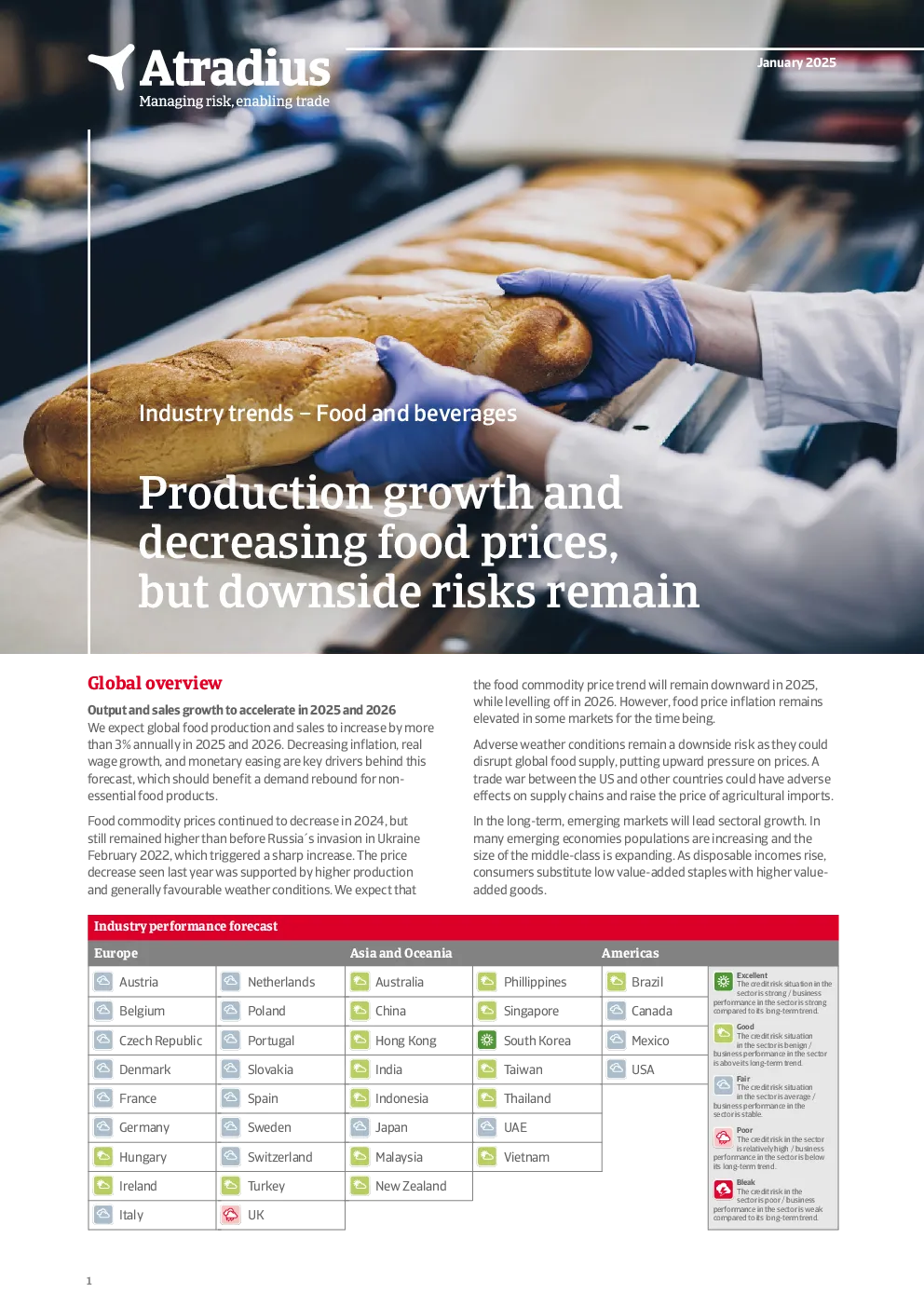
Industry trends – Food and beverages Production growth anddecreasing food prices, Global overview the food commodity price trend will remain downward in 2025,while levelling off in 2026. However, food price inflation remains Output and sales growth to accelerate in 2025 and 2026We expect global food production and sales to increase by more than 3% annually in 2025 and 2026. Decreasing inflation, realwage growth, and monetary easing are key drivers behind this Adverse weather conditions remain a downside risk as they coulddisrupt global food supply, putting upward pressure on prices. Atrade war between the US and other countries could have adverse In the long-term, emerging markets will lead sectoral growth. Inmany emerging economies populations are increasing and thesize of the middle-class is expanding. As disposable incomes rise, Food commodity prices continued to decrease in 2024, butstill remained higher than before Russia´s invasion in UkraineFebruary 2022, which triggered a sharp increase. The price Food and beverages Constraints and downside risks Strengths and growth drivers Margin issues.Profit margins for many food producers arestructurally thin and under pressure. Structural resilience.Demand is inelastic, due to the essential Susceptible to sudden crisis.Price volatility, disease and extremeweather are difficult to predict. Emerging markets growth.Disposable incomes are increasingleading to growth in higher value-added goods. Changing consumer tastes.Consumers are increasinglydemanding foods with health benefits. Critical consumers.Consumers are increasingly demanding fulltransparency from producers. Sustainability.Short-term investment is needed into cleanenergy, green supply chains, food waste reduction and eco- New technologies.Big data solutions are helping to improveefficiency; there is also growth in scientifically engineered AmericasFood and beverages outlook USA Brazil More pressure on margins Price competition weighs on themargins of food businesses We expect Brazilian food output to leveloff in 2025, followed by a 1.9% increase in2026. Household consumption is forecastto slow this year as high food pricesweigh on disposable incomes, the labourmarket is weakening and interest rateshave increased. Discount promotions by We expect US food and beveragesoutput to increase by 1.4% in 2025 andby 2.0% next year. Consumer spendingis underpinned by a tight labour marketand growth of real wages. Consumer The credit risk in the sector is poor /business performance in the sector is weakcompared to its long-term trend. That said, food price inflation willcontinue to put pressure on householdbudgets despite some easing in 2024,which affects purchasing patterns. Inthe grocery retail sector, US householdsstill face food prices that are almost30% higher than pre-Covid. Consumersare seeking affordable options, and Mexico Outlook for sector remains positive Food and drink spending in Mexico isexpected to maintain robust outturnthis year, despite a slowing economicenvironment. Food consumption willcontinue to prioritise staples suchas meat and poultry. With a growingpopulation and a large middle-class An imposition of tariffs by the newadministration is a downside risk for theUS food industry. It could complicatesupply chains, reduce food productionby raising the price of agriculturalimports, and lead to higher food prices Sharon BenferAtradius Senior Underwriter in Baltimore, USA.Sharon is our Trade SectorSpecialist for food in theAmericas. Asia PacificFood and beverages outlook China India Growth remains robust despite lowerconsumer confidence Robust sales growth, but elevated foodprices remain an issue China’s rising middle class is more willingto spend than to save on food compared toprevious generations. It is also less price-sensitive and seeks higher quality foodproducts. This is partly reflected in growthprojections where we expect Chinese foodand beverages output to continue growingby about 5% annually in 2025 and 2026.Growing consumer preference for healthy,organic, and functional foods, driven byincreased health awareness is also oneof key drivers for the sector. However, inthe currently difficult environment withlower economic growth and subdued After a 1% contraction in 2024, weexpect Indian food production and salesto increase by more than 8% annually in2025 and 2026. Growth will be driven bypopulation growth and rising householdincomes and living standards. Rapidurbanisation is driving demand forconvenient and packaged foods as urbanconsumers seek quick and easy mealsolutions. However, food price inflationis currently still high, as food producers Indonesia FairThe credit risk situation in the sector isaverage / business performance in thesector is stable. Solid growth, but also challenges In Indonesia, the food and beveragesindustry provides a significantcontribution to economic growth andjob creation. We expect production andsales to grow by abo