您的浏览器禁用了JavaScript(一种计算机语言,用以实现您与网页的交互),请解除该禁用,或者联系我们。 [美国银行]:在移动中:租房者休息一下 - 发现报告

在移动中:租房者休息一下

信息技术 2025-12-01 美国银行 徐红金
报告封面

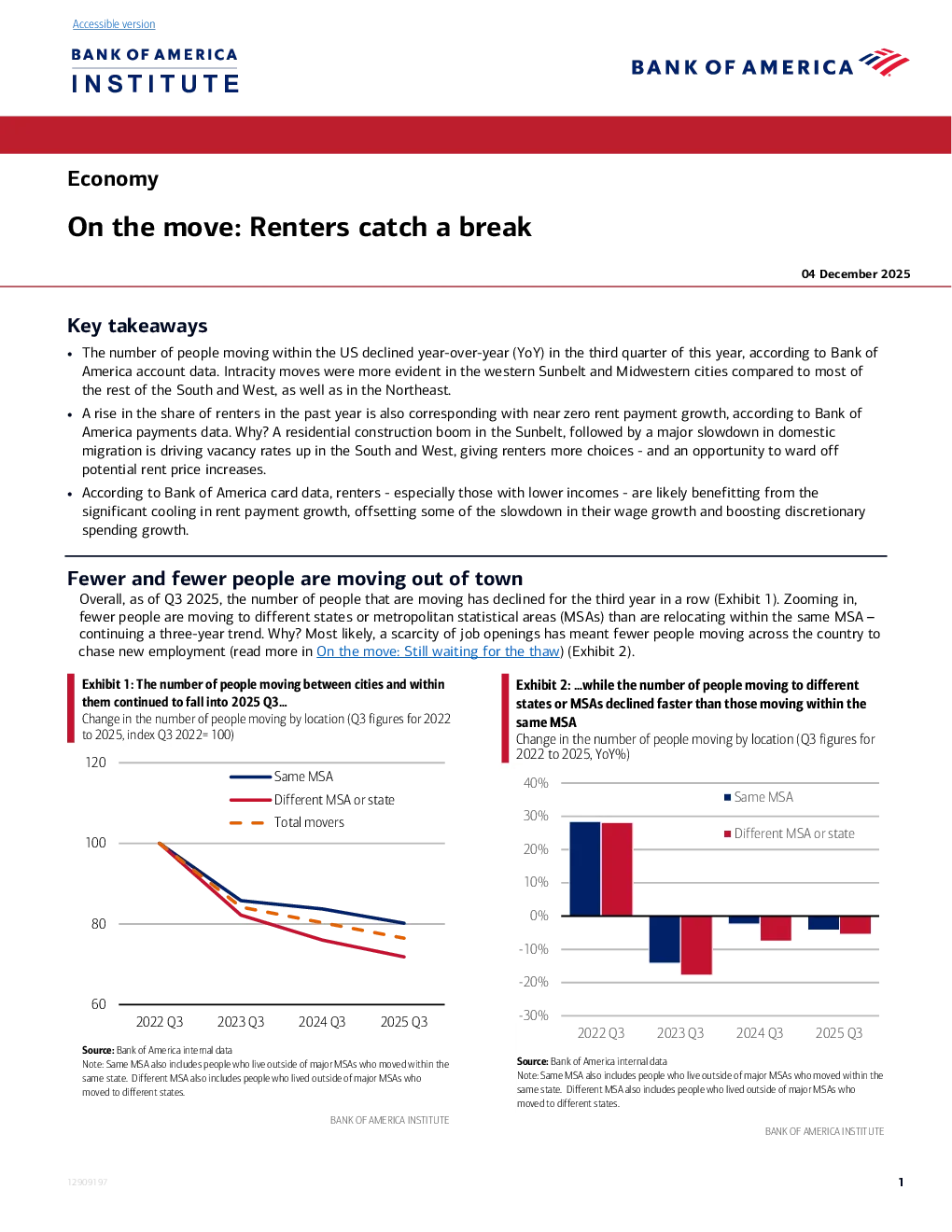
On the move: Renters catch a break 04 December 2025 Key takeaways •The number of people moving within the US declined year-over-year (YoY) in the third quarter of this year, according to Bank ofAmerica account data. Intracity moves were more evident in the western Sunbelt and Midwestern cities compared to most ofthe rest of the South and West, as well as in the Northeast. •A rise in the share of renters in the past year is also corresponding with near zero rent payment growth, according to Bank ofAmerica payments data. Why? A residential construction boom in the Sunbelt, followed by a major slowdown in domesticmigration is driving vacancy rates up in the South and West, giving renters more choices - and an opportunity to ward offpotential rent price increases. •According to Bank of America card data, renters - especially those with lower incomes - are likely benefitting from thesignificant cooling in rent payment growth, offsetting some of the slowdown in their wage growth and boosting discretionaryspending growth. Fewer and fewer people are moving out of townOverall, as of Q3 2025, the number of people that are moving has declined for the third year in a row (Exhibit 1). Zooming in, fewer people are moving to different states or metropolitan statistical areas (MSAs) than are relocating within the same MSA–continuing a three-year trend. Why? Most likely, a scarcity of job openings has meant fewer people moving across the country tochase new employment (read more inOn the move: Still waiting for the thaw) (Exhibit 2). Exhibit2:…while the number of people moving to differentstates or MSAs declined faster than those moving within thesame MSAChange in the number of people moving by location (Q3 figures for Exhibit1:The number of people moving between cities and withinthem continued to fall into 2025 Q3…Change in the number of people moving by location (Q3 figures for 2022 to 2025, index Q3 2022= 100) 2022 to 2025, YoY%) For those still moving to different cities, the Midwest remains a popular choice, according to Bank of America account data,fueled by affordability and an increase in mega-projects such as data center builds (read more in our latestRegional roundup). Infact, three of the top five fastest growing MSAs are in the Midwest, with Indianapolis and Columbus topping the list for thesecond consecutive quarter and Cleveland rounding out the group (Exhibit 3). The western portion of the Sunbelt (seemethodology) remains popular, with Denver, Austin, San Antonio, and Las Vegas seeing larger population inflows. However, there have also been declines in many cities across the South and West, as well as most of the Northeast. Of the majorMSAs that we track, nearly two-thirds saw a decline in domestic migration. And several Sunbelt MSAs (notably Miami, Orlando,Tampa and Houston) whose populations surged during the post-COVID-19 flight to affordability are now seeing populationgrowth slow or even reverse. In fact, eight Sunbelt MSAs have shifted to outright declines, a sharp contrast to the increasesseen as recently as four years ago. Exhibit3: Cities in the Midwest and western Sunbelt were still seeing population growth in the third quarter of 2025, whilethe majority ofcitiesthroughout the Northeast, as well as most of the rest of the West and South continued to see declinesNet population change in major MSAs, according to Bank of America internal data (YoY % change, positive means net inflow, negative means net outflow) Fewer homeowners and more rentersWhat else might be behind the slowdown in movers? One factor could be the rapid increase in the cost of purchasing and owning a home since 2022, which affects both local and longer-distance moves (read more in thefirst quarter’s On the move). Reflecting this, the homeownership rate has declined over the past two years, and as of 2Q 2025, sits below early 2020 levels,likely as more people rent (Exhibit 4). And while it is true that a larger share of younger adults (those under 24 years old) areliving with parents compared to pre-COVID-19 levels, in our view, this is not causing the decline in homeownership rates. In fact, we’d expect the homeownership rate to increase like it did in early 2020 during the onset of COVID-19 (Exhibit 5). Forexample, there was a significant increase in younger people moving home, likely leading to fewer total households and acorresponding increase in the homeownership rate. In other words, there were fewer young people striking out on their own,choosing instead to live with their parents, therefore becoming part of their parents’household. However, with bothhomeownershipandmultigenerational living below 2020 levels, it appears that renting has become a more common choice. Exhibit4:Homeownership rates have declined in the past few yearsafter seeing some recovery in the late 2010sShare of households that own their home (quarterly, %) Shareof population living with their parents by age range (yearly, %) Cooling rent