您的浏览器禁用了JavaScript(一种计算机语言,用以实现您与网页的交互),请解除该禁用,或者联系我们。 [美国银行]:消费者钱包内 - 发现报告

消费者钱包内

商贸零售 2025-12-01 美国银行 落枫
报告封面

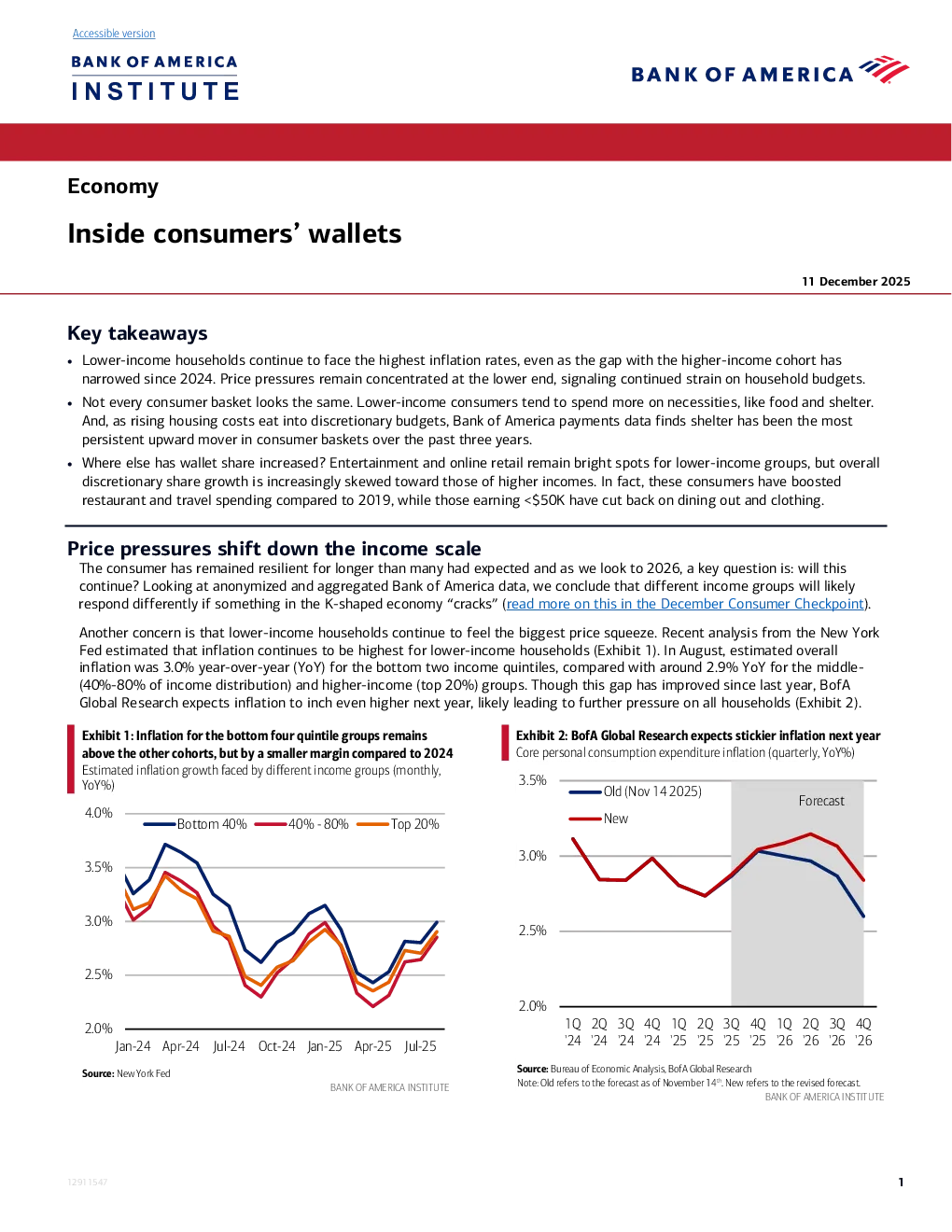
Inside consumers’ wallets Key takeaways •Lower-income households continue to face the highest inflation rates, even as the gap with the higher-income cohort hasnarrowed since 2024. Price pressures remain concentrated at the lower end, signaling continued strain on household budgets. •Not every consumer basket looks the same. Lower-income consumers tend to spend more on necessities, like food and shelter.And, as rising housing costs eat into discretionary budgets, Bank of America payments data finds shelter has been the mostpersistent upward mover in consumer baskets over the past three years. •Where else has wallet share increased? Entertainment and online retail remain bright spots for lower-income groups, but overalldiscretionary share growth is increasingly skewed toward those of higher incomes. In fact, these consumers have boostedrestaurant and travel spending compared to 2019, while those earning <$50K have cut back on dining out and clothing. Price pressures shift down the income scaleThe consumer has remained resilient for longer than many had expected and as we look to 2026, a key question is: will this continue? Looking at anonymized and aggregated Bank of America data, we conclude that different income groups will likelyrespond differently if something in the K-shaped economy“cracks”(read more on this in the December Consumer Checkpoint). Another concern is that lower-income households continue to feel the biggest price squeeze. Recent analysis from the New YorkFed estimated that inflation continues to be highest for lower-income households (Exhibit 1). In August, estimated overallinflation was 3.0% year-over-year (YoY) for the bottom two income quintiles, compared with around 2.9% YoY for the middle-(40%-80% of income distribution) and higher-income (top 20%) groups. Though this gap has improved since last year, BofAGlobal Research expects inflation to inch even higher next year, likely leading to further pressure on all households (Exhibit 2). Estimated inflation growth faced by different income groups (monthly,YoY%) What’s the breakdown by wallet share?What makes the inflation impact different for each income group? The breakdown in consumers’baskets. In aggregate, according to consumer expenditure data from the Bureau of Labor Statistics (BLS), the two largest components of consumerexpenditure are housing (33% of the total) and transportation (17%) (Exhibit 3); in other words, necessities that are hard to avoidor cut back on, and that tend to weigh most heavily on lower-income groups. Similarly, food–both groceries and restaurantspending–accounts for around 13% of the consumer spending basket. Bank of America data fills in the two-year gapHowever, the BLS data on spending shares is lagged (the latest data is for 2023) and might not reflect more recent shifts in consumer spending preferences. Using Bank of America internal data, we analyze the consumer wallet share (see Methodology)in our customer data to see how things have changed. Unsurprisingly, shelter and transportation remain the largest outlays forconsumers. However, since last year, the share in spending on transportation has dropped by four basis points (bp), partly reflectingmoderating gas prices (read more on this in November Consumer Checkpoint) (Exhibit 4). Also, the share of spending on shelterhas increased each year since 2022 due to the continuing increases in rental costs, although they have moderated as of Q3 2025(read more on this in On the Move: Renters catch a break). Change in share of expenditures from previous year (percentage point difference) Not all baskets look alikeFood is where the pressure across income cohorts appears most obvious. While the overall expenditure on food has not changed much since 2023, we find that in 2025, lower-income households have been allocating more of their budget to food at home(groceries) versus food away (restaurants). Conversely, in 2025, the highest income cohort (>$150K) has increased its share inrestaurant spending as part of its overall food budget (Exhibit 5). Exhibit5:Compared to last year, lower-income households have cut their share of spending at quick service restaurants (QSRs) and increasedtheirshare of spending on groceries. Higher-income households have increased their share slightly at restaurants overall in 2025 year-to-date,compared to 2019.Share of spending within food by category by income (annual, %) Higher-income households are allocating more towards travel and experiencesWhat about“nice-to-have”discretionary spending? Bank of America internal data shows that, compared to 2019, fewer lower- income households (<$50K and $50K-$75K) are contributing to overall discretionary spending, while more households earning>$150K are. Notably, the lower-income cohort has pulled back on clothing, as well as airlines and hotels in 2025 year-to-date(Exhibit 6). For households with incomes above $150K, the share of discretionary spending in 2025 year-to-date ha