您的浏览器禁用了JavaScript(一种计算机语言,用以实现您与网页的交互),请解除该禁用,或者联系我们。 [美国银行]:在球上:足球如何推动当地消费 - 发现报告

在球上:足球如何推动当地消费

商贸零售 2026-02-01 美国银行 徐红金
报告封面

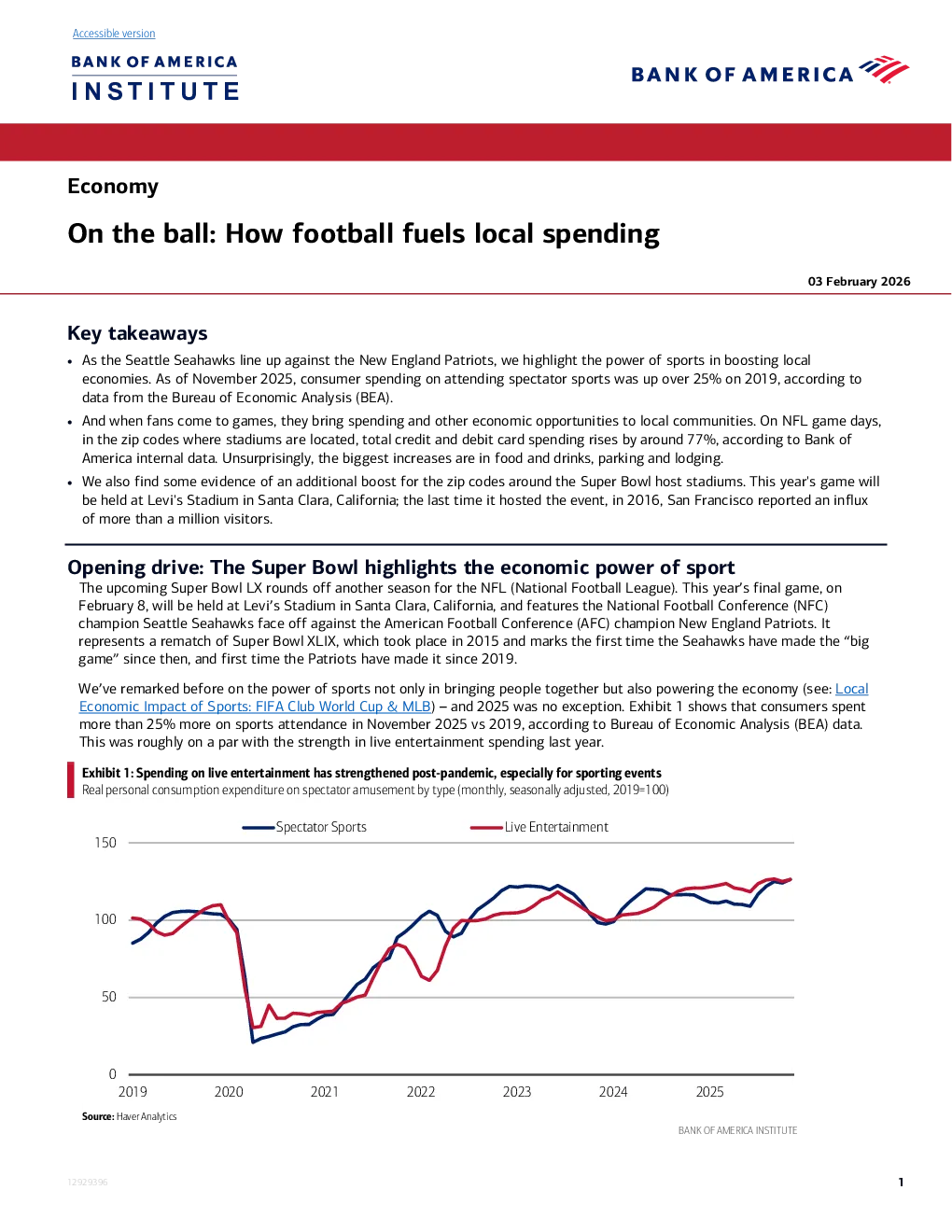
On the ball: How football fuels local spending 03 February 2026 Key takeaways •As the Seattle Seahawks line up against the New England Patriots, we highlight the power of sports in boosting localeconomies. As of November 2025, consumer spending on attending spectator sports was up over 25% on 2019, according todata from the Bureau of Economic Analysis (BEA). •And when fans come to games, they bring spending and other economic opportunities to local communities. On NFL game days,in the zip codes where stadiums are located, total credit and debit card spending rises by around 77%, according to Bank ofAmerica internal data. Unsurprisingly, the biggest increases are in food and drinks, parking and lodging. •We also find some evidence of an additional boost for the zip codes around the Super Bowl host stadiums. This year's game willbe held at Levi's Stadium in Santa Clara, California; the last time it hosted the event, in 2016, San Francisco reported an influxof more than a million visitors. Opening drive: The Super Bowl highlights the economic power of sportThe upcoming Super Bowl LX rounds off another season for the NFL (National Football League). This year’s final game, on February 8, will be held at Levi’s Stadium in Santa Clara, California, and features the National Football Conference (NFC)champion Seattle Seahawks face off against the American Football Conference (AFC) champion New England Patriots. Itrepresents a rematch of Super Bowl XLIX, which took place in 2015 and marks the first time the Seahawks have made the“biggame”since then, and first time the Patriots have made it since 2019. We’ve remarked before on the power of sports not only in bringing people together but also powering the economy (see:LocalEconomic Impact of Sports: FIFA Club World Cup & MLB)–and 2025 was no exception.Exhibit 1shows that consumers spentmore than 25% more on sports attendance in November 2025 vs 2019, according to Bureau of Economic Analysis (BEA) data.This was roughly on a par with the strength in live entertainment spending last year. Exhibit1: Spending on live entertainment has strengthened post-pandemic, especially for sporting eventsReal personal consumption expenditure on spectator amusement by type (monthly, seasonally adjusted, 2019=100) The NFL is a key component to this story. In the 2025 season, the home games of the Seahawks and the Patriots, for example,drew in over 1.1 million spectators. And fans coming to the games bring spending power to local economies and supportemployment and growth. Attendance is not the only way that sport impacts the overall economy. Many fans watch the gamefrom their sofa–and pay for the pleasure via cable and streaming (see also:Streaming: From trickle to torrent)–while otherswatch in local bars and restaurants, spurring spending there. Leaving it all on the field: Big boosts to spending on game daysTo take a closer look at the NFL’s impact on local spending, we conducted a similar analysis to our previous work on Major League Baseball (MLB) and the FIFA Club World Cup. In those studies, we found significant increases in spending in theneighborhoods of the stadiums hosting games. We use daily Bank of America internal credit and debit card data from 2017 to 2025 to look at how overall Bank of America cardspending changed on home game days in the zip codes where the NFL stadiums are based. The data is fairly noisy, includingdisruption from the pandemic, so we look for the average impact across these years after controlling for seasonality and yearlydifferences. Exhibit 2shows our findings, grouping NFL teams and their corresponding stadium zip codes by the divisions in which they play.Across the league, game days are associated with a 77% increase in overall Bank of America card spending within host-stadiumzip codes. This impact varies from the highest–the AFC South (Houston Texans, Indianapolis Colts, Jacksonville Jaguars and TennesseeTitans)–to the lowest–the NFC East (Dallas Cowboys, Philadelphia Eagles, Washington Commanders and New York Giants). Butoverall, all divisions show strong, positive spending boosts on home game days. Exhibit2:There is a large boost to spending in the zipcodeshostingNFL gamesAverage daily increase in total credit and debit card spending on home game days, compared to non-game days, for zip codes of NFL stadiums grouped by NFL divisions (2017-2025, %) What are fans spending on when they come to the game? To answer this, we broke down the card data into key categories(Exhibit 3). The results are unsurprising: food and drinks, parking, and lodging are all big winners on game day. In fact, the boostto these categories is almost double the impact across all other categories of spending. Finally, where do we find the biggest impact on local spending during home games?Exhibit 4shows that the Kansas City Chiefscome out on top in our analysis. Perhaps this should not come as a surprise given their success–appearing in four out of fiveSuper B