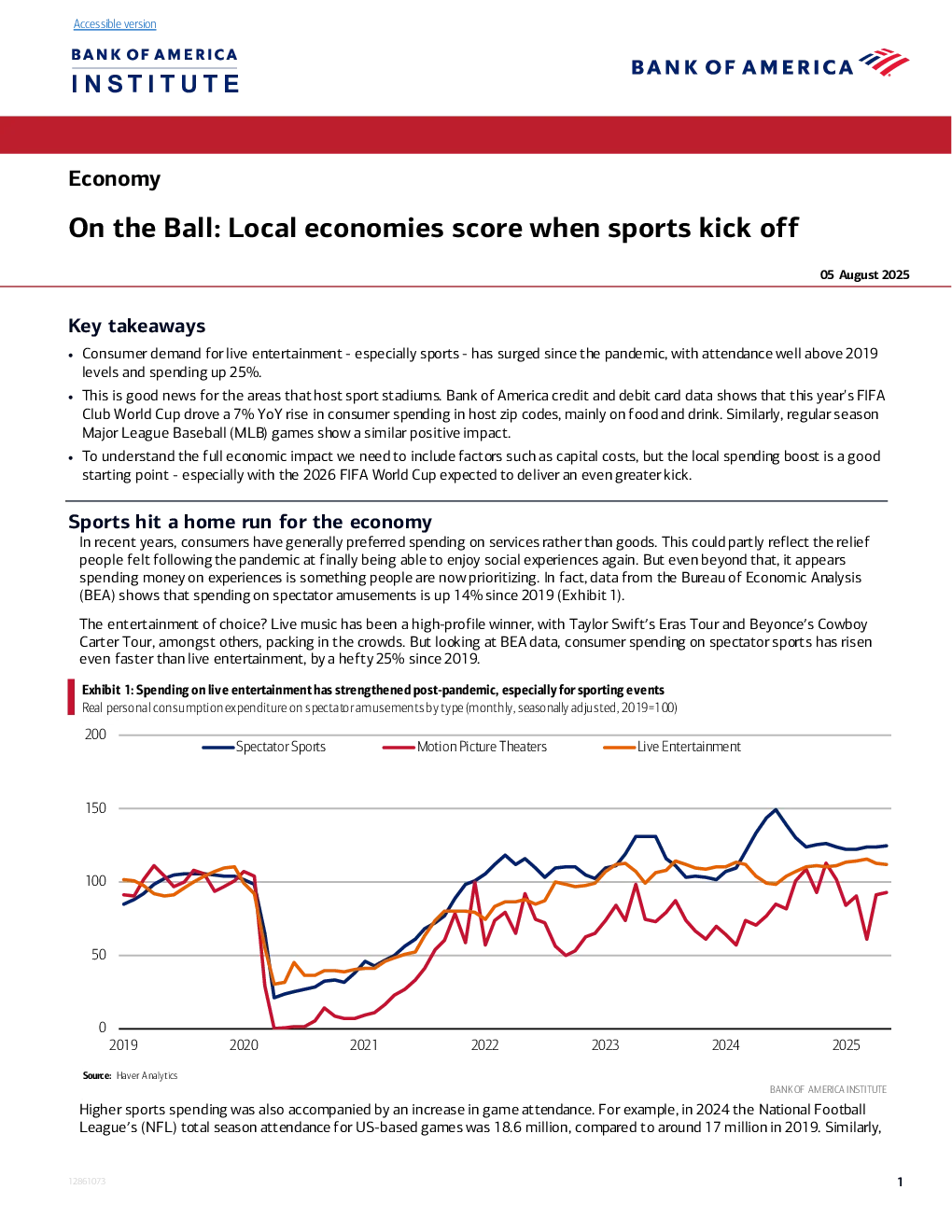
On the Ball: Local economies score when sports kick off 05 August 2025 Key takeaways •Consumer demand for live entertainment - especially sports - has surged since the pandemic, with attendance well above 2019levels and spending up 25%. •This is good news for the areas that host sport stadiums. Bank of America credit and debit card data shows that this year's FIFAClub World Cup drove a 7% YoY rise in consumer spending in host zip codes, mainly on food and drink. Similarly, regular seasonMajor League Baseball (MLB) games show a similar positive impact. •To understand the full economic impact we need to include factors such as capital costs, but the local spending boost is a goodstarting point - especially with the 2026 FIFA World Cup expected to deliver an even greater kick. Sports hit a home run for the economyIn recent years, consumers have generally preferred spending on services rather than goods. This could partly reflect the relief people felt following the pandemic at finally being able to enjoy social experiences again. But even beyond that, it appearsspending money on experiences is something people are now prioritizing. In fact, data from the Bureau of Economic Analysis(BEA) shows that spending on spectator amusements is up 14% since 2019 (Exhibit 1). The entertainment of choice? Live music has been a high-profile winner, with Taylor Swift’s Eras Tour and Beyonce’s CowboyCarter Tour, amongst others, packing in the crowds. But looking at BEA data, consumer spending on spectator sports has riseneven faster than live entertainment, by a hefty 25% since 2019. Real personal consumption expenditure on spectator amusements by type (monthly, seasonally adjusted, 2019=100) Higher sports spending was also accompanied by an increase in game attendance. For example, in 2024 the National FootballLeague’s (NFL) total season attendance for US-based games was 18.6 million, compared to around 17 million in 2019. Similarly, in 2024, the National Basketball Association (NBA) had its second-highest season attendance, around 22.3 million fans (source:Sports Business Journal). Local economies win bigHow does this enthusiasm for watching live sports benefit local economies? For starters, fans bring dollars and they spend them both in and around the stadiums on game day. Some of this spending then supports local businesses and employers, and theemployment that is generated could have knock-on positive impacts for the rest of the economy. To look at some of these impacts, we use Bank of America aggregated and anonymized credit and debit card data and focus onthe zip codes where particular sports stadiums and arenas are located. By comparing spending in these zip codes across sportingevents and seasons, we can get a sense of how this contributes to local economies. We look at two types of sporting competitions–a one-off tournament event, the 2025 FIFA Club World Cup, and a recurringseasonal event, Major League Baseball (MLB). The FIFA Club World Cup 2025 – back of the netThe 2025 International Federation of Association Football (FIFA) Club World Cup concluded in July with Chelsea Football Club winning in impressive style against Paris Saint-Germain at MetLife Stadium in East Rutherford, New Jersey. The tournament,which featured 32 teams, took place from June 14thto July 13th, and was played in 12 venues across the US in Pasadena (LosAngeles, CA), East Rutherford (NY/NJ), Charlotte, Atlanta, Seattle, Philadelphia, Miami, Nashville, Orlando (two venues), Cincinnatiand Washington DC. When we look at Bank of America credit and debit card spending across this time period for the zip codes in which the stadiumsare located, we see a pretty impressive impact.Exhibit 2shows brick-and-mortar card spending in the zip codes both where thegames took place and surrounding the stadiums. There was a big jump in spending in the areas hosting tournament play relativeto other surrounding zip codes. In fact, data shows an average 7% year-over-year (YoY) increase across the tournament dates,reaching above 10% YoY at several points. It is worth noting, however, that the spending impact appears localized–we see limited signs of a boost in surrounding zipcodes, something which is not incredibly surprising. Exhibit2: The localities that hosted2025 FIFA ClubWorld Cupgames saw a jump in card spendingBrick-and-mortar total spending on Bank of America credit and debit Exhibit3:Restaurants and bars saw big jumps in spendingBrick-and-mortar spending per household on Bankof America credit and debit cards in FIFA Club World Cup stadium zip codes (monthly, %YoY) cards in FIFA Club World Cup stadium zip codes compared tosurrounding zip codes (daily, seven-day moving average, % YoY) What categories drove this spend?Exhibit 3shows that, unsurprisingly, restaurants and bars saw big increases in spending in thezip codes where the games took place. Less excitingly, so did parking, though parking as a proportion of overall spending in thisa