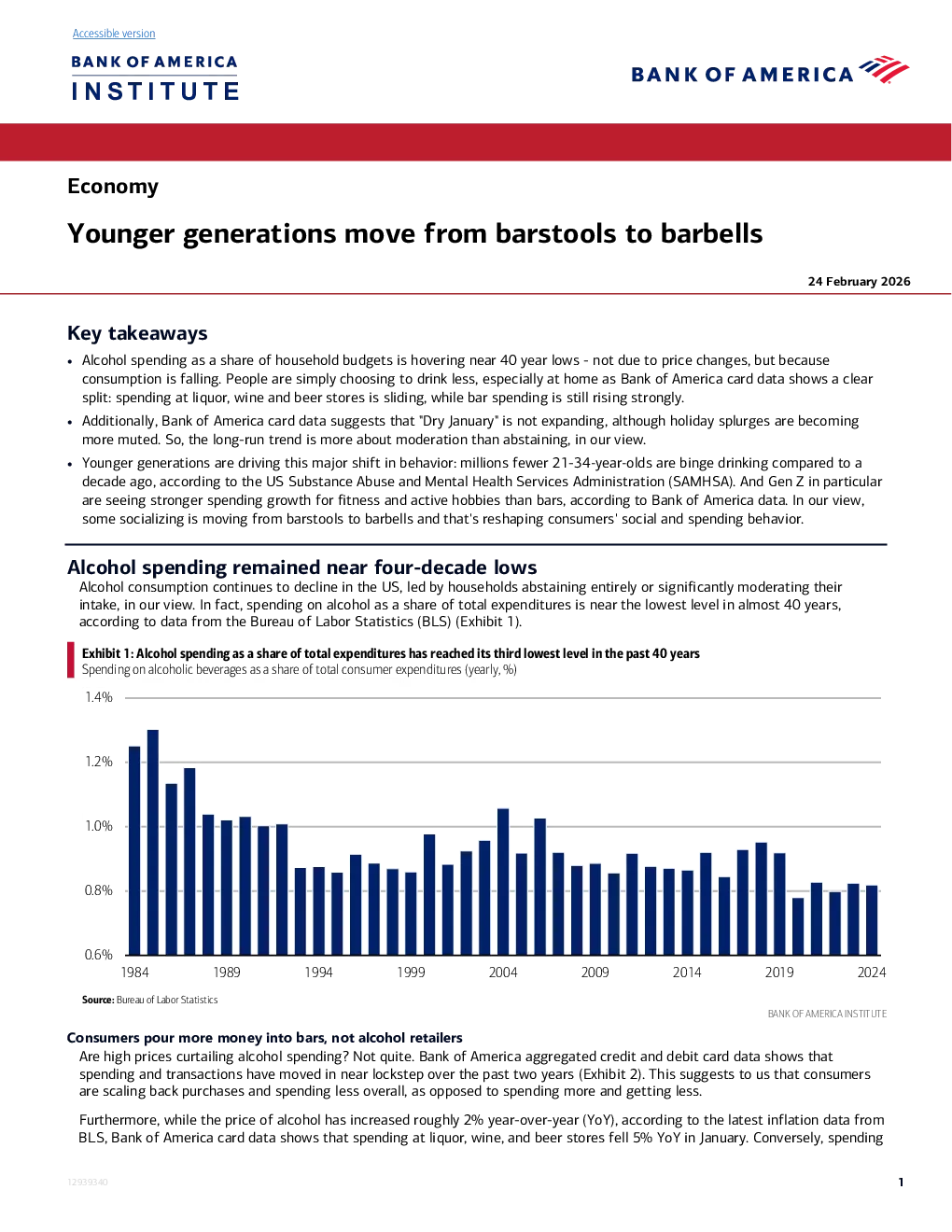
Younger generations move from barstools to barbells 24 February 2026 Key takeaways •Alcohol spending as a share of household budgets is hovering near 40 year lows - not due to price changes, but becauseconsumption is falling. People are simply choosing to drink less, especially at home as Bank of America card data shows a clearsplit: spending at liquor, wine and beer stores is sliding, while bar spending is still rising strongly. •Additionally, Bank of America card data suggests that "Dry January" is not expanding, although holiday splurges are becomingmore muted. So, the long-run trend is more about moderation than abstaining, in our view. •Younger generations are driving this major shift in behavior: millions fewer 21-34‑year‑olds are binge drinking compared to adecade ago, according to the US Substance Abuse and Mental Health Services Administration (SAMHSA). And Gen Z in particularare seeing stronger spending growth for fitness and active hobbies than bars, according to Bank of America data. In our view,some socializing is moving from barstools to barbells and that's reshaping consumers' social and spending behavior. Alcohol spending remained near four-decade lowsAlcohol consumption continues to decline in the US, led by households abstaining entirely or significantly moderating their intake, in our view. In fact, spending on alcohol as a share of total expenditures is near the lowest level in almost 40 years,according to data from the Bureau of Labor Statistics (BLS) (Exhibit 1). Consumers pour more money into bars, not alcohol retailersAre high prices curtailing alcohol spending? Not quite. Bank of America aggregated credit and debit card data shows that spending and transactions have moved in near lockstep over the past two years (Exhibit 2). This suggests to us that consumersare scaling back purchases and spending less overall, as opposed to spending more and getting less. Furthermore, while the price of alcohol has increased roughly 2% year-over-year (YoY), according to the latest inflation data fromBLS, Bank of America card data shows that spending at liquor, wine, and beer stores fell 5% YoY in January. Conversely, spending at bars increased nearly 4% YoY. There are possible explanations for this dichotomy, in our view: some people may be cuttingback on drinking at home while they are still seeking the social aspects that bars have to offer. Exhibit2:Alcohol-related spending and transactions growth havefollowed similar patterns over the past two yearsCard spending and transaction growth at alcohol retailers and bars (3- Exhibit3:Spending growth at bars is much stronger than spendingon alcohol consumed at home over the past two yearsCard spending growth by select alcohol-related categories (3-month month moving average, YoY%) moving average, YoY%) “Dry January” makes room for “Dry December”Another part of the story is that some consumers are abstaining from alcohol or cutting back. So, it could also be that bars may be having success offering mocktails or other alternatives such as non-alcoholic beer and expanded food options, according toBofA Global Research. Trends such as“Dry January”–in which people go sober for the month–increased in popularityimmediately following the COVID-19 pandemic (read more inResolute resolutions?). In fact, Bank of America data shows thatthe share of households with a purchase at alcohol retailers declines sharply every January compared to the rest of the year, buthas also dropped YoY from 2022 until 2025 (Exhibit 4). However, this year, the YoY drop in January leveled out, suggesting to us perhaps the movement is not expanding. However, anew trend may be emerging:“Dry December,”in which people navigate the holiday season without alcoholic beverages. While,traditionally, people splurge on alcohol during the holidays, there has been a steady YoY decline in households participating forthe past three years. Share of households with a purchase at alcohol retailers (monthly, index 2018-2019 average = 100) Many young people are quitting binge drinkingAlso, in our view, people may be moderating their drinking during the holidays to boost health or save money. Data from the US Substance Abuse and Mental Health Services Administration (SAMHSA) supports the moderation trend. While there was anincrease in the amount of people over 50 years old who binge drink (more than four or five drinks in one occasion, seeMethodology for full details) over the past 10 years (2014 - 2024), this was offset by the almost 3.9 million people ages 21 to34 that stopped (Exhibit 5). Change in the number of binge alcohol users by age group (difference from 2014 to 2024, millions, balance is the 2014 and 2024 total number of binge Notably, this huge drop equates to a nearly 10 percentage point decline in the share of those 21- to 34-years old who bingedrink (Exhibit 6). In fact, the most recent reading suggests that only 30% of this age group is drinking to excess compared to th