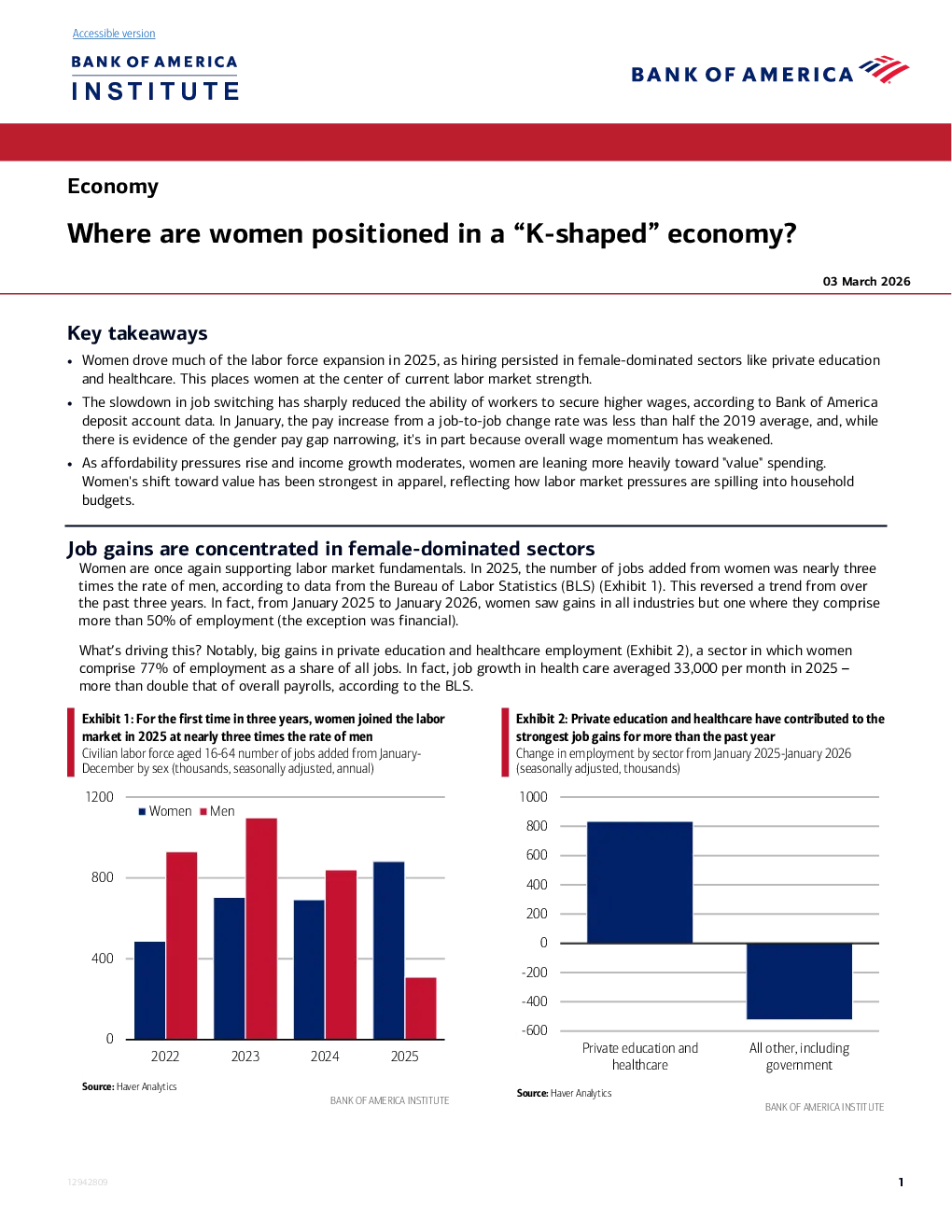
Where are women positioned in a “K-shaped” economy? 03 March 2026 Key takeaways •Women drove much of the labor force expansion in 2025, as hiring persisted in female-dominated sectors like private educationand healthcare. This places women at the center of current labor market strength.•The slowdown in job switching has sharply reduced the ability of workers to secure higher wages, according to Bank of Americadeposit account data. In January, the pay increase from a job-to-job change rate was less than half the 2019 average, and, whilethere is evidence of the gender pay gap narrowing, it's in part because overall wage momentum has weakened.•As affordability pressures rise and income growth moderates, women are leaning more heavily toward "value" spending.Women's shift toward value has been strongest in apparel, reflecting how labor market pressures are spilling into householdbudgets. Job gains are concentrated in female-dominated sectorsWomen are once again supporting labor market fundamentals. In 2025, the number of jobs added from women was nearly three times the rate of men, according to data from the Bureau of Labor Statistics (BLS) (Exhibit 1). This reversed a trend from overthe past three years. In fact, from January 2025 to January 2026, women saw gains in all industries but one where they comprisemore than 50% of employment (the exception was financial). What’s driving this? Notably, big gains in private education and healthcare employment (Exhibit 2), a sector in which womencomprise 77% of employment as a share of all jobs. In fact, job growth in health care averaged 33,000 per month in 2025–more than double that of overall payrolls, according to the BLS. Exhibit1:For the first time in three years, women joined the labormarket in 2025 at nearly three times the rate of menCivilian labor force aged 16-64 number of jobs added from January- Exhibit2: Private education and healthcare have contributed to thestrongest job gains for more than the past yearChange in employment by sector from January 2025-January 2026 December by sex (thousands, seasonally adjusted, annual) (seasonally adjusted, thousands) A narrowing in the gender pay gap: A double-edged swordAn increasingly important lens on today’s cooling labor market is how pay growth is evolving. For both men and women, the rate of after-tax pay increases–whether tied to staying in a job or switching roles–has moderated meaningfully compared to lastyear (Exhibit 3). So too has the rate at which people are changing jobs (read more on this inAugust’s publication on Job hoppers). But there havebeen small signs of reacceleration in the labor market as of late, and, in January, the job change rates (see Methodology) for bothmen and women were above the 2025 average and in line with the 2022 average, supporting evidence of possible renewedmomentum (Exhibit 4). Exhibit3:For both women and men,rate ofpay increases havemoderated in the past two months after holding steady in thesecond half of 2025After-tax pay change by gender (monthly, three-month moving average, Exhibit4:In January,thejob change ratefor women was2.1% and2.0% for menJob change rate bygender(monthly,six-month moving average, %) %) A tougher job market makes pay gains harder to come byThe slowdown in wage increases and job‑change activity reflect a labor market that has continued to normalize after several years of momentum. With fewer open roles, the job‑change premium–the extra pay boost workers typically receive when theyswitch jobs–has started to compress across the board. This softening matters because job changing remains one of the mosteffective ways workers secure higher pay. Men have recently seen a slightly stronger increase in the year‑over‑year growth in job‑change rates, giving them somewhatmore bargaining power to tap into the still‑remaining pockets of opportunity for higher pay. Even so, according to Bank ofAmerica deposit account data, the median pay raise associated with a job change has moderated for both men and women, withJanuary’s level measuring less than half that of the 2019 average (Exhibit 5). Women maintaining a modest edge in job‑change pay raises is a positive sign for narrowing the gender pay gap, though it mayalso reflect differences in starting salary levels or sector mix, both of which influence percentage gains (read more on this inMarch’s Women and wealthpublication). Looking ahead, if“low-hire, low-fire”continues to characterize the labor market, the job‑change premium could compressfurther, limiting the extent to which workers can secure meaningful pay bumps by switching roles. Unemployment holds steady, but the gender gap in pay disruptions has widenedAlthough the overall unemployment rate has not set off any alarm bells, with growing evidence of a divergence in labor market trends across income cohorts, we also see a difference in participation between men and women in the workforce. After having narrowed in 2025, the gap between wo