您的浏览器禁用了JavaScript(一种计算机语言,用以实现您与网页的交互),请解除该禁用,或者联系我们。 [世界黄金协会]:黄金市场评论:当美元自行转向时 - 发现报告

黄金市场评论:当美元自行转向时

有色金属 2026-03-05 世界黄金协会 胡冠群
报告封面

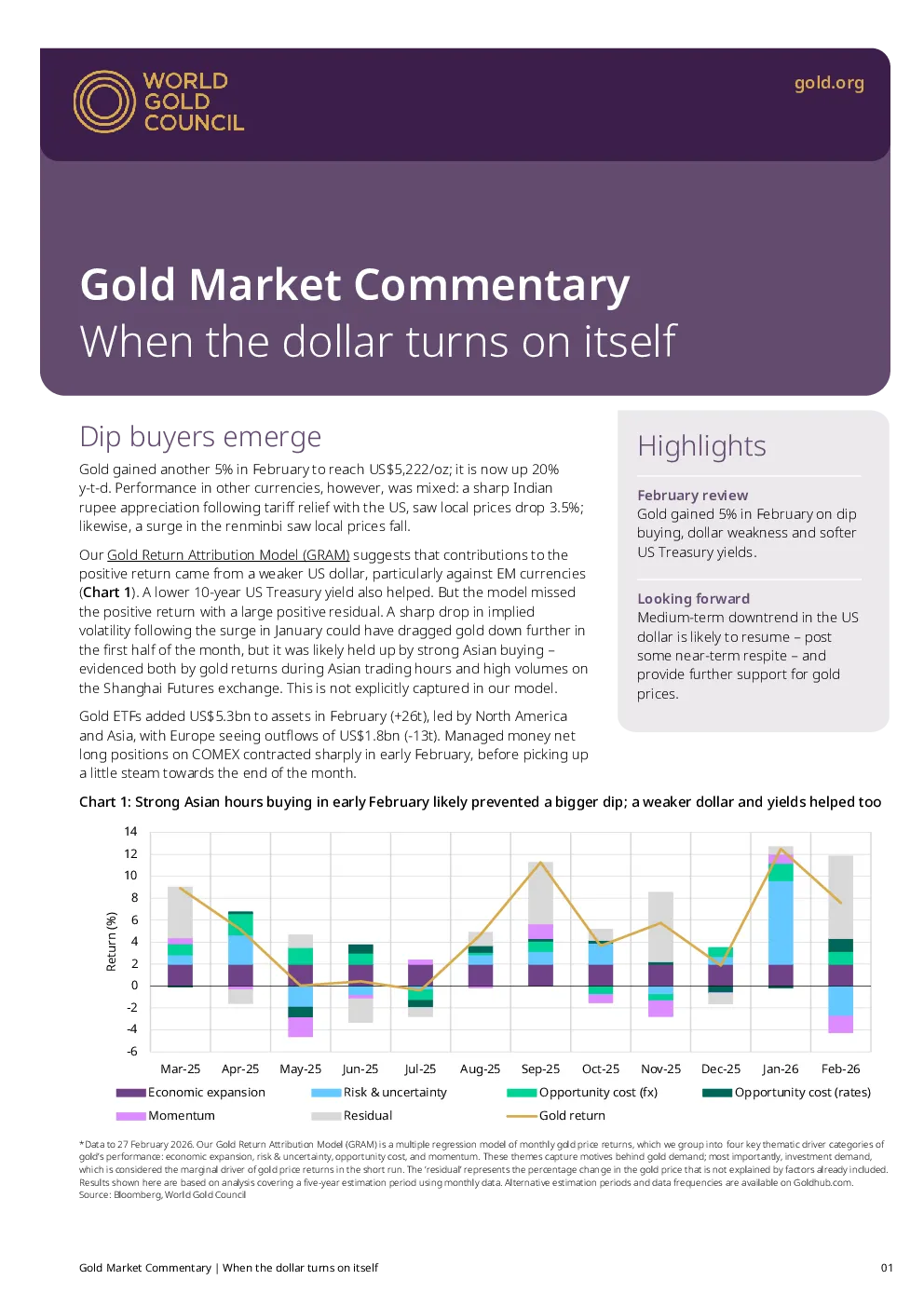
Dip buyers emerge Highlights Goldgainedanother5%in Februaryto reach US$5,222/oz; it is nowup 20%y-t-d.Performance in other currencies, however, wasmixed: asharp Indianrupee appreciation followingtariff reliefwith the US,saw local prices drop3.5%;likewise,a surge in therenminbisaw local pricesfall. FebruaryreviewGold gained 5% in February on dipbuying, dollar weakness and softerUS Treasury yields. OurGold Return Attribution Model (GRAM)suggeststhatcontributions to thepositive return came from a weaker US dollar, particularly againstEM currencies(Chart1). A lower 10-year US Treasury yield also helped. But the model missedthe positive returnwith a large positive residual. Asharpdrop in impliedvolatilityfollowing the surge in January could have dragged gold down further inthe first half of the month, butitwas likely held up by strong Asian buying–evidenced both bygoldreturns duringAsian trading hours and high volumes onthe Shanghai Futures exchange.This is not explicitly captured in our model. Looking forward Medium-termdowntrendinthe USdollaris likely to resume–postsome near-term respite–andprovide further support for goldprices. GoldETFsadded US$5.3bn to assets inFebruary (+26t), led byNorth Americaand Asia, with Europe seeingoutflows of US$1.8bn(-13t).Managed money netlong positions on COMEX contractedsharplyin early February, before picking upa little steam towards the end of the month. •Aweak dollar is more consistent withthe currentUSadministration’s policy of encouragingreshoring When the dollar turns on itself •Weaponisation of the US dollarafter the onset of theUkraine invasion has made central banks and otherinvestors more cautious about US exposure. Thedownward trend in theUS dollar index(DXY)is likelyto resumepost this near-term bounce and is, in our view,a key positive force for gold prices going forward. The USremainsexpensive Chart2:The dollaravoided a breakdown in January Bothon aReal Effective Exchange Rate (REER) basis andprice to sales–a number that is a little harder toadjustthanearnings–the US remains expensive(Chart3). US dollar index (DXY) and relative US economic surprises* Chart3:The US remains expensive US dollar (REER) andUSPrice-to-Salesdifferential* The DXY avoided a technical downside breakdown in January,helped bypositive economic surprisesandsupportivefutures positioning(Chart2). But we view this as atemporary respite.The case for medium-termdollarweaknessrests onthese factors: The“double reward”may be fading •Relative to historyandtoother countries, theUSdollarandUS equitiesremainexpensive Foreign investorshave been facinga choice: hedge USexposure (and accept lower returns) or rotate elsewhere(Chart4). There are tentative signs that this is happeningand the rationaleis quite strong: fiscal headroom inGermany, better valuations, reform momentum in Japan, andpoliticaland concentration risks in the US. •The "double reward" for foreign investors (strong USequities + strong dollar) is fading,withEurope and Japanin particularoffering genuine alternatives •Previous dollar bear marketshave also seen relativeequity market weakness, and the initial currency falls havebeen steep, possibly due to thereinforcingloop ofinvestor outflows Chart5:Dollar bear markets, front loaded, long and badfor equities’ relative performance Chart4:Is the“double reward”fadingfor foreigninvestors? US dollar (DXY) index and US relativeequity performance* Butthere are risks for gold too: To boot,Europeanand Japanesemarketsare considerablysmaller than the USsoshiftscouldmovemarketsmeaningfully,reinforcing the trend. •High priceswilllikelybe of continuedconcerntosomeinvestors •Shouldfinancial flows help drive stronger growth inEurope, Japan and elsewhere, gold in those countries maybecomerelatively less attractivein an environment ofstrong domestic equity markets and growth.WehavealreadyseensomeEuropean goldETF outflows inFebruary as the Januarypricesurge prompted profittaking. Previous dollar bear marketswere long and front-loadedShould these outflows continue,theycould amplify thetrajectoryofaweaker currency and poorer prospectivereturns. Previous major US dollar bear marketsexperiencedlarge initialdrops, possibly a function of this vicious circle(Chart5),which coincided with equity underperformance. Conflict arises So far,however, this marginal rotation is focused more onequities than bonds,with US Treasuries still attractinginflows. With interest rate differentials arguing that the dollaris fairly valued, equity flows may become more important indictating where the dollar goes from here. The Middle East conflict that eruptedat the end of Februarysaw an immediate and unsurprising reaction from assetprices on Monday 2 March.Oil prices climbed, the dollarrallied,and yields softened somewhat. Gold also bounced,upalmost 5% across two trading sessions.Historically it hasrespondedpositivelyin about two-thirds ofinstancesinwhichgeopolitical tensionhas spiked significantly.But thenextt