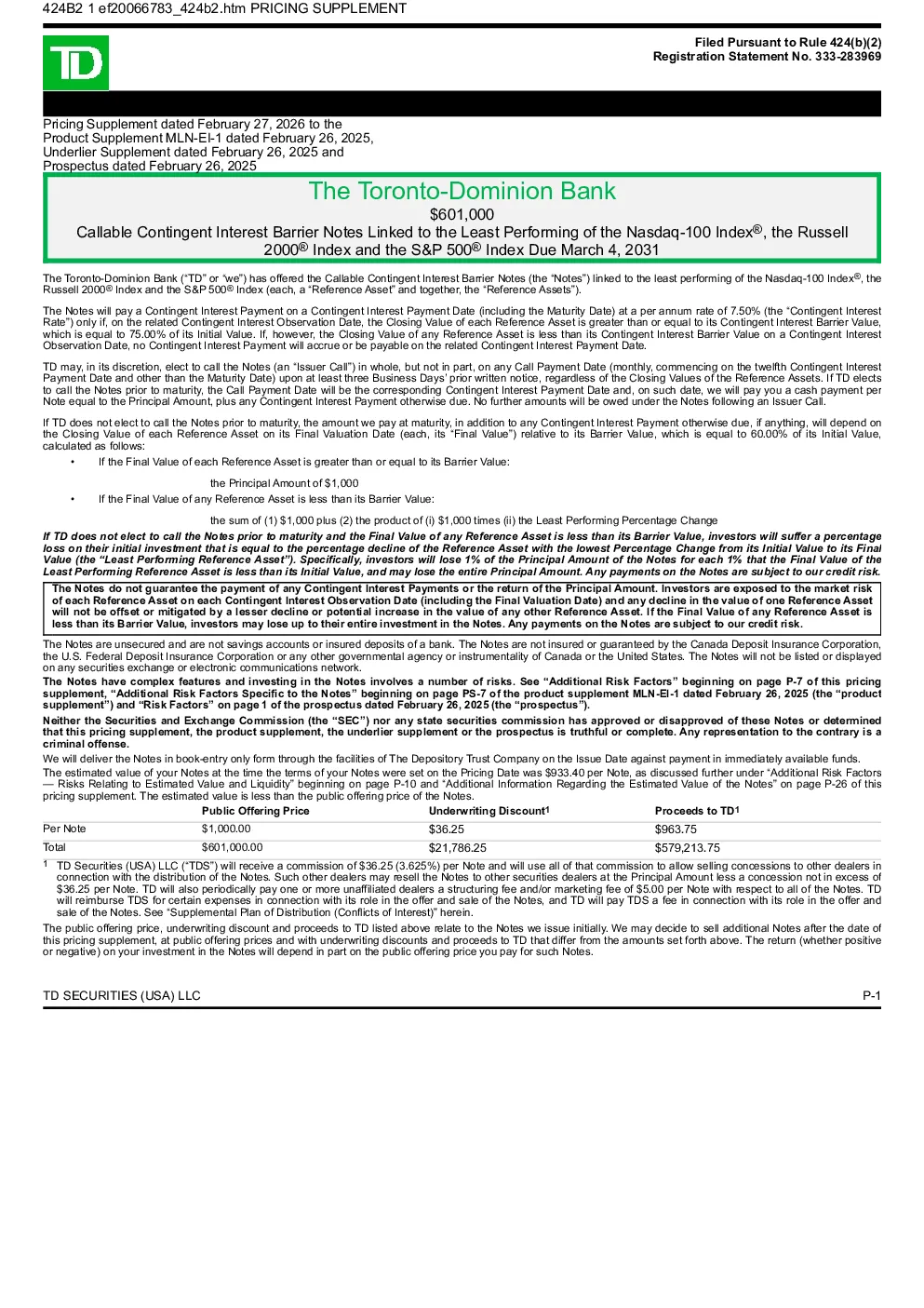
The Toronto-Dominion Bank (TD) has offered Callable Contingent Interest Barrier Notes linked to the least performing of the Nasdaq-100 Index®, the Russell 2000®Index and the S&P 500®Index, with a maturity date of March 4, 2031. The Notes pay a 7.50% contingent interest rate if the closing value of each reference asset is greater than or equal to its 75.00% initial value; otherwise, no interest payment is made. TD may call the Notes in whole at any monthly Call Payment Date (starting from the twelfth contingent interest payment date) upon at least three business days' notice, regardless of reference asset values. If not called before maturity, the payment at maturity depends on the final value of each reference asset relative to its 60.00% initial value barrier: the principal amount ($1,000) plus a product of the principal amount and the Least Performing Percentage Change if any reference asset's final value is below its barrier value, potentially resulting in a total loss of the principal amount.
Key Features and Risks:
- Contingent Interest: The Notes pay a 7.50% contingent interest rate, but only if the closing value of each reference asset meets its 75.00% initial value barrier. Failure to meet this barrier results in no interest payment.
- Issuer Call Option: TD may call the Notes at any monthly Call Payment Date (starting from the twelfth contingent interest payment date) with at least three business days' notice, regardless of reference asset values. If called, investors receive the principal amount plus any accrued interest, with no further payments.
- Maturity Payment: If not called, the maturity payment is $1,000 plus a product of the principal amount and the Least Performing Percentage Change if any reference asset's final value is below its 60.00% initial value barrier, potentially resulting in a total loss of the principal amount.
- Market Risk: Investors are fully exposed to the market risk of each reference asset on each contingent interest observation date, with no diversification benefit as the return is based on the least performing asset.
- Liquidity Risk: The Notes are unsecured and not listed, with potential for limited secondary market liquidity and significant losses if sold before maturity.
- Credit Risk: Payments are subject to TD's credit risk, and changes in TD's credit ratings or spreads may adversely affect the Notes' market value.
- Taxation: The U.S. tax treatment of the Notes is uncertain, with potential for ordinary income inclusion and additional taxes such as the 3.8% Medicare tax on net investment income. Canadian taxation for non-resident holders is also complex, with potential withholding taxes and capital gains considerations.
Examples of Returns:
- Example 1: If TD calls the Notes on the first potential call date and at least one reference asset's closing value is below its contingent interest barrier value, investors receive the principal amount ($1,000) plus prior interest payments, resulting in a total return of 6.875%.
- Example 2: If TD does not call the Notes, and all reference assets' final values are above their barrier values, investors receive the principal amount plus the applicable contingent interest payment, resulting in a total return of 0.625%.
- Example 3: If TD does not call the Notes, and at least one reference asset's final value is below its barrier value but above its contingent interest barrier value, investors receive the principal amount, resulting in a total return of 0.00%.
- Example 4: If TD does not call the Notes, and at least one reference asset's final value is below both its barrier and contingent interest barrier values, investors receive a payment less than the principal amount, resulting in a loss of 60.00%.
Conclusion: The Notes offer a potentially high return but come with significant risks, including market risk, liquidity risk, and credit risk. Investors should carefully consider these risks and consult with their advisors before investing.