海地危机影响快速评估(英)
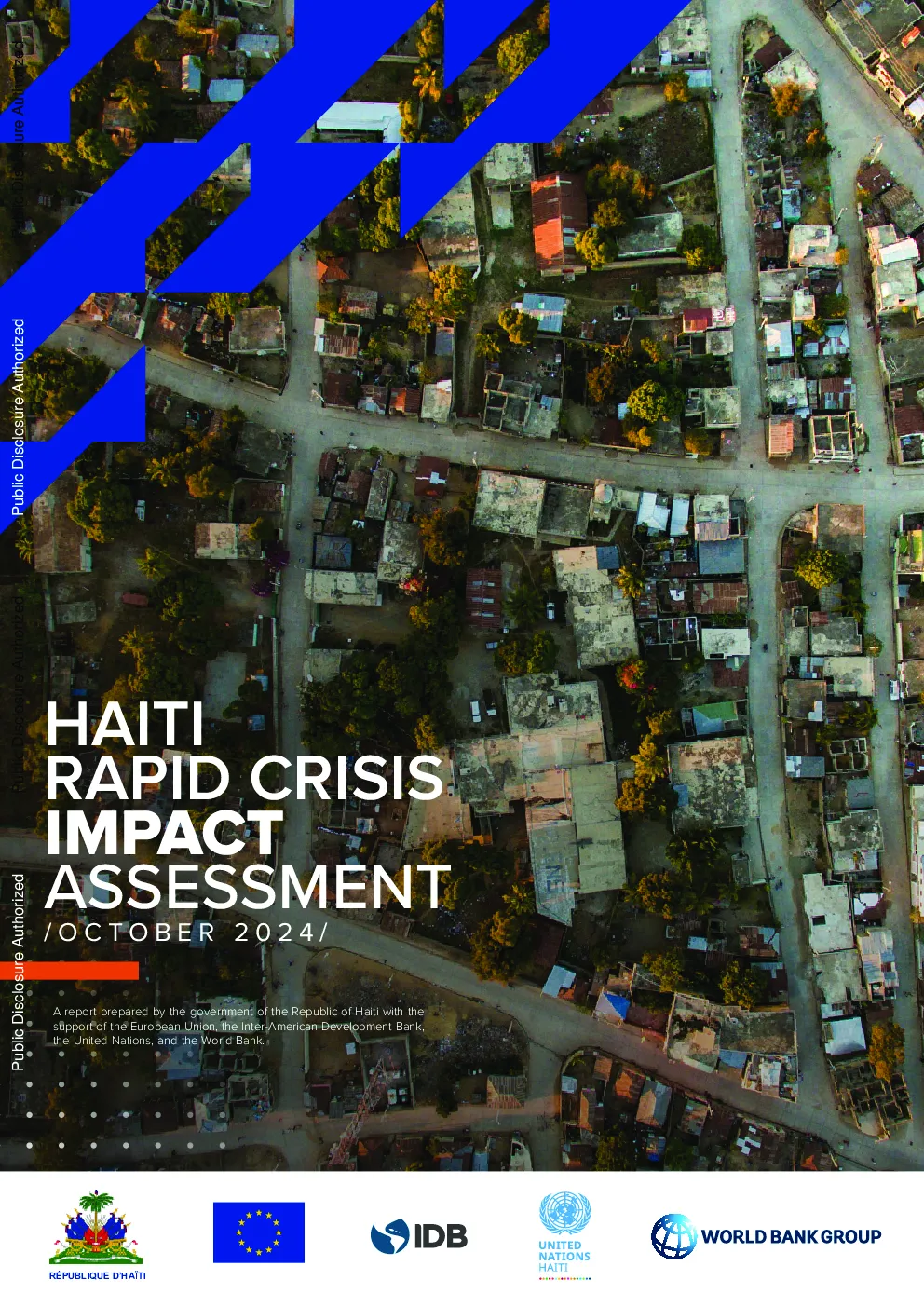
A report prepared by the government of the Republic of Haiti with thesupport of the European Union, the Inter-American Development Bank,the United Nations, and the World Bank. This Rapid Crisis Impact Assessment (RCIA) report for Haiti is a collaborative product authored jointly by the government of Haiti and the staff ofthe European Union, the Inter-American Development Bank, the United Nations, and the World Bank. Acknowledging the institutions’ differentmandates and areas of expertise, the findings, conclusions, and recommendations expressed in the RCIA do not necessarily constitute theviews or formal recommendations of the European Union, United Nations, Inter-Americaan Development Bank, or World Bank on all issues,nor do they reflect the views of the governing bodies of these institutions or their member states. It is also recognized that because of different mandates, not all of the collaborating institutions will share or engage in all activities set forthor proposed in the report, and it is further understood that each institution will carry out or be engaged with any such activities in accordancewith its mandate and operational policies and procedures. / O C T O B E R2 0 2 4/HAITIRAPID CRISISIMPACTASSESSMENT Communes Included in the Rapid CrisisImpact Assessmentwithin thePort-au-Prince Metropolitan Area Acknowledgments The Rapid Crisis Impact Assessment was carried out jointlyby the European Union, the Inter-American DevelopmentBank, the United Nations, and the World Bank, under theleadership and participation of the Government of Haiti. The contributions provided by senior government officialswere essential, among them from the Ministry of Economyand Finance, the Ministry of Planning and External Cooper-ation, the Ministry of Commerce and Industry, the Ministryof National Education and Vocational Training, the Ministryof Justice and Public Security, the Ministry of Social Affairsand Labor, the Ministry of Interior and Territorial Communi-ties, the Ministry of Public Health and Population, and theMinistry of Public Works, Transport and Communications,as well as various other government agencies. The authors appreciate the strong support and contribu-tions of the various national stakeholders that made thiseffort possible, as well as the leadership and technical con-tributions of each of the partner institutions. Tableof Contents I: IntroductionBackground and RationaleObjectivesAssessment MethodologyStructure of the Report56668 II: Context of the Crisis in HaitiMacroeconomic ContextCrisis and Violence ContextScenarios and Risks9101314 343435363637383941414142424343464748485050525354555658596275Priority Axis 3:Promotion of Access to Health Care, Education and Other Basic Social Services;Social Inclusion and Food SecurityInternal DisplacementSocial ProtectionInfrastructure for Elementary and Secondary EducationHigher Education InfrastructureFood Security and NutritionHealth InfrastructureOverview of Recovery NeedsPriority Axis 4:Strengthening Rule of Law and Public SecurityJustice SystemSexual and Gender-Based ViolencePolicePenitentiary SystemCommunity Violence ReductionOverview of Recovery and Reconstruction NeedsIV: Crisis Recovery FrameworkCrisis Recovery Vision, Strategic Objectives, and Core PrinciplesProgrammatic Framework for RecoveryPrioritization and SequencingTransversal IssuesAssumptions, Prerequisites, and RisksV: Institutional ArrangementsInstitutional FrameworkMonitoring ArrangementsVI: Investment PlanInvestment PlanFinancing PlatformReferencesAppendixA:Rapid Crisis Impact Assessment Programmatic Framework (2024–26)Appendix B:Rapid Crisis Impact Assessment Investment Plan Acronyms andAbbreviations ACLEDBINUHCPICRFDAPDGIDINEPAGBVGDPHNPIADBIDPIHSIIPCMEBMEFMSSMOMUPPPRCGRCIASGBVSIMASTZMPPArmed Conflict Location and Event DataUnited Nations Integrated Office in HaitiConsumer Price IndexCrisis recovery frameworkDirectorate of Penitentiary AdministrationGeneral Directorate of TaxesNational Directorate for Drinking Water and SanitationGender-based violenceGross domestic productHaitian National PoliceInter-American Development BankInternally displaced personHaitian Institute of Statistics and InformaticsIntegrated Food Security Phase ClassificationMinimum expenditure basketMinistry of Economy and FinanceMultinational Security Support MissionOperational monitoring unitPurchasing power parityRecovery coordination groupRapid Crisis Impact AssessmentSexual and gender-based violenceMinistry of Social Affairs and Labor databasePort-au-Prince metropolitan area assessments will complement the present evaluation. Tofacilitate such future assessments, the RCIA establishes arecovery framework to allow for progressive expansion toother parts of the country as security conditions improve. ExecutiveSummary After having several multidimensional crises affect Haitifor years, the country is at a critical juncture.The KingstonDeclaration of March 11, 2024, concluded negotiationsamong various Haiti