AI智能总结
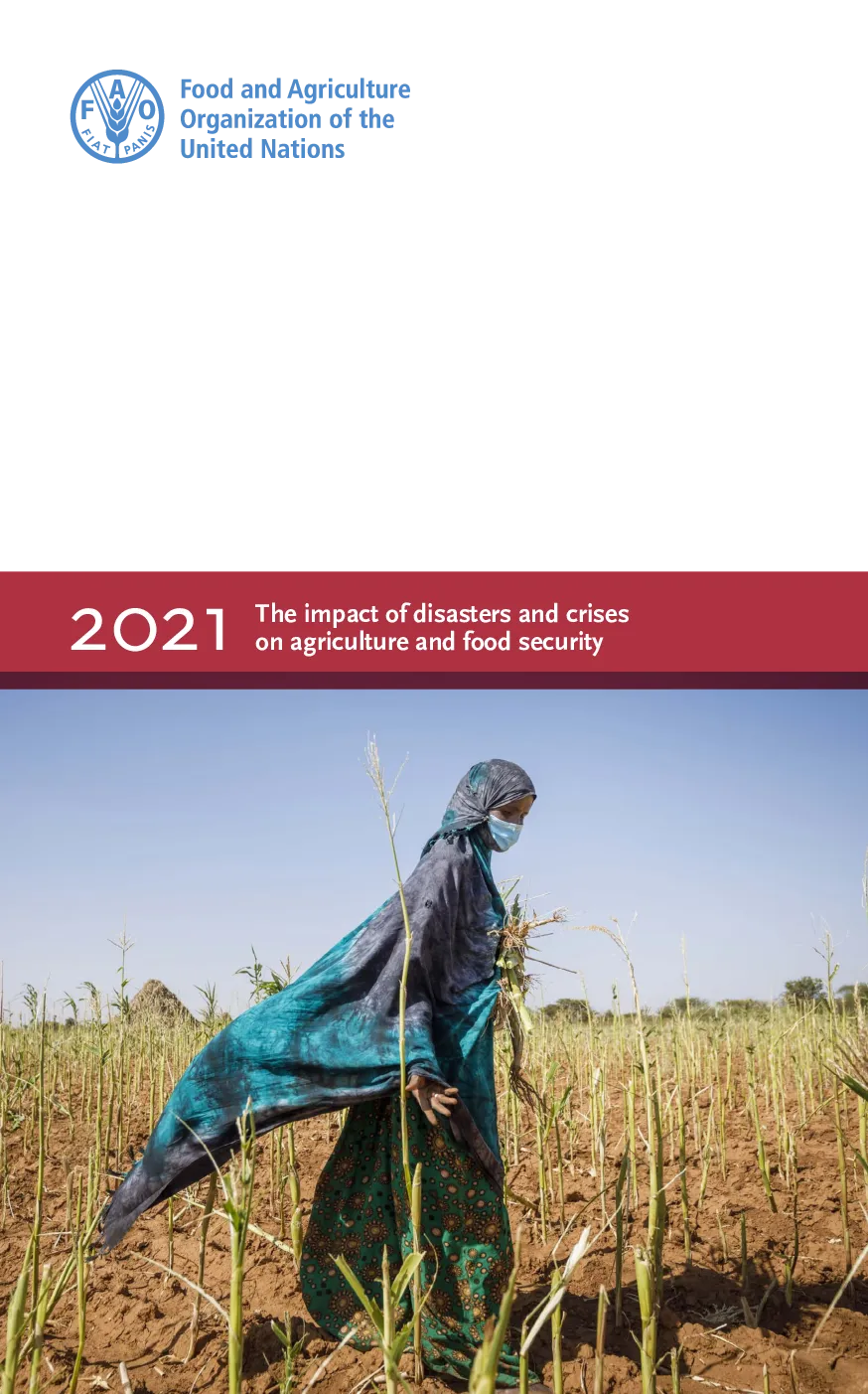
2021 The impact of disasters and criseson agriculture and food security Rome, 2021 The designations employed and the presentation of material in this information product do not imply the expression of any opinionwhatsoever on the part of the Food and Agriculture Organization of the United Nations (FAO) concerning the legal or developmentstatus of any country, territory, city or area or of its authorities, or concerning the delimitation of its frontiers or boundaries.Dashed lines on maps represent approximate border lines for which there may not yet be full agreement. The mention of specificcompanies or products of manufacturers, whether or not these have been patented, does not imply that these have been endorsedor recommended by FAO in preference to others of a similar nature that are not mentioned. ISBN 978-92-5-134071-4© FAO, 2021. Some rights reserved. This work is made available under the Creative Commons Attribution-NonCommercial-ShareAlike 3.0IGO licence (CC BY-NC-SA 3.0 IGO; https://creativecommons.org/licenses/by-nc-sa/3.0/igo/legalcode). Under the terms of this licence, this work may be copied, redistributed and adapted for non-commercial purposes, provided thatthe work is appropriately cited. In any use of this work, there should be no suggestion that FAO endorses any specific organization,products or services. The use of the FAO logo is not permitted. If the work is adapted, then it must be licensed under the same orequivalent Creative Commons licence. If a translation of this work is created, it must include the following disclaimer along with therequired citation: “This translation was not created by the Food and Agriculture Organization of the United Nations (FAO). FAO isnot responsible for the content or accuracy of this translation. The original [Language] edition shall be the authoritative edition.” Disputes arising under the licence that cannot be settled amicably will be resolved by mediation and arbitration as describedin Article 8 of the licence except as otherwise provided herein. The applicable mediation rules will be the mediation rules of theWorld Intellectual Property Organization http://www.wipo.int/amc/en/mediation/rules and any arbitration will be conductedin accordance with the Arbitration Rules of the United Nations Commission on International Trade Law (UNCITRAL). Third-party materials.Users wishing to reuse material from this work that is attributed to a third party, such as tables, figures or images,are responsible for determining whether permission is needed for that reuse and for obtaining permission from the copyright holder.The risk of claims resulting from infringement of any third-party-owned component in the work rests solely with the user. Sales, rights and licensing.FAO information products are available on the FAO website (www.fao.org/publications) andcan be purchased through publications-sales@fao.org. Requests for commercial use should be submitted via:www.fao.org/contact-us/licence-request. Queries regarding rights and licensing should be submitted to: copyright@fao.org. Cover photograph Farmer inspects her crop ruined by desert locust swarms, Ethiopia 2020 ©FAO/Petterik Wiggers INTRODUCTION PART I Agriculture on the proving grounds1 More disasters, more impacton agriculture xxiixxvxxvi2010-2019 the most turbulentdecadeDisasters steady on the riseExceptions are the new ruleBiological hazards: pestand disease outbreaksThe heat is onGlobal 2030 Agenda– one decade leftQuest continues fordisaggregated dataFrom governance of evidenceto governance of actionTime to act 24Chapter I25Proving the case: measurementand evidence 2008–2018 910Chapter II47Disasters and forests:unpacking a complex relationship 1215Chapter III63Impact of disasters on fisheriesand aquaculture CONCLUSIONThe road to 2030: PART II PART III risk-resilient developmentpathways for agriculture177 7779Towards the future of damageand loss monitoring Focus on food chain crises Chapter IV Agriculture in the face of apandemic: COVID-19 impactson food production Chapter VII Extreme exposure: a clearer pictureof agriculture in the climate crisis APPENDICES187 157Technical annex188FAO’s damage and lossassessment methodology Chapter V Animal health at the crossroads:bridging theory, assessmentand policy 113From farm to space: exploringremote sensing applicationsfor disaster impact analysisin agriculture Glossary198 Chapter VI References202 Locusts, a legendary pestwith a present-day toll:lessons from Madagascar Extreme weather events India 2019Though common here, dust storms have becomemore frequent, intense and deadly, such as this one whichstruck Prayagraj, killing many. Climate change Barrow, Alaska, United States of America 2016Sea iceis melting earlier and faster than ever before, leading tomass migration of the walruses, sea lions and fish uponwhich the indigenous Iñupiat people depend. Locust swarmsDesert locusts Kenya 2020Swarms of the ravenous pest invadedco