Anchor Report: Global Physical AI: The Industry Scale-Up Starts
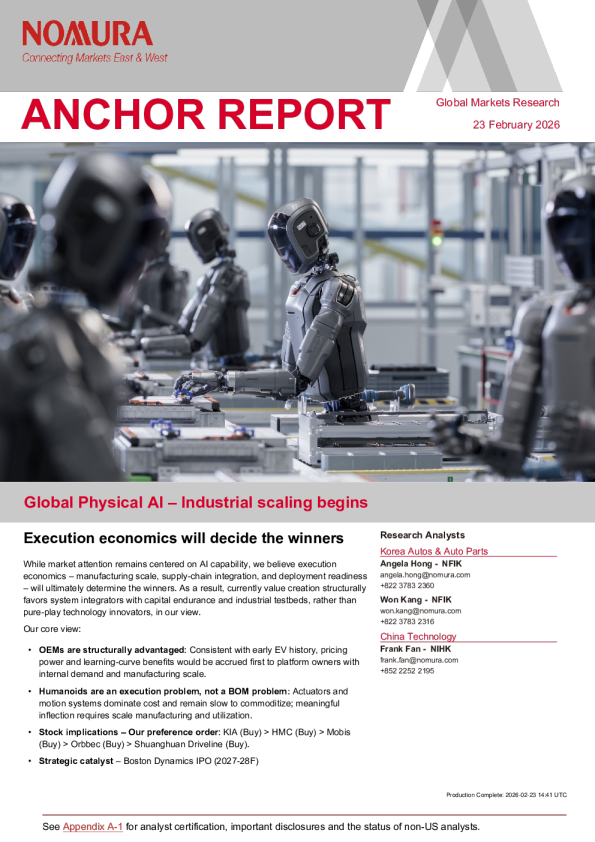
23 February 2026 Global Physical AI – Industrial scaling begins Research Analysts Execution economics will decide the winners Korea Autos & Auto Parts While market attention remains centered on AI capability, we believe executioneconomics – manufacturing scale, supply-chain integration, and deployment readiness– will ultimately determine the winners. As a result, currently value creation structurally Angela Hong - NFIKangela.hong@nomura.com+822 3783 2360 Won Kang - NFIKwon.kang@nomura.com+822 3783 2316China Technology Our core view: Frank Fan - NIHKfrank.fan@nomura.com+852 2252 2195 OEMs are structurally advantaged: Consistent with early EV history, pricingpower and learning-curve benefits would be accrued first to platform owners with Humanoids are an execution problem, not a BOM problem:Actuators andmotion systems dominate cost and remain slow to commoditize; meaningful Stock implications – Our preference order: KIA (Buy) > HMC (Buy) > Mobis(Buy) > Orbbec (Buy) > Shuanghuan Driveline (Buy).• Strategic catalyst– Boston Dynamics IPO (2027-28F)• Production Complete: 2026-02-23 14:41 UTC Global Markets Research Global Physical AI 23 February 2026 EQUITY: AUTOS & AUTO PARTS Research Analysts Industrial scaling begins Korea Autos & Auto Parts Angela Hong - NFIKangela.hong@nomura.com+822 3783 2360 Execution economics will decide the winners Action: Preference order: KIA > HMC > Mobis > Orbbec > Shuanghuan DrivelineWe believe early humanoid value creation will be driven by system integration, deployment Won Kang - NFIKwon.kang@nomura.com+822 3783 2316China Technology access, and balance sheet capacity rather than standalone component performance.Consistent with prior technology transitions (e.g., early EVs), pricing power and learning-curve benefits accrue first to platform owners with internal demand and manufacturing scale, Frank Fan - NIHKfrank.fan@nomura.com+852 2252 2195 Reflecting clearer platform ramp visibility, we raise target prices of most companies underour coverage (Fig. 1). Within Korea, we prefer OEMs over parts suppliers, andKia overHyundai Motoron valuation-driven robotics upside. Among suppliers, we favorHyundaiMobis over Mandogiven its stronger system-level exposure. In China, we prefer vertically-integrated players tied to production ramps, withOrbbec as our top pickand we have a Competitive landscape: industrial scaling archetypes The market is evolving along three distinct paths: 1) automotive OEMs leveraging EV/ADASoverlap and internal factories as deployment testbeds; 2) Chinese manufacturers scalingthrough price competitiveness and policy-backed domestic rollout; and 3) humanoidspecialists driving frontier AI and control innovation. As the industry transitions from Hyundai Motor Group’s physical AI value chain Hyundai Motor Group (HMG) has one of the most vertically integrated humanoidecosystems globally, in our view. Anchored by Boston Dynamics (unlisted), HMG isinternalizing the humanoid value chain across hardware (Mobis, Mando and Wia), software/system integration (Autoever), deployment (Hyundai Motor and Kia), and logistics (Glovis).This structure reduces supply-chain dependency, accelerates iteration, and enables HMG to Economics – The 50/50 hardware-software paradigm and the pivot to RaaSHumanoid economics remain execution-heavy, with actuators/motion systems accounting for ~50% of hardware bill of materials (BOM). Scaling is non-linear as a higher degree offreedom increases actuator and reducer complexity. Sustaining cost inflection requiresmanufacturing scale, procurement leverage, and reliability improvement rather than purecomponent substitution. Over time, value capture may shift toward a 50/50 hardware- Table of contents Executive summary4Competitive landscape7Economics of humanoids14Supply chain analysis17Hyundai Motor Group’s robot value chain19Kia Corp24Hyundai Motor28Hyundai Mobis32Orbbec Inc37Shuanghuan Driveline40HL Mando43Zhejiang Sanhua Intelligent48Appendix A-151 Executive summary Humanoid robotics is entering a transition phase from technical demonstration toward earlycommercialization, driven by advances in physical AI, declining component costs, andexpanding industrial deployment. While public attention often centers on AI capability, webelieve execution economics – manufacturing scale, supply-chain integration, and Stock implications: KIA > HMC > Mobis > Orbbec >Shuanghuan Driveline In the early stage of the humanoid product cycle, we believe OEMs are structurally betterpositioned than component suppliers, as value creation is driven by system integration,deployment access, and balance-sheet capacity rather than standalone componentperformance. Consistent with past technology transitions (e.g., early EVs), pricing power Within Korea, this framework leads us to prefer OEMs over parts suppliers, andKia overHyundai Motor. While both the OEMs benefit similarly from humanoid-driven productivitygains and exposure to Boston Dynam