推动坦桑尼亚可持续渔业发展
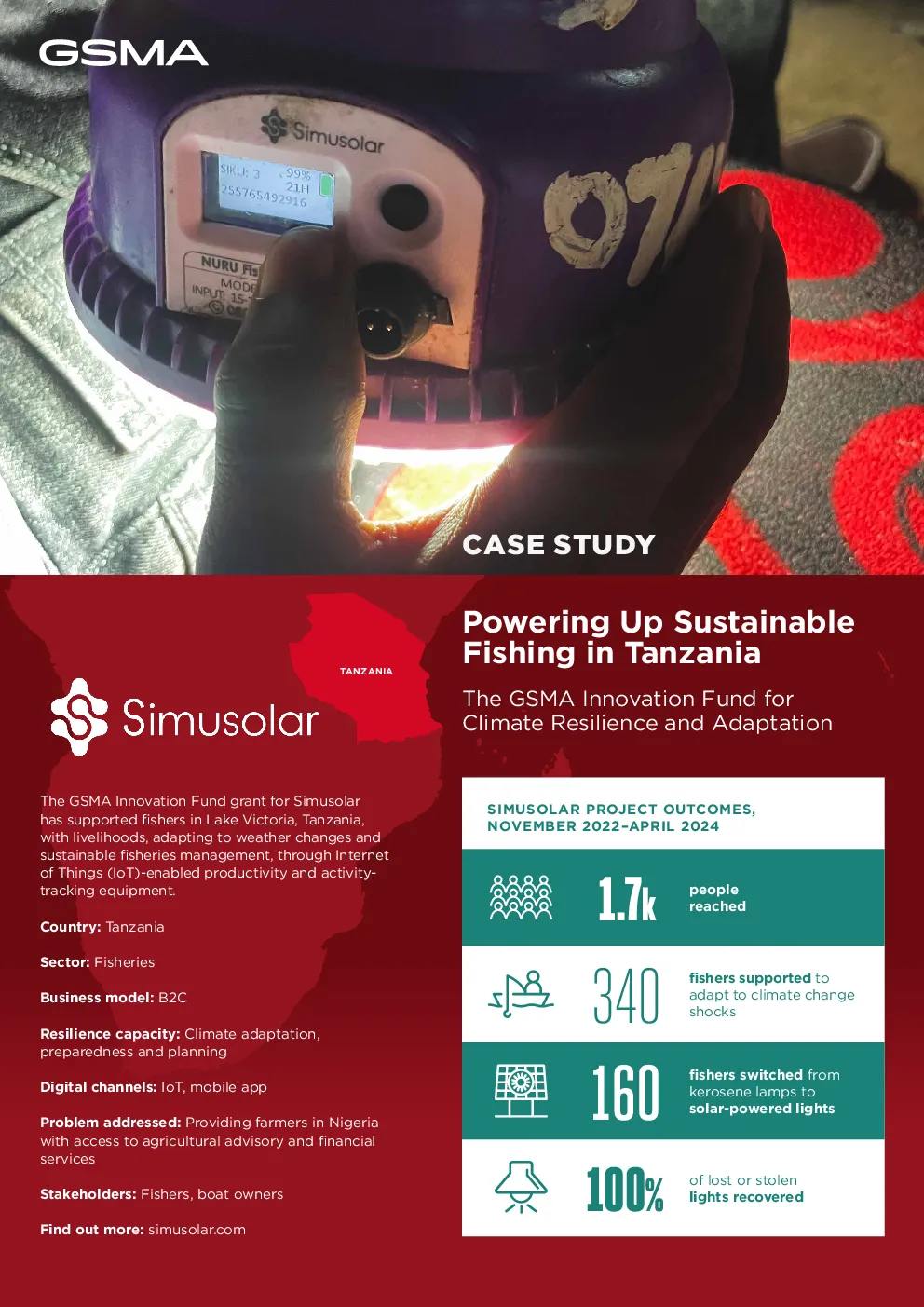
CASE STUDY Powering Up SustainableFishing in Tanzania TANZANIA The GSMA Innovation Fund forClimate Resilience and Adaptation The GSMA Innovation Fund grant for Simusolarhas supported fishers in Lake Victoria, Tanzania,with livelihoods, adapting to weather changes andsustainable fisheries management, through Internetof Things (IoT)-enabled productivity and activity-tracking equipment. SIMUSOLAR PROJECT OUTCOMES,NOVEMBER 2022–APRIL 2024 1.7k Country:Tanzania Sector:Fisheries 340 fishers supportedtoadapt to climate changeshocks Business model:B2C Resilience capacity:Climate adaptation,preparedness and planning fishers switchedfromkerosene lamps tosolar-powered lights Digital channels:IoT, mobile app Problem addressed:Providing farmers in Nigeriawith access to agricultural advisory and financialservices 100% Stakeholders:Fishers, boat owners Find out more:simusolar.com AboutSimusolar Simusolar is a Tanzania-based socialenterprise working to transform agricultureand fisheries in East Africa throughaffordable solar-powered technology. Itsmission is to empower rural livelihoods byproviding smallholder farmers and fisherswith accessible tools designed to increaseproductivity and income, such as solarwater pumps and fishing lights. Simusolar’sinclusive model features pay-as-you-go(PAYG) financing, after-sales support andtailored products for off-grid communities.Through a combination of clean energyinnovation and user-focused design,Simusolar helps build resilience to climatechange while promoting sustainablegrowth and rural development. Introduction three species: the Nile perch, the Nile tilapia, andthe native silver cyprinid, a sardine-like fish knownas “dagaa” in Tanzania.3Dagaa fishers in LakeVictoria fish at night, using kerosene lamps or LEDlights suspended just above the water to drawphototactic zooplankton and other small aquaticorganisms to the surface, which in turn attractsdagaa to the surface to prey on these organisms.4This nightly constellation of boat lights hasbecome a hallmark of the lake’s fishing culture.However, the use of kerosene lamps has severalnegative effects: it contributes to pollution of thelake; emits black carbon; exposes fishers to risksof burns; and has relatively higher operationalcosts for fishers compared to LED lighting. The project spanned 21 months from November2022 to July 2024. With the support of theInnovation Fund, Simusolar launched an IoT-enabled fishing light, called Nuru, to supportmore sustainable fishing practices. Nuru isan energy-efficient, trackable and remotelycontrolled light that integrates with a mobile appto manage fishing operations, monitor weatherand track usage. The solution, which providesanonymised data, was designed to supportefforts by Tanzania’s Ministry of Fisheries todigitalise fishing activities. About the GSMA InnovationFund project Impacts of climate change onfishers in Tanzania Lake Victoria, Africa’s largest freshwater lake,is shared by Tanzania, Uganda and Kenya, withits fisheries playing a vital role in the economiesof all three East African nations.1However,climate change is increasingly threatening thelake’s ecosystem and the livelihoods of fisherswho depend on it. Rising temperatures, shiftingrainfall patterns and environmental degradationare disrupting the lake’s delicate balance whilefishing communities struggle with lost incomeand food insecurity. Simusolar is one of the startups supportedby the GSMA Innovation Fund for ClimateResilience and Adaptation, which was launchedin 2022. This initiative is funded by the UKForeign, Commonwealth & Development Office(FCDO), the Swedish International DevelopmentCooperation Agency (Sida) and is supported bythe GSMA and its members. Unsustainable practices, such as illegal use offine mesh nets that trap juvenile dagaa, andspoilage and contamination from sun drying onbeaches, are placing fish stocks under pressure.Cage aquaculture presents new challenges asfish farmers and wild-capture fishers compete forspace and cages are placed in sensitive breedingareas, which risk disturbing dagaa reproduction.5 For the predominantly rural, low-incomehouseholds in these communities, such shocks canbe devastating. Incomes drop and food insecurityrises as families struggle to afford alternativeprotein sources or offset lost earnings from fishing.Some surveys of these fishing communities havefound that households have very limited capacityto adapt financially to the environmental impactsof climate change and, although they are aware ofchanging conditions, lack effective strategies tosecure reliable income and food.2 Addressing these challenges is crucial tosafeguarding Lake Victoria’s dagaa fishingeconomy and the livelihoods of the fishersand fish processors or traders, most of whomare women. Due to the introduction of large predatory fishspecies, Lake Victoria’s fisheries are dominated by Key project activities How does thesolution work? Figure 1 Simusolar’s Nuru fishing lights a