TAHMO:利用商业微波链路数据开发洪水预警系统
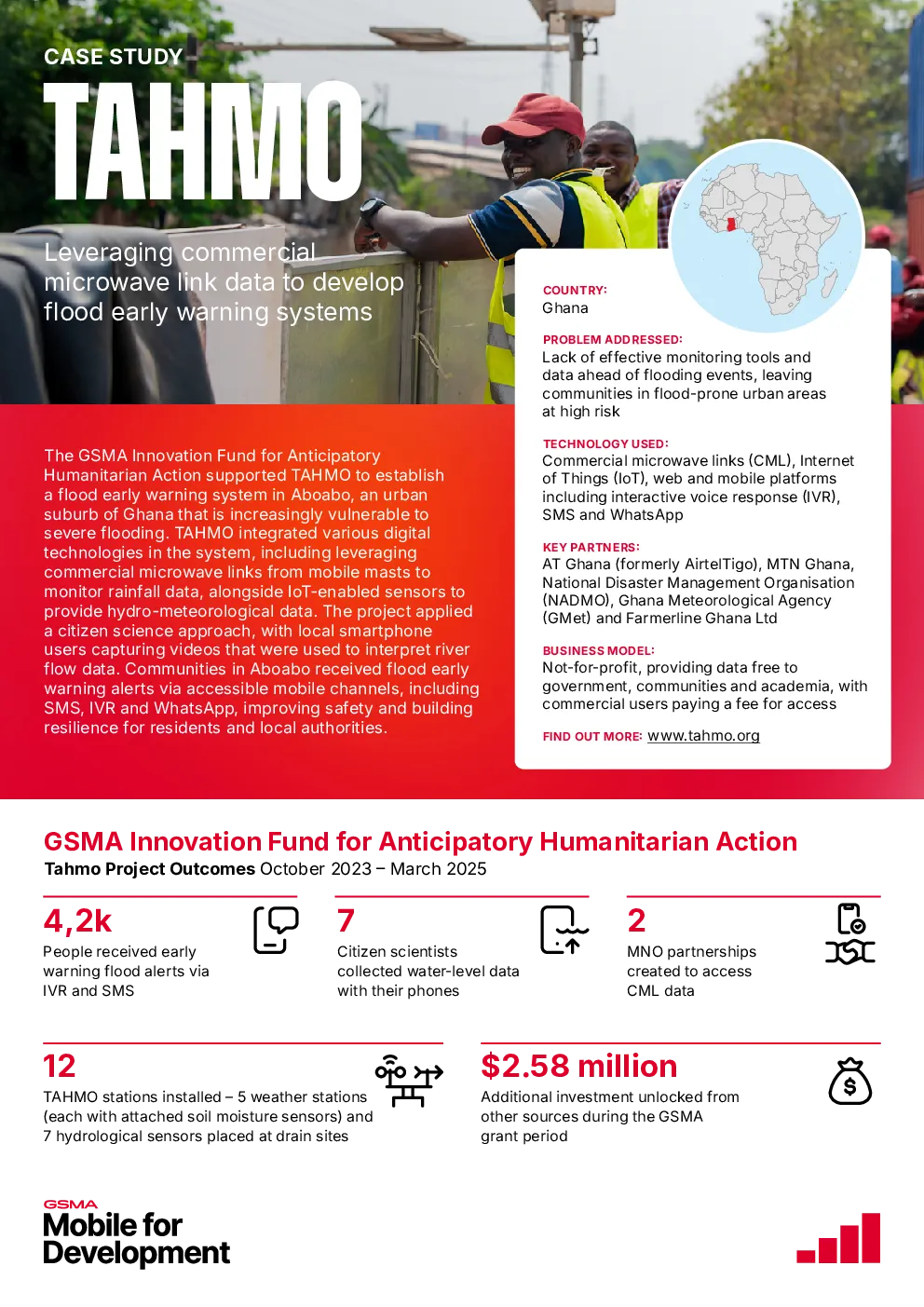
Leveraging commercialmicrowave link data to developflood early warning systems COUNTRY:Ghana PROBLEM ADDRESSED:Lack of effective monitoring tools and data ahead of flooding events, leavingcommunities in flood-prone urban areasat high risk TECHNOLOGY USED:Commercial microwave links (CML), Internet The GSMA Innovation Fund for AnticipatoryHumanitarian Action supported TAHMO to establisha flood early warning system in Aboabo, an urbansuburb of Ghana that is increasingly vulnerable tosevere flooding. TAHMO integrated various digitaltechnologies in the system, including leveragingcommercial microwave links from mobile masts tomonitor rainfall data, alongside IoT-enabled sensors toprovide hydro-meteorological data. The project applieda citizen science approach, with local smartphoneusers capturing videos that were used to interpret riverflow data. Communities in Aboabo received flood earlywarning alerts via accessible mobile channels, includingSMS, IVR and WhatsApp, improving safety and buildingresilience for residents and local authorities. of Things (IoT), web and mobile platformsincluding interactive voice response (IVR),SMS and WhatsApp KEY PARTNERS: AT Ghana (formerly AirtelTigo), MTN Ghana,National Disaster Management Organisation(NADMO), Ghana Meteorological Agency(GMet) and Farmerline Ghana Ltd BUSINESS MODEL:Not-for-profit, providing data free to government, communities and academia, withcommercial users paying a fee for access FIND OUT MORE:www.tahmo.org GSMA Innovation Fund for Anticipatory Humanitarian Action Tahmo Project OutcomesOctober 2023 – March 2025 4,2kPeople received earlywarning flood alerts viaIVR and SMS 7 2 Citizen scientistscollected water-level datawith their phones MNO partnershipscreated to accessCML data $2.58 million 12 TAHMO stations installed – 5 weather stations(each with attached soil moisture sensors) and7 hydrological sensors placed at drain sites Additional investment unlocked fromother sources during the GSMAgrant period About TAHMO The Trans-African Hydro-Meteorological Observatory(TAHMO) is a not-for-profit organisation that providesinstitutional weather and climate data across Sub-Saharan Africa. TAHMO operates a network of morethan 600 hydro-meteorological stations in 23 Africancountries. It provides an innovative rainfall product thatcombines ground data, commercial microwave links andsatellite data for accurate and timely information thatforms the basis for flood early warning systems (EWS). “Telecommunications companies seetheir masts as communication receiversand transmitters, but we see these asrain gauges.” – Professor Nick van de Giesen, TAHMO Co-Founder The GSMA Innovation Fund TAHMO was one of the organisations supported by the GSMA Innovation Fund for AnticipatoryHumanitarian Action, launched in 2022. This initiative was funded by the UK Foreign,Commonwealth & Development Office (FCDO) and was supported by the GSMA and its members. The Fund backed solutions that leverage mobile digital technology to help anticipate potentialhumanitarian impacts and enable effective early response. By focusing on the important theme ofanticipatory action, the Fund contributes towards the minimisation of humanitarian impacts andthe improvement of preparedness in the face of sudden-onset crises. The project Urban flooding has been a frequent occurrence inGhana, often leading to the destruction of property andloss of life. The Aboabo community, a suburb of Kumasilocated in the transitional forest zone of Ghana, hasbecome particularly vulnerable to the devastating effectsof flooding due its location along the Aboabo River,exponential population growth, rapid urbanisation and theimpacts of climate change. The project applied a citizen science approach, withlocal smartphone users capturing videos that were usedto interpret river flow data. To disseminate weather-related alerts to communities, a platform was created inpartnership with the organisation Farmerline, enablingearly warning and advisory messages to be sent via avariety of mobile-enabled channels, including SMS, IVR,WhatsApp and online. Tailored early warning systems are often not availablefor at-risk communities in smaller cities. This can be dueto several factors, including the need for specialised,real-time monitoring equipment which is expensive, aswell as a long and complex chain of communication,from monitoring and forecasting to response. Thehuman resources required to maintain these systems arealso costly. Commercial microwave links1 Increasingly, MNOs around the world are teamingup with third parties like universities, tech firmsand weather organisations to share rainfallinformation collected from their networks. Mobile base stations are connected by backhaulnetworks that distribute data throughout themobile network. This network is comprised offibre optic cables or wireless connections usingmicrowave radio frequencies. TAHMO received funding from the GSMA Innovation Fundfor Antic