向权责发生制会计过渡
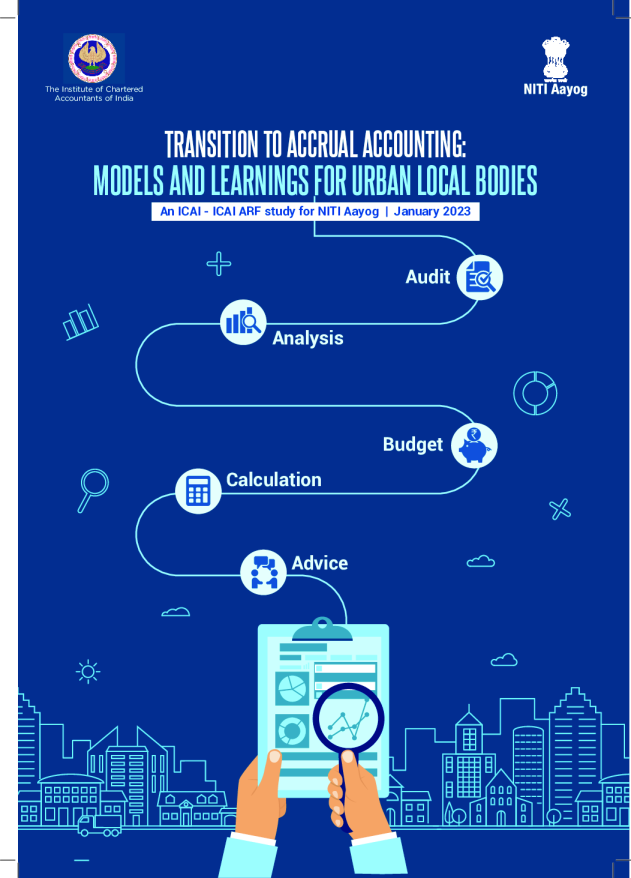
Transition to accrual accounting:Models and learnings for UrbanLocal Bodies An ICAI - ICAI ARF Study for NITI AayogJanuary 2023 ICAI Accounting ResearchFoundationwww.icaiarf.org.in The Institute of CharteredAccountants of Indiawww.icai.org https://www.niti.gov.in/ NITI Aayog is the premier policy think tank of the Government of India, providingdirectional and policy inputs. Apart from designing long-term policies and programmesfor the Government of India, NITI Aayog also provides relevant strategic and technicaladvice to the Centre, States, and Union Territories. NITI Aayog acts as the quintessentialplatform for the Government of India to bring States to act together in national interestand thereby foster cooperative federalism. ICAI ACCOUNTING RESEARCH FOUNDATION https://icaiarf.org.in The Accounting Research Foundation (ICAI ARF) of the Institute of Chartered Accountantsof India (ICAI) is established as a core research body in the areas of accounting, auditing,capital markets, fiscal policies, monetary policies, and related disciplines. Over the years,it has accelerated its work programme as an academy for imparting, spreading andpromoting knowledge, learning, education and understanding in various fields relatedto the profession of accountancy. The ICAI ARF has undertaken and completed manyprojects in the past involving basic and applied research. Authors: CA (Dr) Murali R. S., Practising Chartered AccountantCA Ashok Rao, Practising Chartered AccountantCA Namrata Khandelwal, Deputy Secretary, ICAI, Project Coordinator Project Management Team at Managing Urbanisation Vertical of NITI AayogMs. Anshika Gupta, SpecialistMr. Dhiraj Santdasani, Associate Disclaimer: The opinions/ assertions, expressed in this study are primarily based on the inputs and deliberationsin interviews with serving and retired officials of multiple municipal bodies, State urban developmentdepartments and municipal administration directorates, State audit departments, and other changeagents like accountancy and information technology professionals. The other (non-study) recordsused in the study are based on publicly available information and other sources. Every attempthas been made to ensure the accuracy and completeness of data contained in this Report. Theanalysis and arguments employed herein are attributed to the authors of the study only and notto the organisation they belong to. While due care has been exercised to prepare the report using the data from various sources,NITI Aayog does not confirm the authenticity of data and the accuracy of the methodology toprepare the report. NITI Aayog shall not be held responsible for finding or opinions expressed inthe document. Message,Vice Chairperson,NITI Aayog India is rapidly urbanizing. Over the past few years, urban development in India hasreceived tremendous attention and greater investments than ever before. While citiesare increasingly becoming responsible for instigating economic growth for the nation,they often face severe pressure to provide efficient urban services to the increasingurban population. In such a scenario, strong fiscal management at the local levelbecomes very critical for optimal utilization of financial resources. One of the critical aspects of implementing strong fiscal management is the modeof accounting used for transactions at the municipal level. It is important to realizethat the quality of information with regard to these transactions plays a critical rolein enabling decision-makers to take conversant decisions. A large number of urbanlocal bodies still follow the cash-based accounting system at the local level, whereasworldwide the urban local bodies are shifting to “accrual” based accounting system.Accrual based accounting method by virtue of its comprehensiveness provides abetter understanding of finances for any organization. As cities grow to implementmega infrastructure development projects, the accrual accounting system would bemore reliable to adopt. This report on “Transition to Accrual Accounting: Models and Learnings for UrbanLocal Bodies” is an attempt to create a knowledge product based on the wealthof experience gathered by various states while implementing the reform. 8 Statesincluding Bihar, Chhattisgarh, Delhi, Gujarat, Karnataka, Odisha, Rajasthan, and TamilNadu and Cantonment Boards are covered in the report. Apart from conductingprimary surveys and in-depth analysis of the selected states, the team has alsocompiled learnings from other States through desk-based research. A stakeholderconsultation with all the states concerned was also organized to improve the reportfindings. This report would enable greater capacities amongst the States/ULBs thatare in the process or planning to implement the Accrual-based accounting system. I compliment the efforts of the Institute of Chartered Accountants of India (ICAI) inthe sector and their support in the development of this document. I would also liketo compliment the Managin